Encyclopedia of Life · EOL (see source)
Species
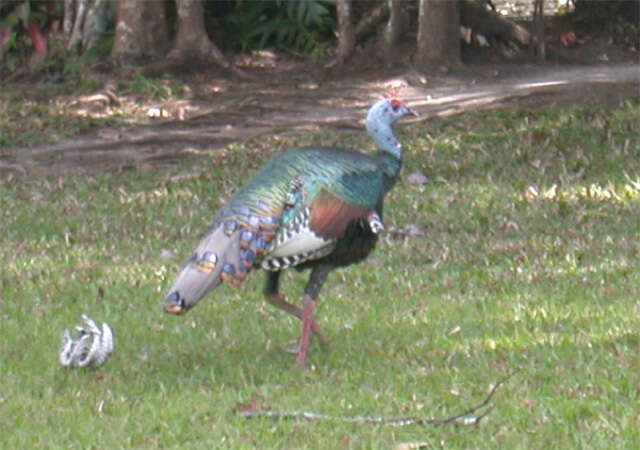
Near Threatened二名法 Meleagris ocellataCuvier,1820 眼斑吐綬雞的分布 眼斑吐綬雞(Meleagris ocellata),又名眼斑火雞,是分佈在尤卡坦半島上等體形的火雞。牠們的近親是野外火雞,故有時會被分類在自己的屬中。牠們與野外火雞的分野要有更多的發現才能處理。雌雞相對較為大隻,長70-120厘米,重3公斤,而雄雞則沒有。 眼斑吐綬雞在墨西哥的分佈地只有約30萬地方,包括金塔納羅奧州、坎佩切州及尤卡坦州。 目录 1 特徵 2 行為 3 參考 4 外部連結 特徵 眼斑吐綬雞的身體呈銅色及綠色。雖然雌雞較深及綠色,胸部羽毛與雄雞相似。雄雞及雌雞都沒有鬍鬚。尾巴羽毛是藍灰色的,在金色的近端位置有一個像眼睛及呈藍銅色的大點。這個大點令一些學者認為牠們與孔雀有關。上身及次級飛羽底呈虹銅色。初級及次級飛羽有像北美洲的火雞的斑紋,但次級飛羽及邊緣的白色較多。 雄雞及雌雞的頭部呈藍色,有橙色或紅色的小節,在雄雞尤為明顯。雄雞的頭上有一個藍色的冠,冠上有像頸上的小節。在繁殖期間,牠們的冠會豎起及變得更鮮色。眼眶沒有羽毛,呈鮮紅色,繁殖期的雄雞特別明顯。腳呈深紅色,比北美洲火雞較短及幼。超過1歲的雄雞腳上有長4厘米的距,比北美洲火雞的長及幼。 眼斑吐綬雞較野外火雞的北美洲亞種細小。雌雞在生蛋時重4公斤,平時重3公斤;繁殖期的雄雞重約5-6公斤。 眼斑吐綬雞的圖畫。 行為 眼斑吐綬雞大部份時間會在地上,面臨威脅時情願逃跑也不會飛走,但牠們並不是不懂飛行,而是可以急速飛行一段短距離。牠們會在高樹上棲息,避免在地上被其他掠食者獵殺。 雌雞每次會在地上生8-15隻蛋。孵化期為28日。小雞很早熟,出生後一晚就可以離開鳥巢。牠們接著會跟隨母雞直至成年。 眼斑吐綬雞的叫聲很獨特,並不像野外火雞的,包含了6-7個小鼓聲,尾聲會加快及加大聲浪,最終的音節很高音及旋律優美。[2]牠們一般會在日出前20-25分鐘開始啼叫。 參考 ^ Meleagris ocellata. IUCN Red List of Threatened Species 2008. International Union for Conservation of Nature. 2008. ^ Branton, S. and R. Berryhill. Pavo! Pavo! The Odyssey of Ocellated Turkey Hunting. ississippi State, Mississippi. 2007. 外部連結 维基共享资源中相关的多媒体资源:眼斑吐綬雞 ARKive Internet Bird Collection 取自“https://zh.wikipedia.org/w/index.php?title=眼斑吐綬雞&oldid=42708155” 分类: IUCN近危物種
via IUCN
Wikidata facts
Show 9 more facts
- taxon rank
- species
- IUCN conservation status
- Near Threatened
- taxon name
- Meleagris ocellata
- Commons category
- Meleagris ocellata
- Commons gallery
- Meleagris ocellata
- litter size
- 12
- egg incubation period
- 28
- taxon common name
- pavji puran
- short name
- M. ocellata
Sources (3)
via Wikidata · CC0
~8 min read
Encyclopedic overview
The ocellated turkey (Meleagris ocellata) is a species of turkey residing primarily in the Yucatán Peninsula, Mexico, as well as in parts of Belize and Guatemala. A relative of the North American wild turkey (Meleagris gallopavo), it was sometimes previously considered in a genus of its own (Agriocharis), but the differences between the two turkeys are currently considered too small to justify generic segregation. It is a relatively large bird, at around 70–122 cm (28–48 in) long and an average weight of 3 kg (6.6 lb) in females and 5 kg (11 lb) in males.
The ocellated turkey lives only in a 130,000 km (50,000 sq mi) range in the Yucatán Peninsula in Mexico—which includes all or part of the states of Quintana Roo, Campeche, Yucatán, Tabasco, and Chiapas—as well as the northern and western parts of Belize and northern Guatemala.
Excerpted from Wikipedia’s “Ocellated Turkey” article, available under the CC BY-SA 4.0 licence.