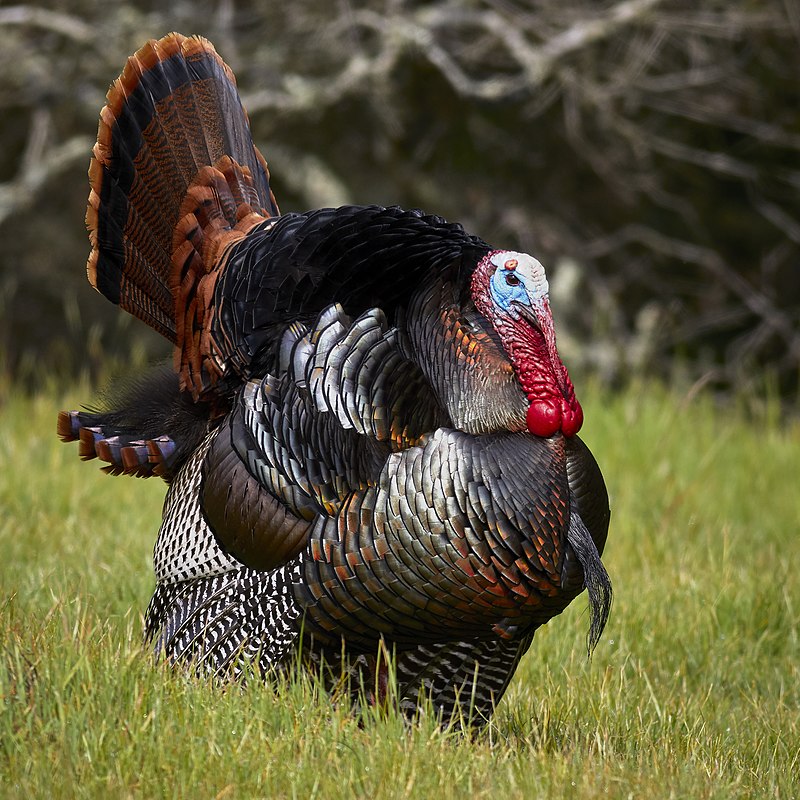
File:Male_wild_turkey_(Meleagris_gallopavo)_strutting.jpg · Wikimedia Commons · See Wikimedia Commons
Meleagris
Sign in to saveAlso known as turkey genus, turkey, turkey bird
North American genus of large birds
OverviewAI-generated
Meleagris is a genus within the family Phasianidae, classified under the kingdom Animalia. The taxon was described in sources including the Brockhaus and Efron Encyclopedic Dictionary, the Encyclopædia Britannica 11th edition, and the New International Encyclopedia. It has at various times been associated with Peru. The group includes the wild turkey, which is an iconic taxon within the class Aves.
Meleagris species are endemic to Mexico and the United States. They have uses as a source of food and feathers, specifically turkey meat. The temporal range of the genus began in the Miocene, approximately 23 million years ago. Records indicate occurrences in the United States, with data held by institutions such as CM, USNM, FHSM, SDNHM, and UCMP. The subject is referenced by 876 other encyclopedia articles.
Synthesized by Vinony from 44 facts across 8 sources: Wikidata, GBIF, iNaturalist, PubMed, Gbif Occ, WoRMS, iDigBio, Vinony graph. Generated from structured data (not the Wikipedia text) and checked against those facts — may still contain errors.
Species
Wild Turkey
Animalia
KINGDOM
- KingdomAnimalia
- PhylumMollusca
- ClassGastropoda
- OrderTrochida
- FamilyTegulidae
シチメンチョウ 生息年代: 中新世前期–現世, 23–0 Ma PreЄ Є O S D C P T J K Pg N シチメンチョウ 分類 界 : 動物界 Animalia 門 : 脊索動物門 Chordata 亜門 : 脊椎動物亜門 Vertebrata 綱 : 鳥綱 Aves 目 : キジ目 Galliformes 科 : キジ科 Phasianidae 属 : シチメンチョウ属 Meleagris 学名 Meleagris Linnaeus, 1758 英名 Turkey 種 シチメンチョウ ヒョウモンシチメンチョウ †Meleagris californica †Meleagris crassipes Meleagris gallopavo ウィキスピーシーズにシチメンチョウ属に関する情報があります。 ウィキメディア・コモンズには、シチメンチョウ属に関連するカテゴリがあります。 シチメンチョウ属(シチメンチョウぞく、学名 Meleagris)は、キジ科の1属である。 現生種・化石種とも、北米大陸でのみ産する。ただしシチメンチョウは世界中で家禽として飼育されている。 分類[編集] かつてはシチメンチョウ科 Meleagrididae またはキジ科シチメンチョウ亜科 Meleagridinae に分類されており、その場合はシチメンチョウ科またはシチメンチョウ亜科の唯一の現生属である(他に化石属がある)。 しかし分子系統からは、シチメンチョウ属はキジ科の系統の内部に位置するため[1]、系統分類ではシチメンチョウ科ないしシチメンチョウ亜科は認められない。 種[編集] 現生種は国際鳥類学会 (IOC) による[2]。 シチメンチョウ Meleagris gallopavo, Wild Turkey ヒョウモンシチメンチョウ Meleagris ocellata, Ocellated Turkey - ユカタン半島に生息。Agriocharis ocellata とする説もある。 †Meleagris californica - 後期更新世に生息。 †Meleagris crassipes - 後期更新世に生息。 他、未記載種2種。 出典[編集] ^ Jan, K.; Andreas, M.; Gennady, C.; Andrej, K.; Gerald, M.; Jürgen, B.; Jürgen, S. (2007). “Waves of genomic hitchhikers shed light on the evolution of gamebirds (Aves: Galliformes)”. BMC Evolutionary Biology 7: 190. doi:10.1186/1471-2148-7-190. http://www.doa
via GBIF
Museum specimens
- Specimen records
- 1,287
- With media
- 1
- Family
- Phasianidae
- Collections
- CM, USNM, FHSM, SDNHM, UCMP
- Recorded in
- United States
Research
1,088 papers- The eggshell: structure, composition and mineralization.ReviewFrontiers in bioscience (Landmark edition) · 2012Hincke MT, Nys Y, Gautron J et al.DOI: 10.2741/3985
- Virus-induced immunosuppression in turkeys (Meleagris gallopavo): A review.ReviewOpen veterinary journal · 2020Kaboudi KDOI: 10.4314/ovj.v9i4.13
- Mortality in Wild Turkeys (Meleagris gallopavo) Associated with Natural Infection with H5N1 Highly Pathogenic Avian Influenza Virus (HPAIV) Subclade 2.3.4.4.Journal of wildlife diseases · 2023Malmberg JL, Miller M, Jennings-Gaines J et al.DOI: 10.7589/JWD-D-22-00161
- Investigating inbreeding in the turkey (Meleagris gallopavo) genome.Poultry science · 2021Adams SM, Derks MFL, Makanjuola BO et al.DOI: 10.1016/j.psj.2021.101366
- Lymphoproliferative Disease Virus and Reticuloendotheliosis Virus Detection and Disease in Wild Turkeys (Meleagris gallopavo).Journal of wildlife diseases · 2024Adcock KG, Berghaus RD, Goodwin CC et al.DOI: 10.7589/JWD-D-23-00012
- Health Assessment of Adult Male Eastern Wild Turkeys (Meleagris gallopavo silvestris) from Western Kentucky, USA.Journal of wildlife diseases · 2024Haynes E, Yabsley MJ, Nemeth NM et al.DOI: 10.7589/JWD-D-23-00162
- Susceptibility of wild turkeys (Meleagris gallopavo) to experimental West Nile virus infection.Avian pathology : journal of the W.V.P.A · 2022Kunkel MR, Casalena MJ, Mead DG et al.DOI: 10.1080/03079457.2022.2123732
- Mortality and Disease in Wild Turkeys ( Meleagris gallopavo silvestris) in Ontario, Canada, from 1992 to 2014: A Retrospective Review.ReviewAvian diseases · 2016MacDonald AM, Jardine CM, Campbell GD et al.DOI: 10.1637/11376-012216-Reg.1
via PubMed
Wikidata facts
Show 11 more facts
- taxon name
- Meleagris
- Commons category
- Meleagris
- taxon rank
- genus
- MCN code
- 0105.12.00
- Unicode character
- 🦃
- topic's main category
- Category:Meleagris
- start time
- 23000000-0
- different from
- Galliformes
- on focus list of Wikimedia project
- Wikipedia:Vital articles/Level/4
- endemic to
- United States
- temporal range start
- Miocene
via Wikidata · CC0
~14 min read
Encyclopedic overview
Turkeys are large, heavyset galliforms in the genus Meleagris, indigenous to the Americas. They are among the largest birds in their native ranges, as well as being one of the heaviest birds in the order Galliformes. There are two extant turkey species: the wild turkey (Meleagris gallopavo) of Southern, Central and Eastern North America, and the ocellated turkey (Meleagris ocellata) of the Yucatán Peninsula in Mexico. Males of both species have a distinctive singular fleshy wattle, called a snood, that hangs from the base of the culmen. Like with other phasianines, the male is bigger and sports fancier plumage than the female.
The earliest turkeys evolved in North America over 20 million years ago. They share a recent common ancestor with grouse, pheasants, and other fowl. The North American wild turkey is the ancestor of the domestic turkey, which was domesticated approximately 2,000 years ago by indigenous peoples. It was this domestic descendant that was later transported by humans to Eurasia, during the Columbian exchange.
Excerpted from Wikipedia’s “Meleagris” article, available under the CC BY-SA 4.0 licence.
Gallery (17)
Available in 124 languages
- Español
- Français
- Deutsch
- 中文
- 日本語
- Русский
- Português
- Italiano
- العربية
- हिन्दी
- Afrikaans
- Albanian
- Armenian
- Asturian
- azb
- Azerbaijani
- Bahasa Indonesia
- Balinese
Show 105 more
- Bangla
- Bashkir
- Basque
- Bikol
- Bosnian
- Breton
- Bulgarian
- Burmese
- Catalan
- Cebuano
- Central Kurdish
- Cherokee
- Cheyenne
- Chuvash
- Croatian
- Czech
- Danish
- Egyptian Arabic
- eml
- Esperanto
- Estonian
- Filipino
- Finnish
- Galician
- Georgian
- Greek
- Gujarati
- Haitian Creole
- Hakka Chinese
- Hausa
- Hebrew
- Hungarian
- hyw
- Icelandic
- Ingush
- Irish
- Javanese
- Kabardian
- Kazakh
- Kurdish
- Ladino
- Latin
- Latvian
- Lithuanian
- lld
- Luxembourgish
- Macedonian
- Malagasy
- Malay
- Malayalam
- Mazanderani
- Minangkabau
- Navajo
- Nederlands
- Nepali
- Northern Frisian
- Norwegian
- Norwegian Nynorsk
- Occitan
- Ossetic
- Pashto
- Pennsylvania German
- Picard
- Polski
- ppl
- Punjabi
- Romanian
- Sardinian
- Scots
- Serbian
- Serbian (Latin)
- Shona
- simple
- Sindhi
- Slovak
- Slovenian
- Southern Sotho
- Sundanese
- Svenska
- Swahili
- szy
- Tajik
- Tamil
- Tatar
- Telugu
- Tiếng Việt
- Türkçe
- Ukrainian
- Urdu
- Walloon
- Waray
- Welsh
- West Flemish
- Western Frisian
- Western Mari
- Wu Chinese
- Yiddish
- Yoruba
- Zaza
- zh_classical
- zh_min_nan
- zh_yue
- فارسی
- ไทย
- 한국어
via Wikidata sitelinks · CC0