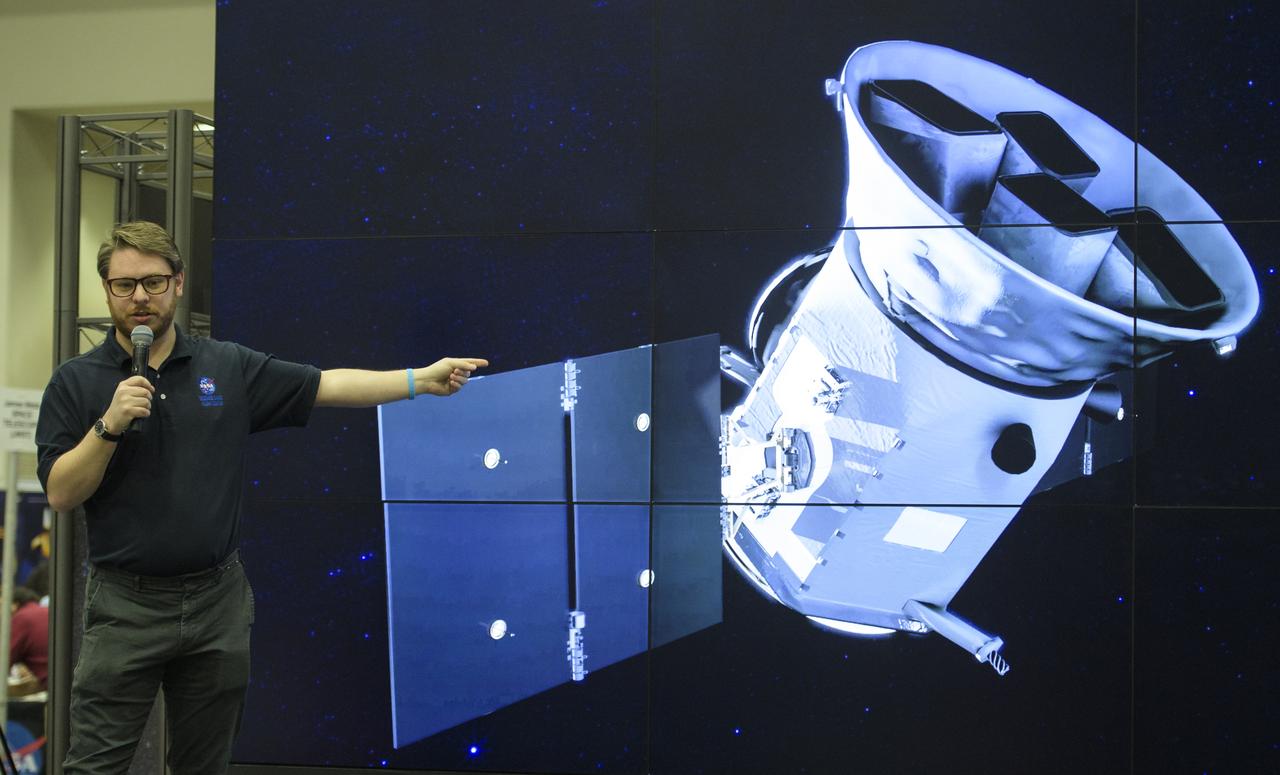
2018 USA Science and Engineering Festival · NASA · NASA — public domain
Kepler-8
Sign in to saveKepler-8 is a star located in the constellation Lyra in the field of view of the Kepler Mission, a NASA-led operation tasked with discovering terrestrial planets. The star, which is slightly hotter, larger, and more massive than the Sun, has one gas giant in its orbit, Kepler-8b. This gas giant is larger than Jupiter, but is less massive, and thus more diffuse. The planet's discovery was announced to the public on January 4, 2010 along with four other planets. As the fifth confirmed planetary system verified by Kepler, it helped demonstrate the capabilities of the Kepler spacecraft.
Astronomical data · SIMBAD
- Object type
- *
- Spectral type
- F6V
- Distance
- 3,314 light-years
- Redshift
- z = -0.0001906137136121755
- Coordinates
- RA 281.2881° · Dec 42.4511°
via SIMBAD · CDS Strasbourg
Wikidata facts
- Instance of
- star
- Constellation
- Lyra
- Child body
- Kepler-8 b
- Distance from Earth
- 1052.9
- Radius
- 1.49
- Mass
- 1.21
- Variable-star type
- rotating variable star
Show 16 more facts
- catalog code
- TIC 123233041
- effective temperature
- 6213
- apparent magnitude
- 13.518508
- parallax
- 0.9842
- radial velocity
- -57.15
- spectral class
- F7
- epoch
- J2000.0
- metallicity
- -0.11
- stellar rotational velocity
- 9.8
- surface gravity
- 13800
- luminosity
- 3.1351128
- right ascension component of proper motion
- 2.176
- declination component of proper motion
- 3.851
- right ascension
- 281.28812082974
- declination
- 42.45108092421
- age estimated by a dating method
- 3.84
Sources (1)
via Wikidata · CC0
~4 min read
Encyclopedic overview
5 sectionsContents
- Nomenclature and history
- Characteristics
- Planetary system
- See also
- References
Kepler-8 is a star located in the constellation Lyra in the field of view of the Kepler Mission, a NASA-led operation tasked with discovering terrestrial planets. The star, which is slightly hotter, larger, and more massive than the Sun, has one gas giant in its orbit, Kepler-8b. This gas giant is larger than Jupiter, but is less massive, and thus more diffuse. The planet's discovery was announced to the public on January 4, 2010 along with four other planets. As the fifth confirmed planetary system verified by Kepler, it helped demonstrate the capabilities of the Kepler spacecraft.
==Nomenclature and history== Kepler-8 was named the way it was because it is home to the eighth planetary system confirmed during the course of the Kepler Mission, a NASA-directed program tasked with searching a region of the sky for terrestrial planets that transit, or cross in front of (and thereby, for a while, make dimmer) the stars that they orbit with respect to Earth. The planet in orbit around Kepler-8, Kepler-8b, was the fifth of the first five planets discovered by the Kepler spacecraft; the first three planets confirmed by Kepler had been previously discovered, and were only used to verify the accuracy of Kepler's measurements. Kepler-8b's discovery was announced to the public on January 4, 2010 at the 215th meeting of the American Astronomical Society in Washington, D.C., alongside planets in orbit around Kepler-4, Kepler-5, Kepler-6, and Kepler-7.
Excerpted from Wikipedia’s “Kepler-8” article, available under the CC BY-SA 4.0 licence.
Gallery (7)
Available in 15 languages
- Español
- Français
- 中文
- 日本語
- Русский
- Português
- Bahasa Indonesia
- Bangla
- Catalan
- Nederlands
- Svenska
- Tiếng Việt
- فارسی
- 한국어
via Wikidata sitelinks · CC0