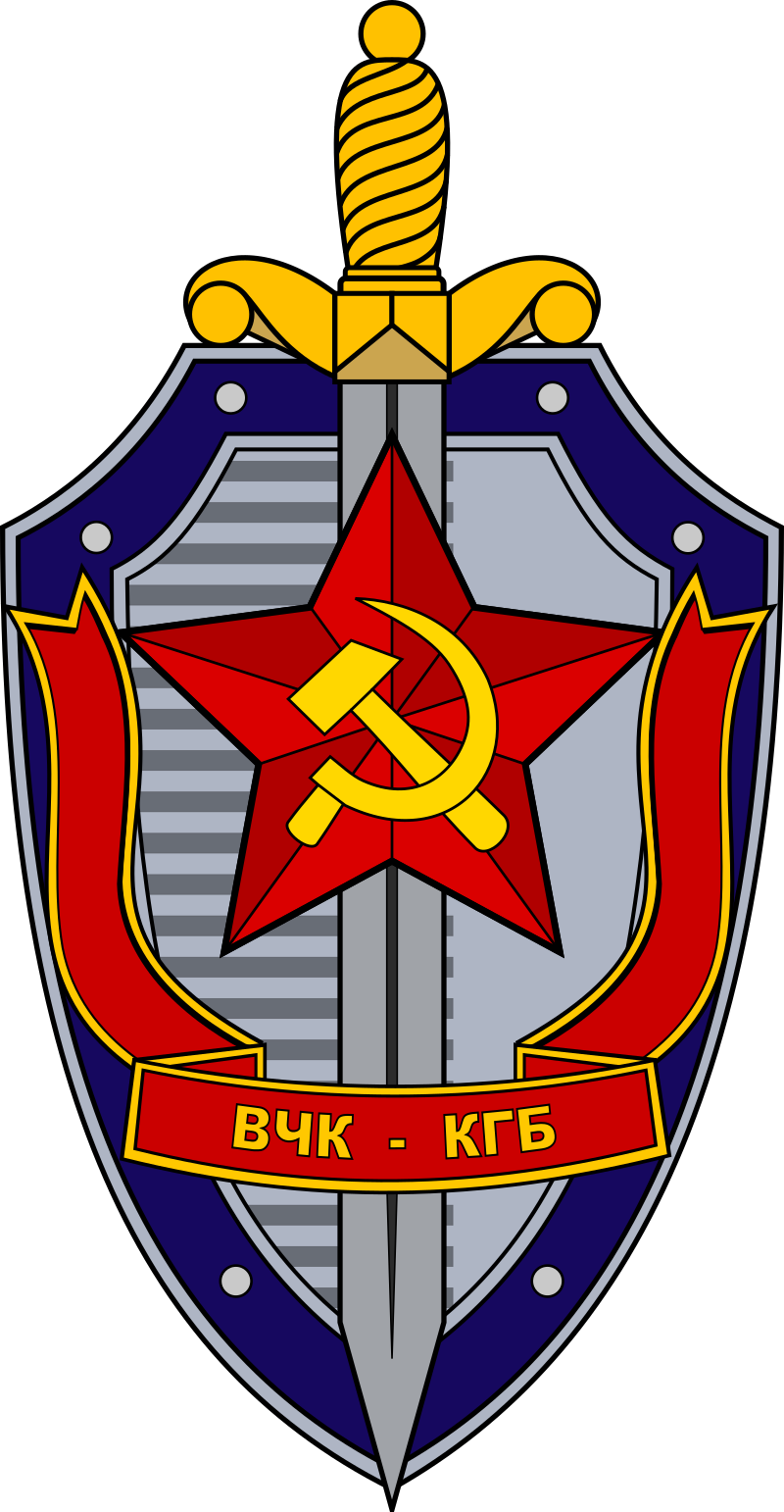
File:Emblema_KGB.svg · Wikimedia Commons · See Wikimedia Commons
Also known as Committee for State Security, Committee for State Security of the USSR, Committee for State Security of the Soviet Union, CSS of the USSR, State Security Committee of the USSR, State Security Committee of the Soviet Union, SSC of the USSR
The Committee for State Security (, ), abbreviated as KGB (, ; ) was the main security agency of the Soviet Union from 1954 to 1991. It was the direct successor of preceding Soviet secret police agencies including the Cheka, OGPU, and NKVD. Attached to the Council of Ministers, it was the chief government agency of "union-republican jurisdiction", carrying out internal security, foreign intelligence, counter-intelligence and secret police functions. Similar agencies operated in each of the republics of the Soviet Union aside from the Russian SFSR, where the KGB was headquartered, with many ass
The KGB was the Soviet Union's main security and intelligence agency from 1954 to 1991, responsible for internal security, foreign intelligence, and secret police operations. It matters historically because it was a central instrument of Soviet state control and successor to earlier Soviet secret police forces, wielding significant power over the country's population and activities abroad.
AI-generated from the Wikipedia summary — may contain errors.
Key facts
- Government agency.agency_name
- KGB
- Government agency.seal
- Emblema KGB.svg
- Government agency.seal_width
- 150
- Government agency.preceding1
- Cheka (1917–1922)
- Government agency.preceding2
- GPU (1922–1923)
- Government agency.preceding3
- OGPU (1923–1934)
- Government agency.preceding5
- NKGB (February–July 1941/1943–1946)
- Government agency.superseding1
- MSB (1991)
- Government agency.superseding2
- TsSR (1991)
- Government agency.superseding3
- AFB (1991)
- Government agency.superseding4
- KOGG (1991)
- Government agency.headquarters
- Lubyanka Building, 2 Bolshaya Lubyanka Street, Moscow, Soviet Union
- Government agency.chief1_name
- Chairman
- Government agency.agency_type
- State committee of union-republican jurisdiction
- Government agency.child1_agency
- Foreign intelligence: First Chief Directorate
- Government agency.child2_agency
- Counter-Intelligence: Second Chief Directorate
- Government agency.child3_agency
- Political police: Fifth Chief Directorate
- Government agency.child4_agency
- Cryptography: Eighth Chief Directorate
via Wikipedia infobox
Wikidata facts
- Field of work
- counterintelligence
- Country
- Soviet Union
- Headquarters
- Moscow
- Parent organization
- Council of Ministers of the USSR
- Chairperson
- Vadim Bakatin
- Employees
- 480000
- Follows
- Ministry for State Security
- Image
- RIAN archive 142949 Lubyanka Square in Moscow.jpg
Show 12 more facts
- Commons category
- KGB
- topic's main category
- Category:KGB
- inception
- 1954-03-13
- dissolved, abolished or demolished date
- 1991-12-03
- applies to jurisdiction
- Soviet Union
- short name
- КГБ
- native label
- Комитет государственной безопасности СССР
- replaces
- NKVD
- different from
- Ministry of State Security
- on focus list of Wikimedia project
- Wikipedia:Vital articles/Level/4
- authority
- Council of Ministers of the USSR
- category for employees of the organization
- Category:KGB officers
Sources (13)
via Wikidata · CC0
~34 min read
Encyclopedic overview
22 sectionsContents
- History
- In the US
- Between the World Wars
- During the Cold War
- In the Soviet Bloc
- Notable operations
- Bangladesh
- Afghanistan
- August 1991 and dissolution
- Organisation
- Republican affiliations
- Leadership
- Directorates
- Other units
- Mode of operation
- List of chairmen
- Commemorative and award badges
- See also
- References
- Sources
- Further reading
- External links
The Committee for State Security (, ), abbreviated as KGB (, ; ) was the main security agency of the Soviet Union from 1954 to 1991. It was the direct successor of preceding Soviet secret police agencies including the Cheka, OGPU, and NKVD. Attached to the Council of Ministers, it was the chief government agency of "union-republican jurisdiction", carrying out internal security, foreign intelligence, counter-intelligence and secret police functions. Similar agencies operated in each of the republics of the Soviet Union aside from the Russian SFSR, where the KGB was headquartered, with many associated ministries, state committees and state commissions.
The agency was a military service governed by army laws and regulations, in the same fashion as the Soviet Army or the MVD Internal Troops. While most of the KGB archives remain classified, two online documentary sources are available. Its main functions were foreign intelligence, counter-intelligence, operative-investigative activities, guarding the state border of the USSR, guarding the Soviet leadership, preserving the security of government communications as well as combating dissent and separatism within Soviet society.
Excerpted from Wikipedia’s “KGB” article, available under the CC BY-SA 4.0 licence.
Gallery (19)
Available in 88 languages
- Español
- Français
- Deutsch
- 中文
- 日本語
- Русский
- Português
- Italiano
- العربية
- हिन्दी
- Afrikaans
- Albanian
- Armenian
- Asturian
- Azerbaijani
- Bahasa Indonesia
- Bangla
- Bashkir
Show 69 more
- Basque
- be_x_old
- Belarusian
- Bosnian
- Breton
- Bulgarian
- Catalan
- Cebuano
- Croatian
- Czech
- Danish
- Egyptian Arabic
- Esperanto
- Estonian
- Finnish
- Galician
- Georgian
- Greek
- Hebrew
- Hungarian
- Icelandic
- Ido
- Irish
- Kazakh
- Kurdish
- Lao
- Latin
- Latvian
- Lithuanian
- Macedonian
- Malay
- Malayalam
- Marathi
- Mongolian
- Nederlands
- Norwegian
- Norwegian Nynorsk
- Occitan
- Pashto
- Polski
- Punjabi
- Romanian
- Rusyn
- Sardinian
- Serbian
- Serbian (Latin)
- Sicilian
- simple
- Slovak
- Slovenian
- Svenska
- syl
- Tamil
- Tatar
- Telugu
- Tiếng Việt
- Türkçe
- Ukrainian
- Urdu
- Uzbek
- Western Frisian
- Western Panjabi
- Wu Chinese
- Yakut
- Yiddish
- zh_yue
- فارسی
- ไทย
- 한국어
via Wikidata sitelinks · CC0