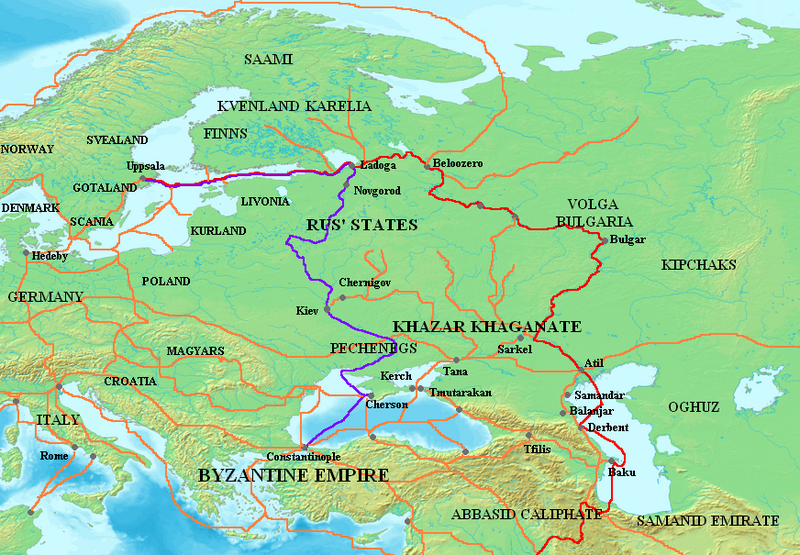
File:Varangian_routes.png · Wikimedia Commons · See Wikimedia Commons
Khazars
Sign in to saveAlso known as Khazaria
The Khazars () were a semi-nomadic Turkic people who established a major commercial empire in the late 6th century CE spanning the south of modern European Russia, southern Ukraine, and western Kazakhstan. It was the most powerful polity to emerge from the break-up of the Western Turkic Khaganate. Astride a major artery of commerce between Eastern Europe and Southwestern Asia, Khazaria became one of the foremost trading empires of the early medieval world, commanding the western marches of the Silk Road and playing a key commercial role as a crossroad between China, the Middle East, and Kievan
The Khazars were a Turkic people who built a powerful trading empire from the late 6th century onward across what is now southern Russia, Ukraine, and Kazakhstan. They became one of the medieval world's most important commercial powers by controlling key trade routes between China, the Middle East, and Eastern Europe along the Silk Road.
AI-generated from the Wikipedia summary — may contain errors.
Key facts
- Country.conventional_long_name
- Khazar Khaganate
- Country.common_name
- Khazaria
- Country.era
- Middle Ages
- Country.status
- Khaganate
- Country.year_start
- 650
- Country.year_end
- 969
- Country.p1
- Western Turkic Khaganate
- Country.p2
- Old Great Bulgaria
- Country.s1
- Cumania
- Country.s2
- Pechenegs
- Country.s3
- Kievan Rus'
- Country.s4
- Durdzuks
- Country.s5
- Volga Bulgaria
- Country.s6
- Alania
- Country.event_end
- Sviatoslav's sacking and razing of Atil
- Country.image_map
- Chasaren.jpg
- Country.image_map_caption
- Khazar Khaganate, 650–850
- Country.currency
- Yarmaq
via Wikipedia infobox
Wikidata facts
- Part of
- Turkic peoples
- Native language
- Khazar language
- Religion
- Tengrism
- Country
- Khazar Khaganate
- Capital
- Balanjar
- Currency
- yarmaq
Show 8 more facts
- described by source
- Brockhaus and Efron Encyclopedic Dictionary
- Commons category
- Khazars
- topic's main category
- Category:Khazars
- inception
- 0618-00-00
- dissolved, abolished or demolished date
- 1048-01-01
- Commons gallery
- Khazars
- different from
- Hazaras
- on focus list of Wikimedia project
- Wikipedia:Vital articles/Level/4
via Wikidata · CC0
~73 min read
Encyclopedic overview
37 sectionsContents
- Effects
- Etymology
- Linguistics
- History
- Tribal origins and early history
- Rise of the Khazar state
- Khazar state: culture and institutions
- Royal Diarchy with sacral Qağanate
- Ruling elite
- Demographics
- Economy
- Khazars and Byzantium
- {{anchor|Second Khazar-Arab war}}Arab–Khazar wars
- Khazars and Hungarians
- Rise of the Rus' and the collapse of the Khazarian state
- Aftermath: impact, decline and dispersion
- Religion
- Tengrism
- Christianity
- Judaism
- History of discussions about Khazar Jewishness
- Islam
- Genetics
- Claims of Khazar ancestry
- Crimean Karaites and Krymchaks
- Ashkenazi-Khazar theories
- Use in antisemitic polemic
- Genetic studies
- In literature
- Cities associated with the Khazars
- See also
- Notes
- Footnotes
- Resource notes
- Citations
- Bibliography
- External links
The Khazars () were a semi-nomadic Turkic people who established a major commercial empire in the late 6th century CE spanning the south of modern European Russia, southern Ukraine, and western Kazakhstan. It was the most powerful polity to emerge from the break-up of the Western Turkic Khaganate. Astride a major artery of commerce between Eastern Europe and Southwestern Asia, Khazaria became one of the foremost trading empires of the early medieval world, commanding the western marches of the Silk Road and playing a key commercial role as a crossroad between China, the Middle East, and Kievan Rus'. For some three centuries (–965), the Khazars dominated the vast area extending from the Volga-Don steppes to the eastern Crimea and the northern Caucasus.
Although they were a confederation of different Turkic-speaking peoples, the precise origins and nature of the Khazars are uncertain, since there is no surviving record in the Khazar language and the state was multilingual and polyethnic. Their native religion is thought to have been Tengrism, like that of the North Caucasian Huns and other Turkic peoples, although their multiethnic population seems to have included pagans, Jews, Christians, and Muslims. Although there is evidence that the ruling elite of the Khazars had converted to Rabbinic Judaism in the 8th century, the scope of the conversion to Judaism within the khanate remains uncertain.
Excerpted from Wikipedia’s “Khazars” article, available under the CC BY-SA 4.0 licence.
Gallery (29)
Available in 88 languages
- Español
- Français
- Deutsch
- 中文
- 日本語
- Русский
- Português
- Italiano
- العربية
- हिन्दी
- Afrikaans
- Albanian
- Amharic
- Aragonese
- Armenian
- Asturian
- Avaric
- azb
Show 69 more
- Azerbaijani
- Bahasa Indonesia
- Bashkir
- Basque
- be_x_old
- Belarusian
- Bulgarian
- Catalan
- Central Kurdish
- Chechen
- Chuvash
- Croatian
- Danish
- Egyptian Arabic
- Esperanto
- Estonian
- Finnish
- Galician
- Georgian
- Greek
- Hebrew
- Hungarian
- Icelandic
- Ido
- Kannada
- Kazakh
- Kurdish
- Kyrgyz
- Latin
- Latvian
- lbe
- Lezghian
- Lingua Franca Nova
- Lithuanian
- Macedonian
- Malagasy
- Malay
- Mazanderani
- Minangkabau
- Mingrelian
- Nederlands
- Norwegian
- Norwegian Nynorsk
- Occitan
- Polski
- Punjabi
- Romanian
- Serbian
- Serbian (Latin)
- simple
- Slovak
- Slovenian
- Svenska
- Swahili
- Tatar
- Telugu
- Tiếng Việt
- Türkçe
- Ukrainian
- Urdu
- Uzbek
- Welsh
- Western Panjabi
- Wu Chinese
- Yakut
- Yiddish
- zh_yue
- فارسی
- 한국어
via Wikidata sitelinks · CC0