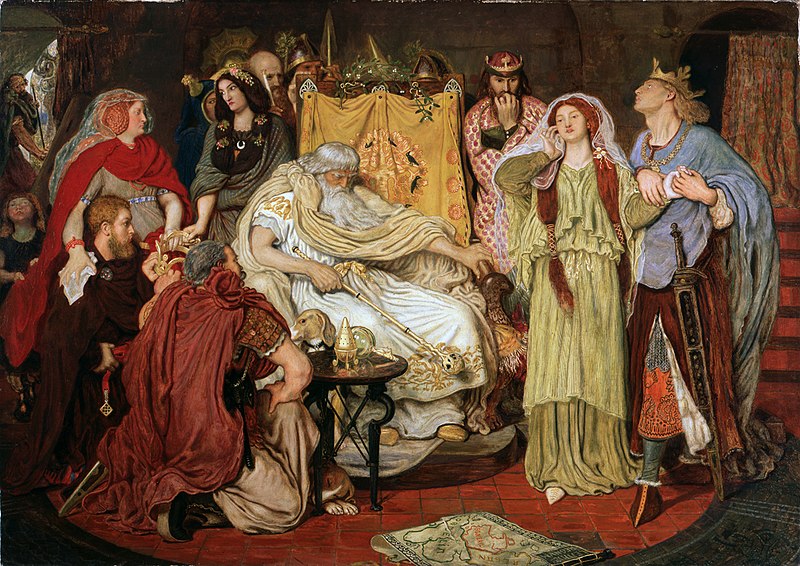
File:Cordelia's_Portion.jpg · Wikimedia Commons · See Wikimedia Commons
King Lear
Sign in to saveAlso known as The Tragedie of King Lear, The Tragedy of King Lear, Tragedy of King Lear, The Life and Death of King Lear, Life and death of king lear
tragedy by William Shakespeare
"King Lear" is a tragedy by William Shakespeare about an aging king who divides his kingdom among his daughters based on their flattery, leading to betrayal, madness, and destruction. The play explores themes of power, family loyalty, and human suffering, and is considered one of Shakespeare's greatest works.
AI-generated from the Wikipedia summary — may contain errors.
Wikidata facts
- Author
- William Shakespeare
- Genre
- tragedy
- Image
- King Lear.jpg
Show 14 more facts
- Commons category
- King Lear
- topic's main category
- Category:King Lear
- Commons gallery
- King Lear
- inception
- 1606-00-00
- language of work or name
- English language
- title
- The Tragedy of King Lear
- location of first performance
- Palace of Whitehall
- date of first performance
- 1606-00-00
- copyright status
- public domain
- number of parts of this work
- 5
- form of creative work
- play
- publication date
- 1608-00-00
- on focus list of Wikimedia project
- Wikipedia:Vital articles/Level/4
- time period
- Renaissance
Sources (11)
via Wikidata · CC0
~40 min read
Encyclopedic overview
The Tragedy of King Lear, often shortened to King Lear, is a tragedy written by William Shakespeare in late 1605 or early 1606. Set in pre-Roman Britain, the play depicts the consequences of King Lear's love-test, in which he divides his power and land according to the praise of his daughters. The play is known for its dark tone, complex poetry, and prominent motifs concerning blindness, madness and human nature.
The earliest known performance was on Saint Stephen's Day in 1606. Modern editors derive their texts from three extant publications: the 1608 quarto (Q1), the 1619 quarto (Q2, unofficial and based on Q1), and the 1623 First Folio. The quarto versions differ significantly from the folio version.
Excerpted from Wikipedia’s “King Lear” article, available under the CC BY-SA 4.0 licence.
Gallery (12)
Available in 72 languages
- Español
- Français
- Deutsch
- 中文
- 日本語
- Русский
- Português
- Italiano
- العربية
- हिन्दी
- Afrikaans
- Albanian
- Armenian
- Asturian
- Bahasa Indonesia
- Bangla
- Basque
- Belarusian
Show 53 more
- Bosnian
- Bulgarian
- Catalan
- Croatian
- Czech
- Danish
- Egyptian Arabic
- Esperanto
- Estonian
- Finnish
- Galician
- Georgian
- Greek
- Hebrew
- Hungarian
- Irish
- Kurdish
- Latin
- Latvian
- Lingua Franca Nova
- Lithuanian
- Macedonian
- Malay
- Malayalam
- Marathi
- Nederlands
- Nepali
- Norwegian
- Occitan
- Polski
- Punjabi
- Romanian
- Scots
- Serbian
- Serbian (Latin)
- simple
- Sindhi
- Slovak
- Svenska
- szy
- Tibetan
- Tiếng Việt
- Türkçe
- Ukrainian
- Urdu
- Waray
- Welsh
- Western Frisian
- Wu Chinese
- zh_classical
- zh_yue
- فارسی
- 한국어
via Wikidata sitelinks · CC0