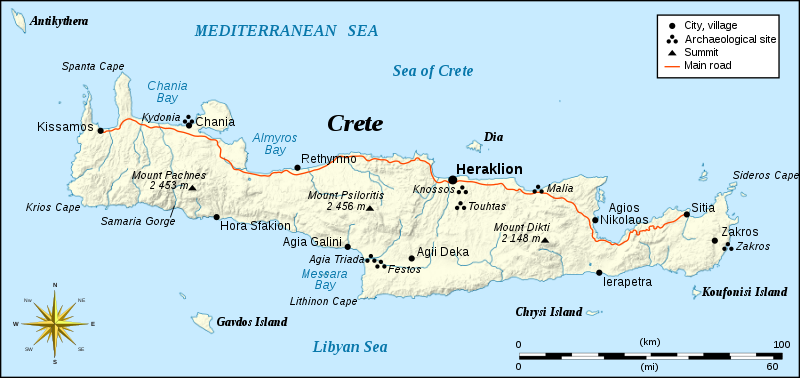
File:Crete_integrated_map-en.svg · Wikimedia Commons · See Wikimedia Commons
Knossos
Sign in to saveAlso known as Cnossus
Knossos (; , ; Linear B: Ko-no-so) is an archaeological site in Crete that was occupied from the Neolithic through the ninth century AD. The site was a major centre of the Minoan civilization and is known for its association with the Greek myth of Theseus and the minotaur. During the early Iron Age it was one of the most prosperous Aegean civilizations, and it eventually became a Roman colony during the Classical period. It is located on the outskirts of Heraklion, and remains a popular tourist destination. Knossos is considered by many to be the oldest city in Europe and one of the earliest N
Knossos is an ancient archaeological site in Crete that was a major center of the Minoan civilization and remained occupied for thousands of years, from the Neolithic period through the ninth century AD. It is historically significant as one of Europe's oldest cities and is famous both for its role in early European civilization and its connection to the Greek myth of Theseus and the minotaur.
AI-generated from the Wikipedia summary — may contain errors.
Key facts
- Ancient site.name
- Knossos
- Ancient site.native_name
- Κνωσσός
- Ancient site.caption
- Reconstructed North Entrance
- Ancient site.map
- 285px
- Ancient site.map_caption
- Map of Crete
- Ancient site.location
- Heraklion, Crete, Greece
- Ancient site.region
- North central coast, southeast of Heraklion
- Ancient site.type
- Minoan palace
- Ancient site.area
- Total inhabited area: . Palace:
- Ancient site.built
- Settlement around 7000 BC; first palace around 1900 BC
- Ancient site.abandoned
- Palace abandoned Late Minoan IIIC, 1380–1100 BC
- Ancient site.epochs
- Neolithic to Late Bronze Age
- Ancient site.cultures
- Minoan, Mycenaean
- Ancient site.excavations
- 1900–present
- Ancient site.archaeologists
- Minos Kalokairinos, Sir Arthur Evans, David George Hogarth, Duncan Mackenzie, Theodore Fyfe, Christian Doll, Piet de Jong, John Davies Evans
- Ancient site.condition
- Restored and maintained for visitation.
- Ancient site.management
- 23rd Ephorate of Prehistoric and Classical Antiquities
- Ancient site.public_access
- Yes
via Wikipedia infobox
Wikidata facts
- Instance of
- polis
- Has part
- Palace of Knossos
- Country
- Greece
- Located in
- Heraklion Municipality
- Time zone
- UTC+03:00
- Image
- Knossos - North Portico 02.jpg
Show 12 more facts
- described at URL
- odysseus.culture.gr/h/2/gh251.jsp?obj_id=716
- Commons category
- Knossos
- inception
- 7000-01-01
- topic's main category
- Category:Knossos
- located in/on physical feature
- Crete
- director of archaeological fieldwork
- Arthur Evans
- culture
- Minoan civilization
- time period
- Minoan civilization
- visitors per year
- 855663
- native label
- 𐀒𐀜𐀰
- on focus list of Wikimedia project
- Wikipedia:Vital articles/Level/4
- P8168
- Rudice
Sources (2)
via Wikidata · CC0
~36 min read
Encyclopedic overview
24 sectionsContents
- History
- Neolithic period
- Bronze Age
- Early Iron Age
- Cemeteries
- Classical and Roman period
- Post-Roman history
- Legends
- Excavation history
- Palace complex
- Layout
- Location
- Storage
- Water management
- Ventilation
- Minoan columns
- Frescoes
- Throne Room
- Notable residents
- See also
- Citations
- Sources
- Further reading
- External links
Knossos (; , ; Linear B: Ko-no-so) is an archaeological site in Crete that was occupied from the Neolithic through the ninth century AD. The site was a major centre of the Minoan civilization and is known for its association with the Greek myth of Theseus and the minotaur. During the early Iron Age it was one of the most prosperous Aegean civilizations, and it eventually became a Roman colony during the Classical period. It is located on the outskirts of Heraklion, and remains a popular tourist destination. Knossos is considered by many to be the oldest city in Europe and one of the earliest Neolithic settlements in Crete.
Knossos is dominated by the monumental Palace of Minos. Like other Minoan palaces, this complex of buildings served as a combination religious and administrative centre rather than a royal residence. The earliest parts of the palace were built around 1900 BC in an area that had been used for ritual feasting since the Neolithic. The palace was continually renovated and expanded over the next five centuries until its final destruction around 1350 BC.
Excerpted from Wikipedia’s “Knossos” article, available under the CC BY-SA 4.0 licence.
Gallery (38)
On the map
3 mapped locations
Available in 70 languages
- Español
- Français
- Deutsch
- 中文
- 日本語
- Русский
- Português
- Italiano
- العربية
- हिन्दी
- Afrikaans
- Amharic
- Armenian
- Asturian
- Azerbaijani
- Bahasa Indonesia
- Basque
- be_x_old
Show 51 more
- Belarusian
- Bulgarian
- Catalan
- Cebuano
- Croatian
- Czech
- Danish
- Egyptian Arabic
- Esperanto
- Estonian
- Filipino
- Finnish
- Galician
- Georgian
- Greek
- Hebrew
- Hungarian
- hyw
- Icelandic
- Kazakh
- Latin
- Latvian
- Limburgish
- Lithuanian
- Macedonian
- Malay
- nds_nl
- Nederlands
- Norwegian
- Norwegian Nynorsk
- Polski
- Romanian
- Serbian
- Serbian (Latin)
- simple
- Slovak
- Slovenian
- Svenska
- Tiếng Việt
- Türkçe
- Ukrainian
- Urdu
- Uzbek
- Waray
- Welsh
- Western Frisian
- Wu Chinese
- zh_yue
- فارسی
- ไทย
- 한국어
via Wikidata sitelinks · CC0