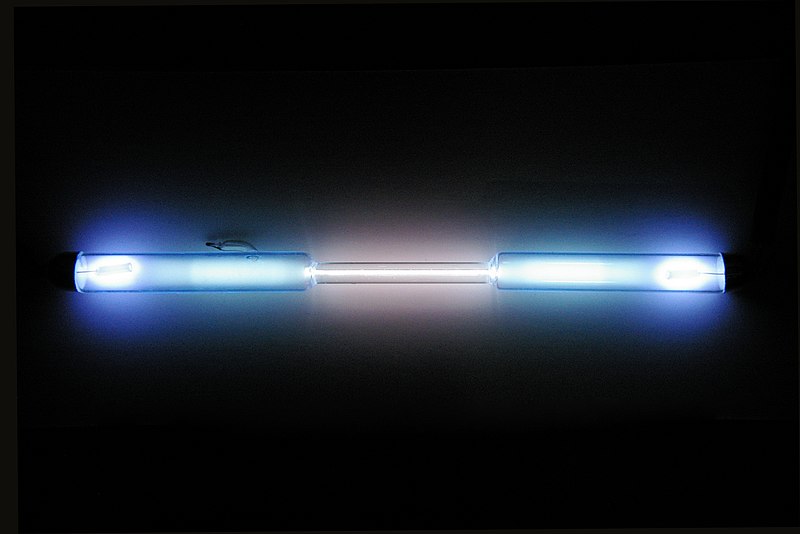
File:Krypton_discharge_tube.jpg · Wikimedia Commons · See Wikimedia Commons
krypton
Sign in to saveAlso known as Kr, element 36, 36Kr
Krypton (from ) is a chemical element; it has symbol Kr and atomic number 36. It is a colorless, odorless noble gas that occurs in trace amounts in the atmosphere and is often used with other rare gases in fluorescent lamps. Krypton is chemically inert.
OverviewAI-generated
Krypton is a chemical element with the symbol Kr and atomic number 36. It has a standard atomic weight of 83.798, while PubChem lists its weight as 83.80. The element was discovered in 1898. Its electron configuration is described as 1s² 2s² 2p⁶ 3s² 3p⁶ 4s² 3d¹⁰ 4p⁶ or [Ar] 3d¹⁰ 4s² 4p⁶. The canonical SMILES representation is [Kr].
Physicochemical properties include an electronegativity of 3 and a standard molar entropy of 164. The molecule has a topological polar surface area of 0, with zero hydrogen bond donors and acceptors, and a charge of 0. The Unicode character for krypton is 氪. In academic literature, a PubMed query for krypton yields 3040 results. Additionally, the subject is referenced by 631 other encyclopedia articles.
Synthesized by Vinony from 24 facts across 4 sources: Wikidata, PubChem, PubMed, Vinony graph. Generated from structured data (not the Wikipedia text) and checked against those facts — may still contain errors.
Chemical data
- Formula
- Kr
- Molecular weight
- 83.8 g/mol
- IUPAC name
- krypton
- SMILES
- [Kr]
- InChIKey
- DNNSSWSSYDEUBZ-UHFFFAOYSA-N
- Polar surface area
- 0 Ų
- H-bond donors
- 0
- H-bond acceptors
- 0
- Formal charge
- 0
via PubChem
Drug data · ChEMBL
- Max clinical phase
- Approved
- Molecule type
- Small molecule
- First approval
- 1982
- Admin. routes
- topical
via ChEMBL · EBI
Research
3,040 papers- Krypton-81m.Progress in nuclear medicine · 1978Goris M, Daspit S
- Krypton-derivatization highlights O(2)-channeling in a four-electron reducing oxidase.Chemical communications (Cambridge, England) · 2020Engilberge S, Wagner T, Carpentier P et al.DOI: 10.1039/d0cc04557h
- HEART.ReviewAnnual review of physiology · 1964BERNE RM, LEVY MNDOI: 10.1146/annurev.ph.26.030164.001101
- A krypton-83m generator.The International journal of applied radiation and isotopes · 1971Moghissi AA, Hupf HBDOI: 10.1016/0020-708x(71)90130-x
- Validation of krypton as a new tracer gas for the standardization tests of collective and individual protection systems.Annals of work exposures and health · 2024Cabaset E, Marchal M, Santandrea A et al.DOI: 10.1093/annweh/wxad071
- Deep-mantle krypton reveals Earth's early accretion of carbonaceous matter.Nature · 2021Péron S, Mukhopadhyay S, Kurz MD et al.DOI: 10.1038/s41586-021-04092-z
- [The pharmacology of the rare gases (helium, neon, argon, krypton, xenon)].ReviewActualites pharmacologiques · 1974Featherstone RM, Settle W
- The krypton thunderbolt.Hospital practice · 1976Commoner BDOI: 10.1080/21548331.1976.11707001
via PubMed
Wikidata facts
- Instance of
- atmophile element
- Part of
- noble gases
- Named after
- hiding
- Mass
- 83.798
- Image
- KrTube.jpg
Show 16 more facts
- electronegativity
- 3
- element symbol
- Kr
- Commons category
- Krypton
- topic's main category
- Category:Krypton
- atomic number
- 36
- Commons gallery
- Krypton
- chemical formula
- Kr
- canonical SMILES
- [Kr]
- time of discovery or invention
- 1898-00-00
- discoverer or inventor
- Morris Travers
- location of discovery
- United Kingdom
- standard molar entropy
- 164
- Unicode character
- 氪
- electron configuration
- [Ar] 3d¹⁰ 4s² 4p⁶
- on focus list of Wikimedia project
- Wikipedia:Vital articles/Level/4
- different from
- kryptonite
Sources (7)
via Wikidata · CC0
~11 min read
Encyclopedic overview
11 sectionsContents
- History
- Characteristics
- Isotopes
- Chemistry
- Natural occurrence
- Applications
- Precautions
- See also
- References
- Further reading
- External links
Krypton (from ) is a chemical element; it has symbol Kr and atomic number 36. It is a colorless, odorless noble gas that occurs in trace amounts in the atmosphere and is often used with other rare gases in fluorescent lamps. Krypton is chemically inert.
Krypton, like the other noble gases, is used in lighting and photography. Krypton light has many spectral lines, and krypton plasma is useful in bright, high-powered gas lasers (krypton ion and excimer lasers), each of which resonates and amplifies a single spectral line. Krypton fluoride also makes a useful laser medium. From 1960 to 1983, the official definition of the metre was based on the wavelength of one spectral line of krypton-86, because of the high power and relative ease of operation of krypton discharge tubes.
Excerpted from Wikipedia’s “krypton” article, available under the CC BY-SA 4.0 licence.
Gallery (13)
Available in 155 languages
- Español
- Français
- Deutsch
- 中文
- 日本語
- Русский
- Português
- Italiano
- العربية
- हिन्दी
- abstract
- Afrikaans
- Albanian
- Amharic
- Angika
- Aragonese
- Armenian
- Asturian
Show 136 more
- azb
- Azerbaijani
- Bahasa Indonesia
- Balinese
- Bangla
- Bashkir
- Basque
- be_x_old
- Belarusian
- Bhojpuri
- Bikol
- Bosnian
- Breton
- Bulgarian
- Burmese
- Catalan
- cdo
- Cebuano
- Central Kurdish
- Church Slavic
- Chuvash
- Cornish
- Corsican
- Croatian
- Czech
- Danish
- Egyptian Arabic
- Erzya
- Esperanto
- Estonian
- Faroese
- Fiji Hindi
- Filipino
- Finnish
- Friulian
- Galician
- Gan Chinese
- Ganda
- Georgian
- Greek
- Gujarati
- Haitian Creole
- Hakka Chinese
- Hebrew
- Hungarian
- Icelandic
- Ido
- Interlingua
- Irish
- Javanese
- Kalmyk
- Kannada
- Kazakh
- kbp
- Komi
- Kyrgyz
- Latin
- Latvian
- Ligurian
- Limburgish
- Lithuanian
- Lojban
- Lombard
- Low German
- Luxembourgish
- Macedonian
- Malay
- Malayalam
- Manx
- Marathi
- Mongolian
- Moroccan Arabic
- Nederlands
- Nepali
- Newari
- Northern Frisian
- Norwegian
- Norwegian Nynorsk
- Novial
- Occitan
- Odia
- olo
- Ossetic
- Pashto
- Piedmontese
- Polski
- Punjabi
- Quechua
- roa_rup
- Romanian
- Sanskrit
- Sardinian
- Saterland Frisian
- Scottish Gaelic
- Serbian
- Serbian (Latin)
- Sicilian
- simple
- Sindhi
- Sinhala
- Slovak
- Slovenian
- Somali
- Standard Moroccan Tamazight
- Sundanese
- Svenska
- Swahili
- Tajik
- Tamil
- Tatar
- Telugu
- Tibetan
- Tiếng Việt
- Toki Pona
- Türkçe
- Ukrainian
- Urdu
- Uyghur
- Uzbek
- Veps
- Waray
- Welsh
- Western Frisian
- Western Mari
- Western Panjabi
- Wu Chinese
- Yakut
- Yiddish
- Yoruba
- zh_classical
- zh_min_nan
- zh_yue
- Zulu
- فارسی
- ไทย
- 한국어
via Wikidata sitelinks · CC0