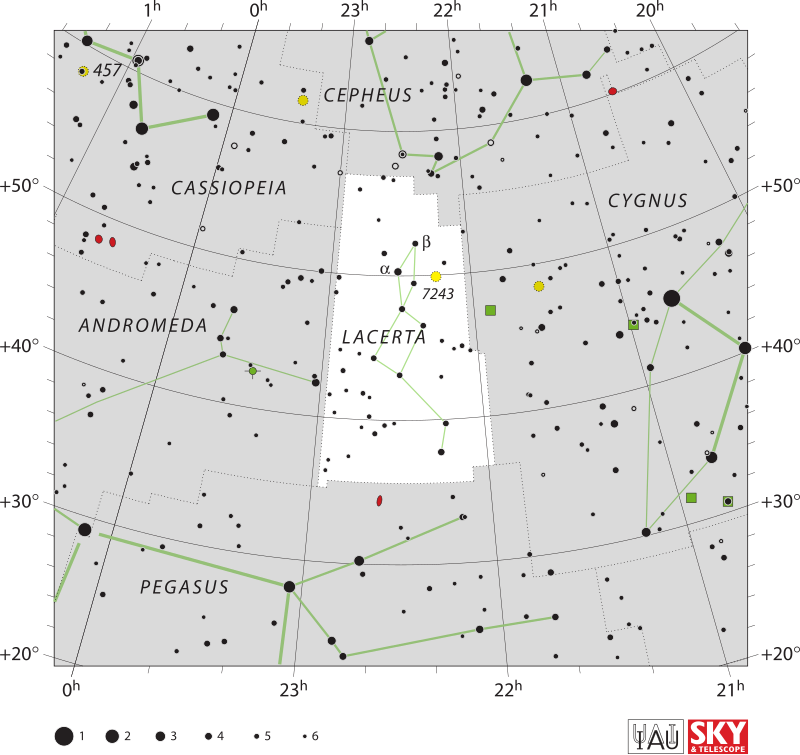
File:Lacerta_IAU.svg · Wikimedia Commons · See Wikimedia Commons
Lacerta
Sign in to saveAlso known as Lac, Lacertae, Little Cassiopeia
Lacerta is one of the 88 modern constellations defined by the International Astronomical Union. Its name is Latin for lizard. A small, faint constellation, it was defined in 1687 by the astronomer Johannes Hevelius. Its brightest stars form a "W" shape similar to that of Cassiopeia, and it is thus sometimes referred to as 'Little Cassiopeia'. It is located between Cygnus, Cassiopeia and Andromeda on the northern celestial sphere. The northern part lies on the Milky Way.
Lacerta is a small, faint constellation in the northern sky whose name means "lizard" in Latin, created by astronomer Johannes Hevelius in 1687 and now recognized as one of the 88 official constellations. It matters as a navigational reference point in the night sky, located between the constellations Cygnus, Cassiopeia, and Andromeda, with its brightest stars forming a distinctive "W" shape.
AI-generated from the Wikipedia summary — may contain errors.
Key facts
- Constellation.name
- Lacerta
- Constellation.abbreviation
- Lac
- Constellation.genitive
- Lacertae
- Constellation.pronounce
- ,genitive
- Constellation.symbolism
- the Lizard
- Constellation.family
- Perseus
- Constellation.quadrant
- NQ4
- Constellation.areatotal
- 201
- Constellation.arearank
- 68th
- Constellation.numbermainstars
- 5
- Constellation.numberbfstars
- 17
- Constellation.numberbrightstars
- 0
- Constellation.numbernearbystars
- 1
- Constellation.brighteststarname
- α Lac (Stellio)
- Constellation.starmagnitude
- 3.76
- Constellation.neareststarname
- EV Lac
- Constellation.stardistancely
- 16.48
- Constellation.stardistancepc
- 5.05
via Wikipedia infobox
Wikidata facts
- Instance of
- constellation
- Official name
- Lacerta
- Area
- 201
- Shares border with
- Pegasus
- Image
- LacertaCC.jpg
Show 8 more facts
- topic has template
- Template:Stars of Lacerta
- Commons category
- Lacerta (constellation)
- topic's main category
- Category:Lacerta
- Commons gallery
- Lacerta (constellation)
- short name
- Lac
- time of discovery or invention
- 1687-00-00
- discoverer or inventor
- Johannes Hevelius
- on focus list of Wikimedia project
- Wikipedia:Vital articles/Level/4
via Wikidata · CC0
~4 min read
Encyclopedic overview
10 sectionsContents
- Features
- Stars
- Deep-sky objects
- History
- Equivalents
- Namesakes
- See also
- References
- Sources
- External links
Lacerta is one of the 88 modern constellations defined by the International Astronomical Union. Its name is Latin for lizard. A small, faint constellation, it was defined in 1687 by the astronomer Johannes Hevelius. Its brightest stars form a "W" shape similar to that of Cassiopeia, and it is thus sometimes referred to as 'Little Cassiopeia'. It is located between Cygnus, Cassiopeia and Andromeda on the northern celestial sphere. The northern part lies on the Milky Way.
== Features == thumb|left|200px|The constellation Lacerta as it can be seen by the naked eye. Lacerta is typical of Milky Way constellations: no bright galaxies, nor globular clusters, but instead open clusters, for example NGC 7243, the faint planetary nebula IC 5217 and quite a few double stars. It also contains the prototypic blazar BL Lacertae. Lacerta contains no Messier objects.
Excerpted from Wikipedia’s “Lacerta” article, available under the CC BY-SA 4.0 licence.
Gallery (8)
Available in 82 languages
- Español
- Français
- Deutsch
- 中文
- 日本語
- Русский
- Português
- Italiano
- العربية
- Afrikaans
- Armenian
- Asturian
- Azerbaijani
- Bahasa Indonesia
- Bangla
- Bashkir
- Basque
- be_x_old
Show 63 more
- Belarusian
- Bosnian
- Breton
- Bulgarian
- Burmese
- Catalan
- cdo
- Cornish
- Corsican
- Croatian
- Czech
- Danish
- Egyptian Arabic
- Esperanto
- Estonian
- Finnish
- Galician
- Georgian
- Greek
- Hakka Chinese
- Hebrew
- Hungarian
- Icelandic
- Irish
- Javanese
- Kashmiri
- Latin
- Latvian
- Lithuanian
- Luxembourgish
- Macedonian
- Malay
- Malayalam
- Manx
- Nederlands
- Northern Frisian
- Norwegian
- Norwegian Nynorsk
- Polski
- Romanian
- Serbian
- Serbian (Latin)
- simple
- Slovak
- Slovenian
- Svenska
- Swahili
- Tibetan
- Tiếng Việt
- Türkçe
- Ukrainian
- Urdu
- Uzbek
- Waray
- Welsh
- Wu Chinese
- Yakut
- Zaza
- zh_min_nan
- zh_yue
- فارسی
- ไทย
- 한국어
via Wikidata sitelinks · CC0