File:Short_Magazine_Lee-Enfield_Mk_1_(1903)_-_UK_-_cal_303_British_-_Armémuseum_noBG.jpg · Wikimedia Commons · See Wikimedia Commons
Lee-Enfield
Sign in to saveAlso known as three-oh-three, Lee Enfield, Lee–Enfield, Lee-Enfield rifle series
The Lee–Enfield is a bolt-action, magazine-fed repeating rifle that served as the main firearm of the military forces of the British Empire and Commonwealth during the first half of the 20th century, and was the standard service rifle of the British Armed Forces from its official adoption in 1895 until 1957.
Key facts
- Weapon.name
- Howard Francis self-loading carbine
- Weapon.image
- File:Short Magazine Lee-Enfield Mk 1 (1903) - UK - cal 303 British - Armémuseum noBG.jpg
- Weapon.caption
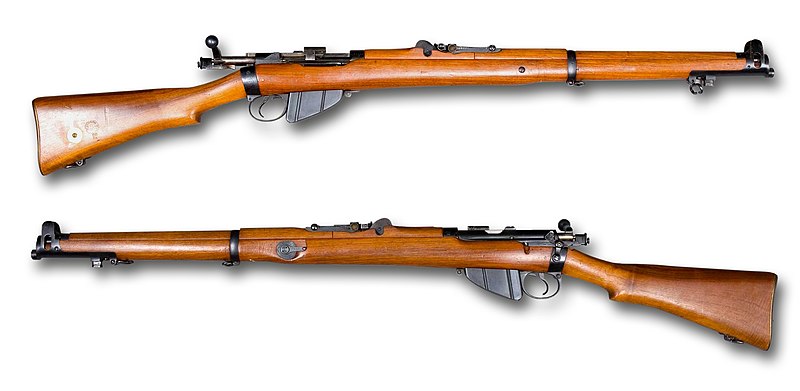
- A 1903 Short Magazine Lee–Enfield Mk I in the Swedish Army Museum
- Weapon.origin
- United Kingdom
- Weapon.type
- Carbine
- Weapon.is_ranged
- yes
- Weapon.is_UK
- YES
- Weapon.service
- 1895–1957 (as the standard British service rifle)
- Weapon.used_by
- See Users
- Weapon.designer
- Howard Francis
- Weapon.number
- 17,000,000+
- Weapon.variants
- See Models/marks
- Weapon.cartridge
- 7.63×25mm Mauser
- Weapon.action
- Bolt-action
- Weapon.rate
- Semi-automatic
- Weapon.feed
- 12-round box magazine
- Weapon.sights
- Iron sights
via Wikipedia infobox
Wikidata facts
- Subclass of
- repeating rifle
- Has part
- magazine
- Operator
- British Army
- Country of origin
- United Kingdom of Great Britain and Ireland
- Manufacturer
- Pakistan Ordnance Factories
- Designed by
- Royal Small Arms Factory
- Conflict
- Second Boer War
- Image
- Short Magazine Lee-Enfield Mk 1 (1903) - UK - cal 303 British - Armémuseum.jpg
Show 6 more facts
- Commons category
- Lee–Enfield
- ammunition
- .303 British
- service entry
- 1895-01-01
- total produced
- 17000000
- Commons gallery
- Lee-Enfield
- native label
- Lee-Enfield
Sources (3)
via Wikidata · CC0
~67 min read
Encyclopedic overview
40 sectionsContents
- Design and history
- Models/marks of Lee–Enfield rifle and service periods
- Magazine Lee–Enfield
- Short Magazine Lee–Enfield Mk I
- Short Magazine Lee–Enfield Mk III
- Pattern 1913 Enfield
- Inter-war period
- Lee–Enfield No. 1 Mk V
- Rifle No. 4
- Rifle No. 5 Mk I—the "jungle carbine"
- Lee–Enfield conversions and training models
- Sniper rifles
- .22 training rifles
- Muskets and shotguns
- Civilian conversions and variants
- L59A1 Drill Rifle
- Special service Lee–Enfields: Commando and automatic models
- De Lisle commando carbine
- Ekins automatic rifle
- Howard Francis carbine
- Howell automatic rifle
- Rieder automatic rifle
- Turner automatic conversion
- Conversion to 7.62×51mm NATO
- Ishapore 2A/2A1
- 4 Mk 4 Rifle
- Manufacturers
- List of manufacturers
- Australian International Arms No. 4 Mk IV
- Khyber Pass copies
- Armalon
- Contemporary service
- Civilian use
- Conversions
- Variants
- Users
- Non-state users
- See also
- Notes
- References
The Lee–Enfield is a bolt-action, magazine-fed repeating rifle that served as the main firearm of the military forces of the British Empire and Commonwealth during the first half of the 20th century, and was the standard service rifle of the British Armed Forces from its official adoption in 1895 until 1957.
A redesign of the Lee–Metford (adopted by the British Army in 1888), the Lee–Enfield superseded it and the earlier Martini–Henry and Martini–Enfield rifles. It featured a ten-round box magazine which was loaded with the .303 British cartridge manually from the top, either one round at a time or by means of five-round chargers. The Lee–Enfield was the standard-issue weapon to rifle companies of the British Army, colonial armies (such as India and parts of Africa), and other Commonwealth nations in both the First and Second World Wars (such as Australia, New Zealand, South Africa, and Canada). Although officially replaced in the United Kingdom with the L1A1 SLR in 1957, it remained in widespread British service until the early/mid-1960s and the 7.62 mm L42A1 sniper variant remained in service until the 1990s. As a standard-issue infantry rifle, it is still found in service in the armed forces of some Commonwealth nations, notably with the Bangladesh Police, which makes it the second longest-serving military bolt-action rifle still in official service, after the Mosin–Nagant (Mosin-Nagant receivers are used in the Finnish 7.62 Tkiv 85). Total production of all Lee–Enfields is estimated at over 17 million rifles.
Excerpted from Wikipedia’s “Lee-Enfield” article, available under the CC BY-SA 4.0 licence.