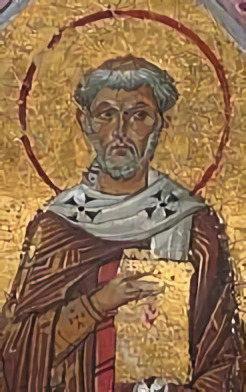
File:Pope_St._Leo_I_the_Great.jpg · Wikimedia Commons · See Wikimedia Commons
OverviewAI-generated
Leo I, also referred to as Pope Leo I, was a historical figure recognized in the Popes collection. Born in 390, he died in 461. His literary output includes works such as *Skzbnagirkʻ tumari Srboyn Lewoni ew sahmani surb zhoghovoyn Kʻaghkedoni* and *Sancti Leonis Magni Papæ Primi opera omnia*. Other titles associated with him include *Opera omnia ad mss. codicum fidem emendata* and *D. Leonis Papae hvivs nominis primi ...*.
Records indicate varying counts of his works, with sources listing 5, 36, and 83 items. One specific work is noted as *Opera omnia, nunc primum epistolis xxx tribus de gratia Christi opusculis auctiora*. He is referenced by 2,201 other encyclopedia articles.
Synthesized by Vinony from 16 facts across 7 sources: Wikidata, Crossref, MusicBrainz, Open Library, Europeana Sparql, Vinony collections, Vinony graph. Generated from structured data (not the Wikipedia text) and checked against those facts — may still contain errors.
Wikidata facts
- Instance of
- human
- Given name
- Leo
- Gender
- male
- Citizenship
- Ancient Rome
- Place of birth
- Tuscany
- Place of death
- Rome
- Occupation
- Catholic priest
- Position held
- Pope
- Languages spoken
- Latin
- Religion
- Christianity
- Image
- Herrera mozo San León magno Lienzo. Óvalo. 164 x 105 cm. Museo del Prado.png
- Work location
- Rome
Show 15 more facts
- date of birth
- 0390-01-01
- date of death
- 0461-11-10
- described by source
- Wikitólica
- Commons category
- Leo I Magnus
- canonization status
- saint
- topic's main category
- Category:Pope Leo I
- time period
- Roman Empire
- honorific prefix
- Doctor of the Church
- name in native language
- Leo PP. I
- feast day
- November 10
- place of burial
- Old St. Peter's Basilica
- different from
- Leo I
- writing language
- Latin
- has works in the collection
- Victoria and Albert Museum
- on focus list of Wikimedia project
- Wikipedia:Vital articles/Level/4
via Wikidata · CC0
Works in European collections
36 objects attributed to Leo I, held across European museums, libraries & archives · via Europeana
Maximus, Taurin. Ep. (S) Petrus Chrysologus, Rav. Archiep. (S) Fulgentius, Rusp. Ep. (S) Valerianus, Cemed. Ep. (D.) Amedeus, Lansaniensis, Ep. (D.) Asterius, Amasenus Ep. (S) Opera Ex edit. et recensione Theophili Rainandi [Printed Text]

Untitled

Untitled

Untitled

Untitled

Untitled

Untitled

Untitled

Untitled

Untitled

Untitled

Untitled

Untitled

Untitled

Untitled

Untitled

Untitled

Untitled

Untitled

Untitled

Untitled
Untitled

Untitled

Untitled
Untitled
Untitled
Untitled

Untitled

Untitled

Untitled

Untitled

Untitled

Untitled
Untitled
Untitled
Untitled
~26 min read
Encyclopedic overview
Pope Leo I (Italian: Leone I) (c. 391 – 10 November 461), also known as Leo the Great (Latin: Leo Magnus; Italian: Leone Magno), was Bishop of Rome from 29 September 440 until his death on 10 November 461. He is the first of the three Popes listed in the Annuario Pontificio with the title "the Great", alongside Popes Gregory I and Nicholas I.
Leo was a Roman aristocrat. He is perhaps best known for meeting Attila the Hun in 452 and persuading him to turn back from his invasion of Italy, though how large a part his personal authority played is debated, and some argue that Attila was already ready to end his campaign. He is also a Doctor of the Church, most remembered theologically for issuing the Tome of Leo, a document which was a major foundation to the debates of the Council of Chalcedon, the fourth ecumenical council. That meeting dealt primarily with Christology and elucidated the definition of Christ's being as the hypostatic union of two natures, divine and human, united in one person, "with neither confusion nor division". It was followed by a major schism associated with Monophysitism, Miaphysitism and Dyophysitism. He also contributed significantly to developing ideas of papal authority.
Excerpted from Wikipedia’s “Leo I” article, available under the CC BY-SA 4.0 licence.
Gallery (8)
Available in 85 languages
- Español
- Français
- Deutsch
- 中文
- 日本語
- Русский
- Português
- Italiano
- العربية
- Afrikaans
- Albanian
- Albanian
- Armenian
- Asturian
- Bahasa Indonesia
- Basque
- Bavarian
- be_x_old
Show 66 more
- Belarusian
- Bikol
- Breton
- Bulgarian
- Catalan
- cdo
- Cebuano
- Croatian
- Czech
- Danish
- Egyptian Arabic
- Esperanto
- Estonian
- Filipino
- Finnish
- Galician
- Georgian
- Greek
- Hakka Chinese
- Hebrew
- Hungarian
- Icelandic
- Iloko
- Irish
- Javanese
- Latin
- Latvian
- Lithuanian
- Low German
- Macedonian
- Malagasy
- Malay
- Mazanderani
- Mongolian
- Nederlands
- Norwegian
- Norwegian Nynorsk
- Occitan
- Polski
- Quechua
- Romanian
- Sardinian
- Scots
- Serbian
- Serbian (Latin)
- Sicilian
- simple
- Slovak
- Slovenian
- Svenska
- Swahili
- Tamil
- Tiếng Việt
- Türkçe
- Ukrainian
- Urdu
- Waray
- Western Frisian
- Wu Chinese
- Yoruba
- Zaza
- zh_min_nan
- zh_yue
- فارسی
- ไทย
- 한국어
via Wikidata sitelinks · CC0