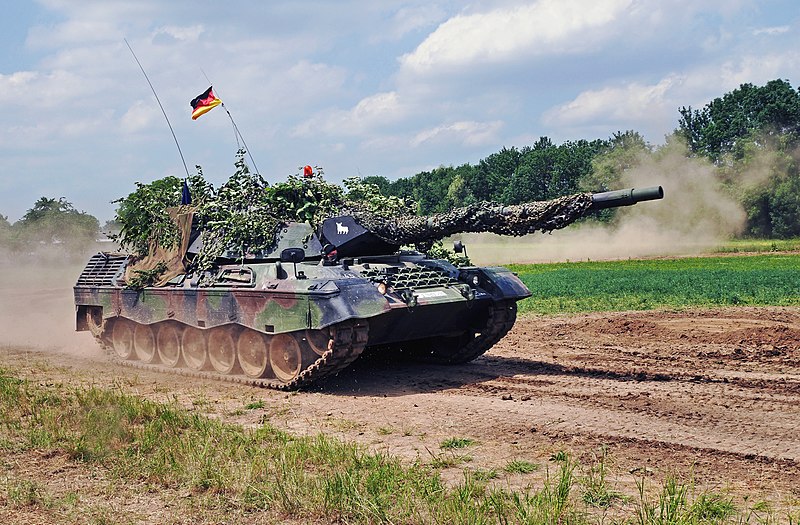
File:Leopard_1A5.jpg · Wikimedia Commons · See Wikimedia Commons
Key facts
- Type
- Main battle tank
- Place of origin
- West Germany
- In service
- 1965–present
- Wars
- Yugoslav Wars Bosnian War Kurdish–Turkish conflict War in Afghanistan Russo-Ukrainian War Russian invasion of Ukraine
- Designer
- Porsche
- Designed
- 1956–1961
- Manufacturer
- KraussMaffei , OTO Melara
- Produced
- 1965–1984
- Number span no built
- 6,565 4,744 main battle tanks, 1,741 utility and anti-aircraft vehicles, 80 prototypes and pre-series vehicles
- Mass
- 42.2 tonnes (increased on later models from original 40 tonnes)
- Length
- 9.54/8.29 m (gun forward/rearward)
- Width
- 3.37 m (11.1 ft)
- Height
- 2.39/2.7 m (turret roof/absolute)
- Crew
- 4 (commander, driver, gunner, radio operator/loader)
- Armour
- Steel: 10–70 mm (0.39–2.76 in) RHAe
- Main armament
- 1 × 105 mm Royal Ordnance L7 A3 L/52 rifled gun (13 rounds in turret 42 rounds in hull)
- Secondary armament
- 2 × 7.62 mm MG 3 or FN MAG ( co-axial and commander's hatch) (5500 rounds)
- Engine
- MTU MB 838 CaM 500, 10-cylinder, 37.4 litres, multi-fuel engine, 830 PS (820 hp; 610 kW) at 2,200 RPM
via Wikipedia infobox
Wikidata facts
- Subclass of
- main battle tank
- Country of origin
- Germany
- Followed by
- Leopard 2
- Manufacturer
- KNDS Deutschland
- Conflict
- War in Bosnia and Herzegovina
- Image
- Leopard1 cfb borden 2.JPG
- Height
- 2.76
- Width
- 3.37
- Speed
- 65
Show 5 more facts
- Commons category
- Leopard 1 tanks
- Commons gallery
- Leopard 1
- powered by
- V engine
- native label
- Leopard 1
- ride height
- 440
via Wikidata · CC0
~40 min read
Encyclopedic overview
The Kampfpanzer Leopard, subsequently Leopard 1 following the introduction of the successive Leopard 2, is a main battle tank designed by Porsche and manufactured by Krauss-Maffei in West Germany, first entering service in 1965. Developed in an era when HEAT warheads were thought to make conventional heavy armour of limited value, the Leopard design focused on effective firepower and mobility instead of heavy protection. It featured moderate armour, only effective against low caliber autocannons and heavy machine guns, giving it a high power-to-weight ratio. This, coupled with a modern suspension and drivetrain, gave the Leopard superior mobility and cross-country performance compared to most other main battle tanks of the era, only being rivaled by the French AMX-30 and Swedish Strv 103.
The main armament of the Leopard consists of a German license-built version of the British Royal Ordnance L7 105 mm rifled gun, one of the most effective and widespread tank guns of the era.
Excerpted from Wikipedia’s “Leopard 1” article, available under the CC BY-SA 4.0 licence.