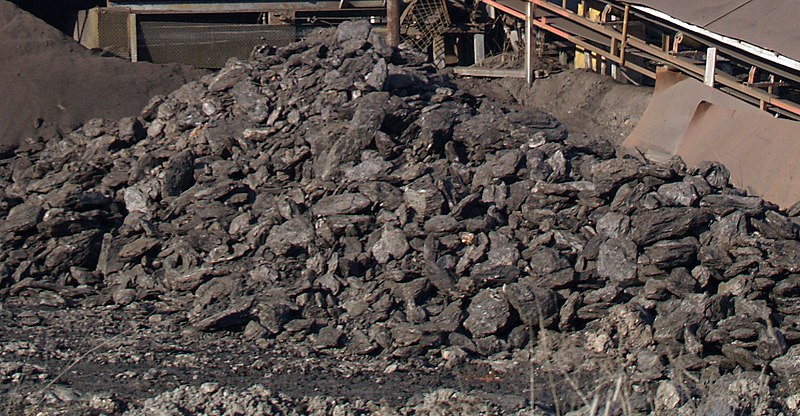
File:Lignite-coal.jpg · Wikimedia Commons · See Wikimedia Commons
lignite
Sign in to saveAlso known as brown coal
Lignite (), often called brown coal, is a soft, brown, combustible sedimentary rock formed from naturally compressed peat. It has a carbon content around 25–35% and is considered the lowest rank of coal due to its relatively low heat content. When removed from the ground, it contains a very high amount of moisture, which partially explains its low carbon content. Lignite is mined all around the world and is used almost exclusively as a fuel for steam-electric power generation.
Lignite, also known as brown coal, is a soft sedimentary rock with relatively low carbon content (25–35%) that forms from compressed peat and contains significant moisture. It is the lowest-ranking type of coal and is mined worldwide primarily to generate electricity in steam-electric power plants.
AI-generated from the Wikipedia summary — may contain errors.
Wikidata facts
- Subclass of
- coal
- Image
- Mineral Lignito GDFL028.jpg
Show 4 more facts
- partially coincident with
- xyloid lignite
- Commons category
- Lignite
- described by source
- Brockhaus and Efron Encyclopedic Dictionary
- exact match
- purl.obolibrary.org/obo/ENVO_2000008
Sources (6)
via Wikidata · CC0
~16 min read
Encyclopedic overview
19 sectionsContents
- Characteristics
- Uses
- As fuel
- Home heating
- In agriculture {{anchor|in agriculture}}
- In drilling mud {{anchor|in industry}}
- As an industrial adsorbent
- In jewellery {{anchor|in jewelry}}
- Geology
- Extraction
- Resources and reserves
- List of countries by lignite resources
- Australia
- North America
- Production
- Gallery
- See also
- References
- External links
Lignite (), often called brown coal, is a soft, brown, combustible sedimentary rock formed from naturally compressed peat. It has a carbon content around 25–35% and is considered the lowest rank of coal due to its relatively low heat content. When removed from the ground, it contains a very high amount of moisture, which partially explains its low carbon content. Lignite is mined all around the world and is used almost exclusively as a fuel for steam-electric power generation.
Lignite combustion produces less heat for the amount of carbon dioxide and sulfur released than other ranks of coal. As a result, lignite is the most harmful coal to human health. Depending on the source, various toxic heavy metals, including naturally occurring radioactive materials, may be present in lignite and left over in the coal fly ash produced from its combustion, further increasing health risks.
Excerpted from Wikipedia’s “lignite” article, available under the CC BY-SA 4.0 licence.
Gallery (21)
Available in 70 languages
- Español
- Français
- Deutsch
- 中文
- 日本語
- Русский
- Português
- Italiano
- العربية
- हिन्दी
- Afrikaans
- Albanian
- Armenian
- Asturian
- Bahasa Indonesia
- Bangla
- Basque
- be_x_old
Show 51 more
- Belarusian
- Bosnian
- Bulgarian
- Burmese
- Catalan
- Chuvash
- Croatian
- Czech
- Danish
- Esperanto
- Estonian
- Finnish
- Galician
- Greek
- Hebrew
- Hungarian
- Icelandic
- Kazakh
- Kyrgyz
- Latvian
- Limburgish
- Lithuanian
- Lower Sorbian
- Macedonian
- Malagasy
- Malayalam
- Mongolian
- Nederlands
- Norwegian
- Norwegian Nynorsk
- Occitan
- Polski
- Romanian
- Rusyn
- Serbian
- Serbian (Latin)
- simple
- Slovak
- Slovenian
- Svenska
- Tamil
- Telugu
- Tiếng Việt
- Türkçe
- Ukrainian
- Upper Sorbian
- Uzbek
- Wu Chinese
- فارسی
- ไทย
- 한국어
via Wikidata sitelinks · CC0