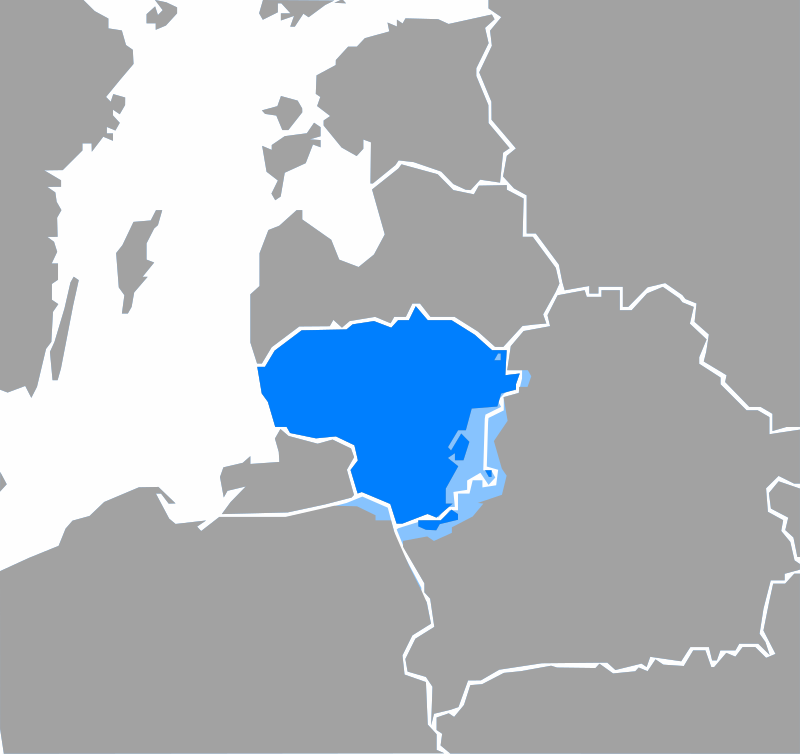
File:Map_of_Lithuanian_language.svg · Wikimedia Commons · See Wikimedia Commons
Lithuanian
Sign in to saveAlso known as Lithuanian language, Lietuvių
Baltic language spoken in Lithuania
Lithuanian is a language spoken in Lithuania, a Baltic country in Northern Europe. It's one of only two surviving Baltic languages and is notable for preserving many ancient linguistic features that help scholars understand the early development of Indo-European languages.
AI-generated from the Wikipedia summary — may contain errors.
Wikidata facts
- Instance of
- modern language
- Subclass of
- East Baltic
- Country
- Poland
Show 20 more facts
- Wikimedia language code
- lt
- Commons category
- Lithuanian language
- topic's main category
- Category:Lithuanian language
- language regulatory body
- Commission of the Lithuanian Language
- time of earliest written record
- 1515-00-00
- has grammatical case
- vocative case
- has tense
- future tense
- linguistic typology
- nominative–accusative language
- has grammatical gender
- feminine
- different from
- Lithuanian
- indigenous to
- Lithuania
- category for films in this language
- Category:Lithuanian-language films
- P10369
- metrology
- P11012
- Wikimedia Foundation
- entry in abbreviations table
- литов.
- short name
- litova
- female form of label
- la langue lituanienne
- native label
- Lietuviškai
- number of speakers, writers, or signers
- 4000000
Sources (9)
via Wikidata · CC0
~40 min read
Encyclopedic overview
Lithuanian (lietuvių kalba, pronounced [lʲiəˈtʊvʲuː kɐɫˈbɐ]) is an East Baltic language belonging to the Baltic branch of the Indo-European language family. It is the language of Lithuanians and the official language of Lithuania as well as one of the official languages of the European Union. There are approximately 2.8 million native Lithuanian speakers in Lithuania and about 1.5 million speakers elsewhere. Around half a million inhabitants of Lithuania of non-Lithuanian background speak Lithuanian daily as a second language.
Lithuanian is closely related to neighbouring Latvian, though the two languages are not mutually intelligible. It is written in a Latin script. Some linguists consider it to be the most conservative of the existing Indo-European languages, retaining features of the Proto-Indo-European language that have otherwise been lost to more recent linguistic developments in the remainder of its descendant languages.
Excerpted from Wikipedia’s “Lithuanian” article, available under the CC BY-SA 4.0 licence.
Gallery (12)
Available in 162 languages
- Español
- Français
- Deutsch
- 中文
- 日本語
- Русский
- Português
- Italiano
- العربية
- हिन्दी
- Afrikaans
- Albanian
- Albanian
- Amharic
- Angika
- Aragonese
- Armenian
- Asturian
Show 143 more
- Aymara
- Azerbaijani
- Bahasa Indonesia
- Bangla
- Bashkir
- Basque
- bat_smg
- be_x_old
- Belarusian
- Bosnian
- Breton
- Bulgarian
- Catalan
- Cebuano
- Central Kurdish
- Chechen
- Church Slavic
- Chuvash
- Cornish
- Croatian
- Czech
- Danish
- Egyptian Arabic
- Erzya
- Esperanto
- Estonian
- Extremaduran
- Faroese
- Fiji Hindi
- Filipino
- Finnish
- fiu_vro
- Galician
- Georgian
- Greek
- Guarani
- Hakka Chinese
- Hebrew
- Hungarian
- Icelandic
- Ido
- Iloko
- Interlingue
- Irish
- Kabyle
- Karachay-Balkar
- Kashubian
- Kazakh
- kge
- Kinyarwanda
- Komi
- Kotava
- Kurdish
- Kyrgyz
- Latgalian
- Latin
- Latvian
- Ligurian
- Limburgish
- Lingua Franca Nova
- Lithuanian
- Lombard
- Low German
- Lower Sorbian
- Luxembourgish
- Macedonian
- Malagasy
- Malay
- Malayalam
- Manipuri
- Manx
- Māori
- Marathi
- Mari
- Mazanderani
- Mingrelian
- Moksha
- Mongolian
- nds_nl
- Nederlands
- Nepali
- Northern Frisian
- Northern Sami
- Norwegian
- Norwegian Nynorsk
- Occitan
- Old English
- olo
- Ossetic
- Papiamento
- Pashto
- Piedmontese
- Polski
- Punjabi
- Quechua
- Romanian
- Rusyn
- Samoan
- Sanskrit
- Santali
- Sardinian
- Scots
- Scottish Gaelic
- Serbian
- Serbian (Latin)
- Silesian
- simple
- Slovak
- Slovenian
- Svenska
- Swahili
- Talysh
- Tamil
- Tatar
- Tiếng Việt
- Tok Pisin
- Türkçe
- Udmurt
- Ukrainian
- Upper Sorbian
- Urdu
- Uyghur
- Uzbek
- Volapük
- Walloon
- Waray
- Welsh
- Western Frisian
- Western Panjabi
- wikifunctions
- Wu Chinese
- Yakut
- Yiddish
- Yoruba
- Zaza
- Zeelandic
- zh_classical
- zh_min_nan
- zh_yue
- Zulu
- فارسی
- ไทย
- 한국어
via Wikidata sitelinks · CC0