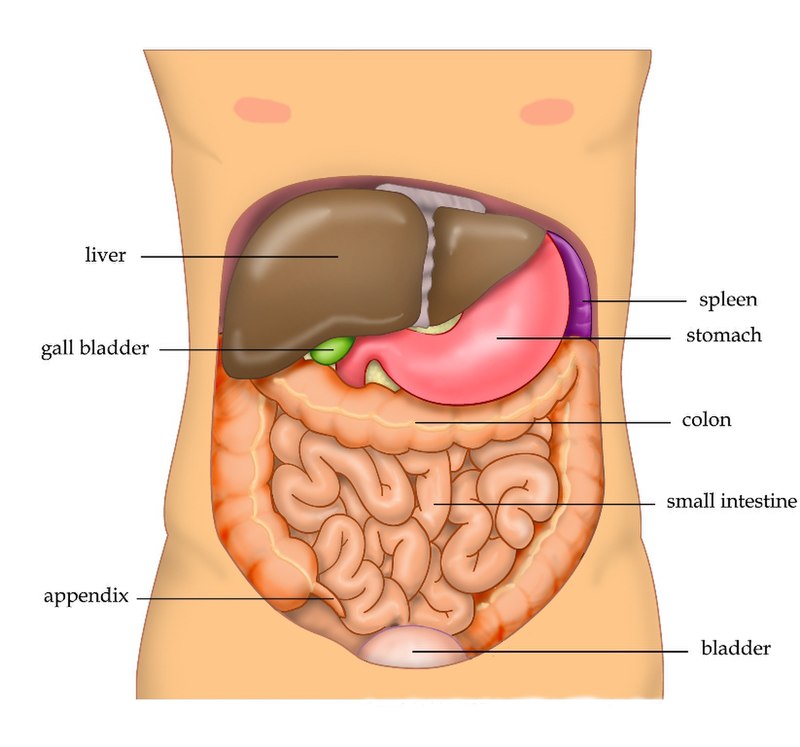
File:Anatomy_Abdomen_Tiesworks.jpg · Wikimedia Commons · See Wikimedia Commons
liver
Sign in to saveAlso known as hepar
The liver is a major metabolic organ exclusively found in vertebrates, which performs many essential biological functions such as detoxification of the organism, and the synthesis of various proteins and various other biochemicals necessary for digestion and growth. In humans, it is located in the right upper quadrant of the abdomen, below the diaphragm and mostly shielded by the lower right rib cage. Its other metabolic roles include carbohydrate metabolism, the production of a number of hormones, conversion and storage of nutrients such as glucose and glycogen, and the decomposition of red b
OverviewAI-generated
The liver is an organ located in the abdominal cavity and serves as a component of the human digestive system. It follows the foregut in anatomical sequence. The organ receives arterial supply from the hepatic artery proper and is drained by the hepatic vein. Innervation is provided by the vagus nerve and celiac ganglia, which the liver also innervates.
The liver is studied by the fields of anatomy and hepatology. It is partially coincident with the concept of liver as food. The subject is described by the Brockhaus and Efron Encyclopedic Dictionary and the Encyclopædia Britannica 11th edition. It appears in the Commons category "Livers" and has a corresponding gallery. The topic is listed on Wikipedia’s vital articles level 4 list.
Synthesized by Vinony from 19 facts across 3 sources: Wikidata, PubMed, Vinony graph. Generated from structured data (not the Wikipedia text) and checked against those facts — may still contain errors.
Key facts
- Anatomy.Name
- Liver
- Anatomy.Latin
- jecur, iecur
- Anatomy.Greek
- hepar (ἧπαρ)root hepat- (ἡπατ-)
- Anatomy.Image
- Anatomy Abdomen Tiesworks.jpg
- Anatomy.Caption
- The human liver is located in the upper right abdomen
- Anatomy.Width
- 240
- Anatomy.Image2
- Liver 01 animation1.gif
- Anatomy.Caption2
- Location of human liver (in red) shown on a male body
- Anatomy.Precursor
- Foregut
- Anatomy.System
- Digestive system
- Anatomy.Artery
- Hepatic artery
- Anatomy.Vein
- Hepatic vein and hepatic portal vein
- Anatomy.Nerve
- Celiac ganglia and vagus nerve
via Wikipedia infobox
Research
1,455,980 papers- Immune Responses in the Liver.ReviewAnnual review of immunology · 2018Kubes P, Jenne CDOI: 10.1146/annurev-immunol-051116-052415
- Liver, ageing and disease.ReviewNature reviews. Gastroenterology & hepatology · 2025Le Couteur DG, Ngu MC, Hunt NJ et al.DOI: 10.1038/s41575-025-01099-z
- The immune niche of the liver.ReviewClinical science (London, England : 1979) · 2021Cheng ML, Nakib D, Perciani CT et al.DOI: 10.1042/CS20190654
- Intestinal flora plays a role in the progression of hepatitis-cirrhosis-liver cancer.ReviewFrontiers in cellular and infection microbiology · 2023Liu S, Yang XDOI: 10.3389/fcimb.2023.1140126
- Role and Mechanisms of Mitophagy in Liver Diseases.ReviewCells · 2020Ma X, McKeen T, Zhang J et al.DOI: 10.3390/cells9040837
- Liver aging: underlying mechanisms and therapeutic strategies.ReviewMolecular aspects of medicine · 2025Zhong L, Wang L, Syed JN et al.DOI: 10.1016/j.mam.2025.101397
- Priming and Maintenance of Adaptive Immunity in the Liver.ReviewAnnual review of immunology · 2024Kawashima K, Andreata F, Beccaria CG et al.DOI: 10.1146/annurev-immunol-090122-041354
- Fetal liver development and implications for liver disease pathogenesis.ReviewNature reviews. Gastroenterology & hepatology · 2023Lotto J, Stephan TL, Hoodless PADOI: 10.1038/s41575-023-00775-2
via PubMed
Wikidata facts
- Part of
- human digestive system
- Follows
- foregut
- Image
- Leber Schaf.jpg
Show 13 more facts
- Commons category
- Livers
- topic's main category
- Category:Liver
- arterial supply
- hepatic artery proper
- venous drainage
- hepatic vein
- Commons gallery
- Liver
- anatomical location
- abdominal cavity
- innervated by
- celiac ganglia
- on focus list of Wikimedia project
- Wikipedia:Vital articles/Level/4
- partially coincident with
- liver as food
- studied by
- hepatology
- ground level 360 degree view URL
- www.openanatomy.org/atlases/nac/liver-2014-02-20/viewer/#!/state/984f950d-b35a-4952-afd9-ceafec728f8c
- innervates
- vagus nerve
- NCI Thesaurus ID
- C12392
Sources (10)
via Wikidata · CC0
~45 min read
Encyclopedic overview
37 sectionsContents
- Structure
- Gross anatomy
- Lobes
- Surfaces
- Impressions
- Microscopic anatomy
- Functional anatomy
- Couinaud classification system
- Gene and protein expression
- Development
- Fetal blood supply
- Functions
- Blood supply
- Biliary flow
- Metabolism
- Carbohydrate metabolism
- Protein metabolism
- Lipid metabolism
- Breakdown
- Blood reservoir
- Lymph production
- Other
- Clinical significance
- Disease
- Symptoms
- Diagnosis
- Liver regeneration
- Liver transplantation
- Society and culture
- Food
- Giraffe liver
- Arrow/bullet poison
- Other animals
- See also
- References
- Works cited
- External links
The liver is a major metabolic organ exclusively found in vertebrates, which performs many essential biological functions such as detoxification of the organism, and the synthesis of various proteins and various other biochemicals necessary for digestion and growth. In humans, it is located in the right upper quadrant of the abdomen, below the diaphragm and mostly shielded by the lower right rib cage. Its other metabolic roles include carbohydrate metabolism, the production of a number of hormones, conversion and storage of nutrients such as glucose and glycogen, and the decomposition of red blood cells. Anatomical and medical terminology often use the prefix hepat- from ἡπατο-, from the Greek word for liver, such as hepatology, and hepatitis.
The liver is also an accessory digestive organ that produces bile, an alkaline fluid containing cholesterol and bile acids, which emulsifies and aids the break up of dietary fat. The gallbladder, a small hollow pouch that sits just under the right lobe of liver, stores and concentrates the bile produced by the liver, which is later excreted to the duodenum to help with digestion. The liver's highly specialized tissue, consisting mostly of hepatocytes, regulates a wide variety of high-volume biochemical reactions, including the synthesis and breakdown of small and complex organic molecules, many of which are necessary for normal vital functions. Estimates regarding the organ's total number of functions vary, but is generally cited as being around 500. For this reason, the liver has sometimes been described as the body's chemical factory.
Excerpted from Wikipedia’s “liver” article, available under the CC BY-SA 4.0 licence.
Gallery (28)
Available in 185 languages
- Español
- Français
- Deutsch
- 中文
- 日本語
- Русский
- Português
- Italiano
- العربية
- हिन्दी
- abstract
- Afrikaans
- Albanian
- Albanian
- Amharic
- Aragonese
- Aramaic
- Armenian
Show 166 more
- Assamese
- Asturian
- Atikamekw
- Avaric
- Aymara
- azb
- Azerbaijani
- Bahasa Indonesia
- Bangla
- Bashkir
- Basque
- bat_smg
- bdr
- be_x_old
- Belarusian
- Betawi
- Bikol
- Bosnian
- Breton
- Bulgarian
- Buriat
- Burmese
- Catalan
- cdo
- Cebuano
- Central Kurdish
- Chechen
- Chuvash
- Cornish
- Croatian
- Czech
- Danish
- Divehi
- Egyptian Arabic
- eml
- Erzya
- Esperanto
- Estonian
- Fiji Hindi
- Fijian
- Filipino
- Finnish
- Galician
- gcr
- Georgian
- Greek
- Guarani
- Haitian Creole
- Hakka Chinese
- Hebrew
- Hungarian
- hyw
- Iban
- Icelandic
- Ido
- Iloko
- Interlingua
- Interlingue
- Irish
- Javanese
- Kannada
- Kashmiri
- Kazakh
- kbp
- kge
- Khmer
- Kikuyu
- Kurdish
- Kyrgyz
- Lao
- Latin
- Latvian
- lbe
- Lezghian
- Limburgish
- Lingala
- Lingua Franca Nova
- Lithuanian
- lld
- Lombard
- Low German
- Luxembourgish
- Macedonian
- Malagasy
- Malay
- Malayalam
- Maltese
- Manipuri
- Marathi
- Mari
- Mingrelian
- Moksha
- Mongolian
- nah
- Nederlands
- Nepali
- Newari
- Norwegian
- Norwegian Nynorsk
- Occitan
- Odia
- Old English
- Oromo
- Ossetic
- Pampanga
- Pangasinan
- Pashto
- Piedmontese
- Polski
- Punjabi
- Quechua
- roa_rup
- Romanian
- Rundi
- Rusyn
- Sanskrit
- Santali
- Sardinian
- Scots
- Scottish Gaelic
- Serbian
- Serbian (Latin)
- Shona
- Sicilian
- simple
- Sindhi
- Sinhala
- Slovak
- Slovenian
- Somali
- Standard Moroccan Tamazight
- Sundanese
- Svenska
- Swahili
- szy
- Tachelhit
- Tajik
- Tamil
- Tatar
- Telugu
- Tibetan
- Tiếng Việt
- Türkçe
- Turkmen
- Ukrainian
- Urdu
- Uyghur
- Uzbek
- Venetian
- Volapük
- Walloon
- Waray
- Wayuu
- Welsh
- Western Panjabi
- Wu Chinese
- Xhosa
- Yakut
- Yiddish
- Zaza
- zh_min_nan
- zh_yue
- Zhuang
- فارسی
- ไทย
- 한국어
via Wikidata sitelinks · CC0