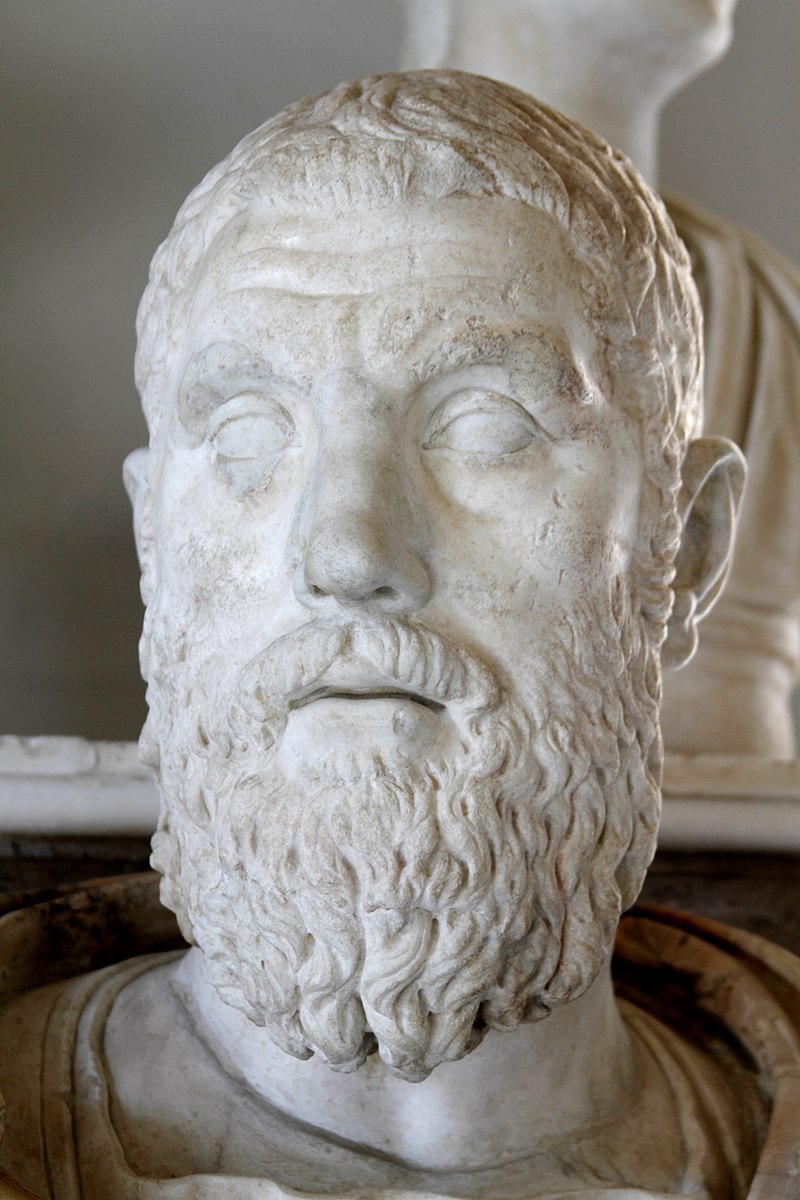
File:Bust_of_Macrinus_-_Palazzo_Nuovo_-_Musei_Capitolini_-_Rome_2016.jpg · Wikimedia Commons · See Wikimedia Commons
Macrinus
Sign in to saveAlso known as Marcus Opellius Severus Macrinus Augustus
Marcus Opellius Macrinus (; – June 218) was a Roman emperor who reigned from April 217 to June 218, jointly with his young son Diadumenianus. Born in Caesarea (now called Cherchell, in modern Algeria), in the Roman province of Mauretania Caesariensis to an equestrian family of Berber origins, he became the first emperor who did not hail from the senatorial class and also the first emperor who never visited Rome during his reign. Before becoming emperor, Macrinus served under Emperor Caracalla as a praetorian prefect and dealt with Rome's civil affairs. He later conspired against Caracalla and
Macrinus was a Roman emperor who ruled from 217 to 218 CE and made history as the first emperor to come from outside the traditional senatorial class, rising from his role as a military administrator under the previous emperor. His brief reign matters because it marked an unusual moment in Roman history when power shifted away from the aristocratic establishment, though his rule lasted only about a year before he was overthrown.
AI-generated from the Wikipedia summary — may contain errors.
Key facts
- Roman emperor.image
- Bust of Macrinus - Palazzo Nuovo - Musei Capitolini - Rome 2016.jpg
- Roman emperor.alt
- White statue of a bearded man
- Roman emperor.caption
- Bust, Capitoline Museums
- Roman emperor.succession
- Roman emperor
- Roman emperor.reign
- 11 April 217 – 8 June 218
- Roman emperor.predecessor
- Caracalla
- Roman emperor.successor
- Elagabalus
- Roman emperor.regent
- Diadumenian (218)
- Roman emperor.birth_place
- Caesarea, Mauretania Caesariensis(now Cherchell, Algeria)
- Roman emperor.death_place
- Cappadocia(modern-day Turkey)
- Roman emperor.spouse
- Nonia Celsa
- Roman emperor.issue
- Diadumenian
- Roman emperor.full name
- Marcus Opellius Macrinus
- Roman emperor.regnal name
- Imperator Caesar Marcus Opellius Severus Macrinus Pius Felix Augustus
via Wikipedia infobox
Wikidata facts
- Instance of
- human
- Gender
- male
- Citizenship
- Ancient Rome
- Place of birth
- Cherchell
- Place of death
- Cappadocia
- Spouse
- Nonia Celsa
- Child
- Diadumenian
- Occupation
- lawyer
- Position held
- Praetorian prefect
- Religion
- ancient Roman religion
- Family
- Severan dynasty
- Image
- Bust of Macrinus - Palazzo Nuovo - Musei Capitolini - Rome 2016.jpg
Show 6 more facts
- Commons category
- Macrinus
- date of death
- 0218-00-00
- date of birth
- 0165-00-00
- time period
- Severan dynasty
- manner of death
- capital punishment
- name in native language
- Marcus Opellius Macrinus
Sources (2)
via Wikidata · CC0
~15 min read
Encyclopedic overview
12 sectionsContents
- Background and career
- Reign
- Downfall
- Execution
- ''Damnatio memoriae''
- In popular culture
- Notes
- References
- Citations
- Sources
- Further reading
- External links
Marcus Opellius Macrinus (; – June 218) was a Roman emperor who reigned from April 217 to June 218, jointly with his young son Diadumenianus. Born in Caesarea (now called Cherchell, in modern Algeria), in the Roman province of Mauretania Caesariensis to an equestrian family of Berber origins, he became the first emperor who did not hail from the senatorial class and also the first emperor who never visited Rome during his reign. Before becoming emperor, Macrinus served under Emperor Caracalla as a praetorian prefect and dealt with Rome's civil affairs. He later conspired against Caracalla and had him murdered in a bid to protect his own life and succeeded Caracalla as emperor.
Macrinus was proclaimed emperor of Rome by 11 April 217 while in the eastern provinces of the empire and was subsequently confirmed as such by the Senate; however, for the duration of his reign, he never had the opportunity to return to Rome. His predecessor's policies had left Rome's coffers empty and the empire at war with several kingdoms, including Parthia, Armenia, and Dacia. As emperor, Macrinus first attempted to enact reform to restore economic and diplomatic stability in Rome. While Macrinus' diplomatic actions brought about peace with each of the individual kingdoms, the additional monetary costs and subsequent fiscal reforms generated unrest in the Roman military.
Excerpted from Wikipedia’s “Macrinus” article, available under the CC BY-SA 4.0 licence.
Gallery (9)
Available in 77 languages
- Español
- Français
- Deutsch
- 中文
- 日本語
- Русский
- Português
- Italiano
- العربية
- Afrikaans
- Albanian
- Aragonese
- Armenian
- azb
- Azerbaijani
- Bahasa Indonesia
- Basque
- Belarusian
Show 58 more
- Bosnian
- Breton
- Bulgarian
- Catalan
- Croatian
- Czech
- Danish
- Egyptian Arabic
- Esperanto
- Estonian
- Filipino
- Finnish
- Galician
- Georgian
- Greek
- Hebrew
- Hungarian
- Icelandic
- Kabyle
- Kongo
- Kurdish
- Latin
- Latvian
- Lithuanian
- Macedonian
- Malagasy
- Marathi
- Mingrelian
- Nederlands
- Norwegian
- Norwegian Nynorsk
- Occitan
- Old English
- Piedmontese
- Polski
- Romanian
- Serbian
- Serbian (Latin)
- Sicilian
- Slovak
- Slovenian
- Svenska
- Swahili
- Tiếng Việt
- Türkçe
- Ukrainian
- Urdu
- Waray
- Welsh
- Western Frisian
- Wu Chinese
- Yoruba
- Zaza
- zh_min_nan
- zh_yue
- فارسی
- ไทย
- 한국어
via Wikidata sitelinks · CC0