Encyclopedia of Life · EOL (see source)
Species
SPECIES
- KingdomAnimalia
- PhylumChordata
- ClassMammalia
- OrderDiprotodontia
- FamilyMacropodidae
Observations: Not much is known about the longevity of these animals. In the wild they have been estimated to live over 15 years (Bernhard Grzimek 1990), which is possible even if unverified. One captive specimen lived 12.4 years (Richard Weigl 2005).
via GBIF
Museum specimens
- Specimen records
- 104
- With media
- 14
- Family
- Macropodidae
- Collections
- RBINS-SCIENTIFIC HERITAGE, AMNH
- Recorded in
- Australia
Wikidata facts
- Instance of
- taxon
- Image
- Black-striped wallaby.jpg
Show 7 more facts
Sources (1)
via Wikidata · CC0
~1 min read
Encyclopedic overview
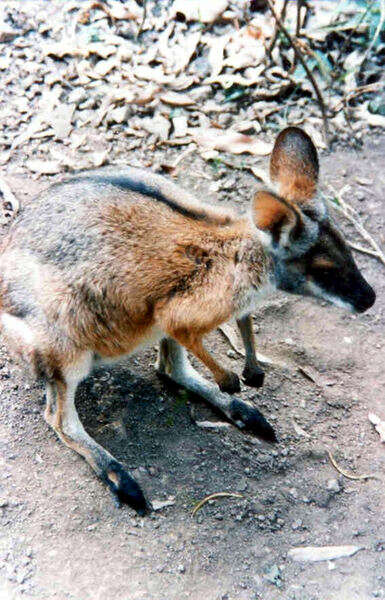
The black-striped wallaby (Notamacropus dorsalis), also known as the scrub wallaby or eastern brush wallaby, is a medium-sized wallaby found in Australia, from Townsville in Queensland to Narrabri in New South Wales. In New South Wales, it is only found west of the Great Dividing Range. It is decreasing in these areas, but is not classified as threatened as a species yet. The New South Wales population, however, is classified as endangered.
The black-striped wallaby resembles the mainland Australian subspecies of the red-necked wallaby, differing in the black line down its back, a white stripe over the hip and more red colouration (extending down the arms and further down the abdomen). It is a shy, predominantly nocturnal grazer and is not well-known, owing to its preference for thick scrub, where it may easily be hidden. Monocotyledonous plants (leaves and seedheads) seem to constitute preferred food.
Excerpted from Wikipedia’s “Macropus dorsalis” article, available under the CC BY-SA 4.0 licence.