
OverviewAI-generated
Mali, officially the Republic of Mali, is a country located in Western Africa. Its capital is Bamako, and it contains the administrative territorial entities of Kayes Region, Koulikoro Region, and Sikasso. The nation’s highest point is Mount Hombori. Mali shares diplomatic relations with Germany, Morocco, Mauritania, and Taiwan.
The country has a population of 22,395,489 and covers an area of 1,240,192 square kilometers. Official languages include Bambara, Bobo, Bozo, and Dogon. The currency used is the West African CFA franc and the Malian franc. Mali’s top-level Internet domain is .ml, and its mobile country code is 610. The head of government includes Abdoulaye Idrissa Maïga, Soumeylou Boubèye Maïga, Boubou Cisse, and Moctar Ouane.
Synthesized by Vinony from 67 facts across 9 sources: Wikidata, REST Countries, Open Meteo, Openweathermap, World Bank, OpenStreetMap, PubMed, Vinony graph, Geo. Generated from structured data (not the Wikipedia text) and checked against those facts — may still contain errors.
Weather now
cached 20h ago7-day forecast
via Open-Meteo
Country
- Capital
- Bamako
- Population
- 22,395,489
- Region
- Africa · Western Africa
- Demonym
- Malian
- Currencies
- XOF (Fr)
- Languages
- French
- Calling code
- +223
- Drives on
- Right
- Gini
- 33 (2009)
- FIFA code
- MLI
- TLD
- .ml
- Timezones
- UTC
- Borders
- DZA, BFA, GIN, CIV, MRT, NER, SEN
via REST Countries
Indicators · World Bank
- GDP
- $26.8B(2024)
- Population
- 24,478,595(2024)
- Life expectancy
- 60.7 yrs(2024)
- Unemployment
- 2.8 %(2025)
- Urban population
- 31.6 %(2024)
- Internet users
- 36.8 %(2024)
- Forest area
- 10.9 %(2023)
- Renewable energy
- 71.1 %(2022)
via World Bank Open Data · CC BY 4.0
Air quality
- PM2.5
- 39.6 µg/m³
- PM10
- 102.2 µg/m³
Wikipedia views (30d)
164,350 totalvia Wikimedia Pageviews API
Key facts
- Country.common_name
- Mali
- Country.conventional_long_name
- Republic of Mali
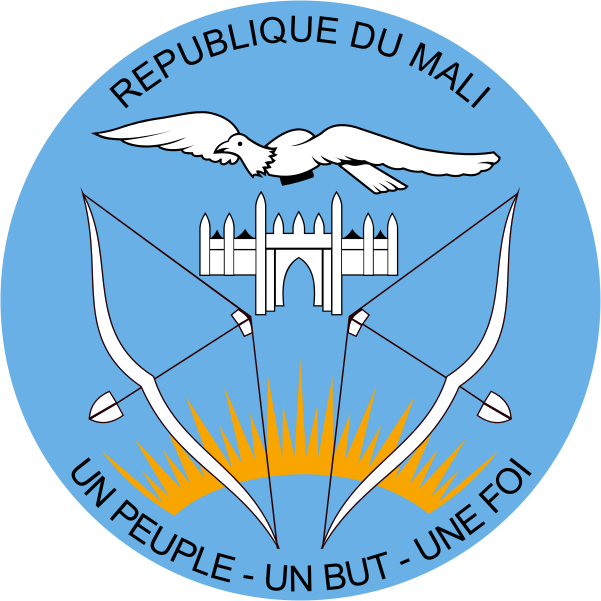
- Country.image_coat
- National coat of arms of Mali.svg
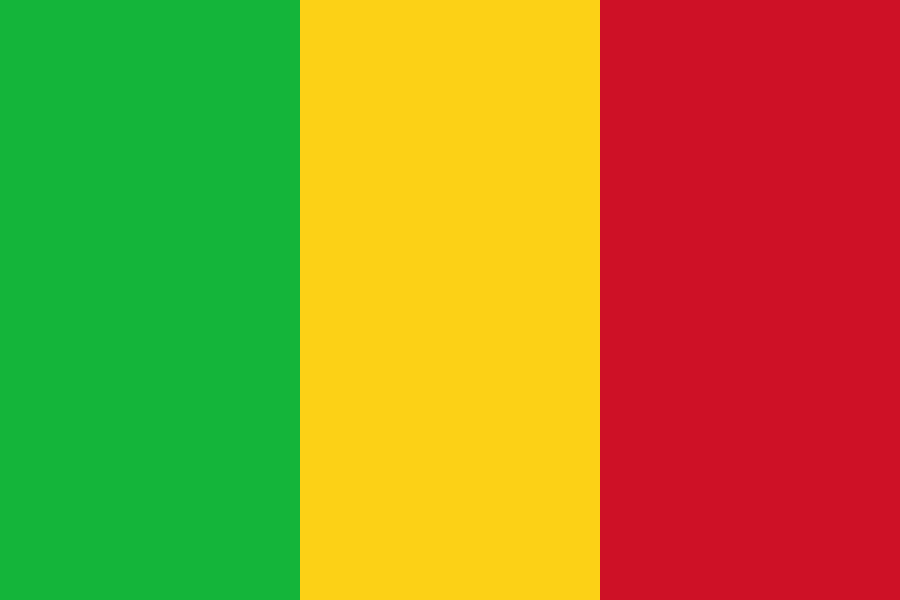
- Country.image_flag
- Flag of Mali.svg
- Country.national_motto
- "One people, one goal, one faith"
- Country.languages_type
- Spoken languages
- Country.languages2_type
- Working language
- Country.religion_year
- 2021
- Country.capital
- Bamako
- Country.demonym
- Malian
- Country.largest_city
- Bamako
- Country.government_type
- Unitary presidential republic under a military junta
- Country.leader_title1
- President
- Country.leader_name1
- Assimi Goïta
- Country.leader_title2
- Prime Minister
- Country.leader_name2
- Abdoulaye Maïga (interim)
- Country.legislature
- National Assembly
- Country.area_rank
- 23rd
via Wikipedia infobox
Research
10,996 papers- The estimated burden of fungal diseases in Mali.ReviewJournal de mycologie medicale · 2023Doumbo SN, Cissoko Y, Dama S et al.DOI: 10.1016/j.mycmed.2022.101333
- Cutaneous leishmaniasis in Mali.ReviewDermatologic clinics · 2011Paz C, Doumbia S, Keita S et al.DOI: 10.1016/j.det.2010.08.013
- Mali.Department of State publication. Background notes series · 1989United States. Department of State. Bureau of Public Affairs
- Zika Virus Circulation in Mali.Emerging infectious diseases · 2020Diarra I, Nurtop E, Sangaré AK et al.DOI: 10.3201/eid2605.191383
- Meningococcal Vaccine in Mali and Gambia.The New England journal of medicine · 2023Griffin DWJ, Hoy JF, McMahon JHDOI: 10.1056/NEJMc2307375
- Mali.Department of State publication. Background notes series · 1986United States. Department of State. Bureau of Public Affairs
- Childhood brain tumors in Mali.Medecine et sante tropicales · 2019Togo P, Togo B, Doumbia AK et al.DOI: 10.1684/mst.2019.0919
- Meningococcal Vaccine in Mali and Gambia. Reply.The New England journal of medicine · 2023Clarke E, Alderson MR, Tapia MDDOI: 10.1056/NEJMc2307375
via PubMed
Wikidata facts
- Instance of
- country
- Named after
- Mali Empire
- Official name
- Mali ka Fasojamana
- Demonym
- Mailíoch
- Country
- Mali
- Contains
- Kidal Region
- Continent
- Africa
- Capital
- Bamako
- Official language
- Tamasheq
- Currency
- Malian franc
- Population
- 19329841
- Area
- 1240192
- Head of government
- Abdoulaye Maïga
- Head of state
- Bah Ndaw
- Legislature
- National Assembly
- Shares border with
- Mauritania
- Highest point
- Mount Hombori
- Official website
- www.primature.gov.ml
- Image
- Mali - Location Map (2013) - MLI - UNOCHA.svg
- Life expectancy
- 57.966
- Nominal GDP
- 18827176532
- Unemployment rate
- 8
- Calling code
- +223
Show 56 more facts
- Licence plate code
- RMM
- Mains voltage
- 220
- Motto
- Un bobl, un nod, un ffydd
- Flag
- flag of Mali
- Coat of arms
- Coat of Arms of Mali
- diplomatic relation
- Ukraine
- mobile country code
- 610
- category for films shot at this location
- Category:Films shot in Mali
- topic's main category
- Category:Mali
- Commons gallery
- Mali
- maritime identification digits
- 649
- top-level Internet domain
- .ml
- total fertility rate
- 6.229
- Commons category
- Mali
- replaces
- French West Africa
- number of out-of-school children
- 2474516
- inception
- 1960-09-22
- category for people born here
- Category:Births in Mali
- category for people who died here
- Category:Deaths in Mali
- history of topic
- history of Mali
- lowest point
- Senegal River
- member of
- African Continental Free Trade Area
- category of associated people
- Category:Malian people
- driving side
- right
- Unicode character
- 🇲🇱
- topic's main Wikimedia portal
- Portal:Mali
- geography of topic
- Geography of Mali
- marriageable age
- 16
- native label
- Mali
- literacy rate
- 33.1
- culture
- culture of Mali
- VAT rate
- 18
- BTI Status Index
- 4.36
- BTI Governance Index
- 4.66
- economy of topic
- economy of Mali
- demographics of topic
- demographics of Mali
- different from
- Mali
- madhhab
- Malikism
- Democracy Index
- 3.93
- Human Development Index
- 0.428
- P11012
- Windhoek
- central bank
- Central Bank of West African States
- hashtag
- Mali
- on focus list of Wikimedia project
- Wikipedia:Vital articles/Level/4
- Happy Planet Index score
- 39.3
- Gini coefficient
- 36.1
- Inequality-adjusted Human Development Index
- 0.291
- P12749
- dubnium
- birth rate
- 41.217
- male population
- 11406819
- death rate
- 8.951
- rural population
- 12327741
- female population
- 11186771
- urban population
- 10265849
- P8168
- Glen Drover
- located in/on physical feature
- West Africa
Sources (15)
via Wikidata · CC0
Travel guide
Understand
The Sudanese Republic and Senegal became independent of France on 22 Sept 1960 as the Mali Federation. Senegal withdrew after only a few months, and the Sudanese Republic was renamed Mali. The country was then governed by dictatorships until 1991. In 1992 the country's first democratic presidential elections were held.
Just under half the population is less than 15 years old. The great majority of Malians are Muslim, some also practice indigenous beliefs, and a tiny number are Christian. Around 10% of the population is nomadic. Most Malians work in agriculture and fishing.
See
The Great Mosque of Djenné, built in 1907, is made completely of mud, and it has five stories and three towers. Every spring the people replaster the Mosque. Regrettably, entrance to non-Muslims is not allowed. Apparently this prohibition is a consequence of a fashion photo-shoot held by Vogue inside the mosque in 1996, which was regarded by the locals as "pornographic".
Sites and cultural landscapes making up the Mali Empire can be seen in different parts of the country.
Do
Cruise the Niger River on a traditional pirogue.
Eat
thumb|Street food in [[Mopti]] The most universal Malian dish is rice with sauce, often peanut "tiga diga na," tomato/onion/oil or leaf/okra based which is usually served some fish or meat if purchased or prepared for guests. "To", a gelatinous corn or millet food served with sauce, is another Malian classic, though more a village food than something most tourists would encounter. In the north, couscous is also quite common.
In the largest cities, decent "western" restaurants can be found, charging near western prices. Bamako even has good Chinese, Vietnamese, Italian, Lebanese and more. In smaller places, the standard Malian restaurant serves chicken or beef with fries and/or salad - usually edible and affordable, but boring and not particularly Malian. The better places in the more touristy areas may also have some local specialities. "Street food" is a lot more fun and cheaper: breakfast will be omelet sandwiches, lunch is usually rice with a couple of sauces to choose from, and dinner presents many options including beans, spaghetti cooked in oil and a little tomato, potatoes, fried rice, chicken, meatballs, beef kebabs, fish and salad. You can find little tables along the roadsides and near transport centers.
Snacks you may find for sale include little cakes (especially in bus stations), various fried doughs (either sweet or with hot sauce), peanuts, roasted corn if in season, sesame sticks, and frozen juices in little plastic sacks. Fresh fruit is widely available and…
Drink
thumb|Malian tea Treat tap water with suspicion. It is often so heavily chlorinated that one suspects few bugs could survive in it. But short-term visitors will be safer with bottled water. There are several cheap local brands, but be warned that they are only drunk by foreigners and wealthy Malians: don't rely on finding bottled water in shops patronised by "ordinary" Malians. Soft drinks such as Coca-Cola or Fanta are more widely available and safe . Street vendors sell water and home-made ginger and berry drinks in little plastic bags. They are often iced which makes them very refreshing in the heat. Generally, you shouldn't drink these without treating them first.
However, one which is called "bissap" in French and "dabileni" ("red hybiscus") in Bambara, is made from hibiscus flowers that are boiled during preparation, and so generally is safe to drink. It is a particularly delicious non-alcoholic drink you shouldn't miss. In Bamako, it is possible to purchase at most corner stores treated water in small plastic bags for CFA50; these are much cheaper than bottles. The bags are marked with a brand name; be careful not to mistake them for the tap water that is sold in unmarked plastic bags by street vendors. Also widely sold in this way is sweet milk and yoghurt, which are normally clean because the bags are industrially filled. Fresh milk can also be bought from buckets at the roadside in some villages, although it should always be thoroughly boiled before drinking as it …
Sleep
There are various types of accommodation options of various prices and qualities. You will pay USD60-100 per night (and up) for a what would be a decent to nice hotel by western standards. At the other end of the spectrum you can pay about USD5-10 per night for a bed or mattress, usually with mosquito net and sheets, in a room or on the roof. Such places will usually have toilets and showers in a shared facility (think camp site camping with less gear). All tourist areas have hotels or auberges and many places will also have homestays. Sleeping on the roof terrace, if available, is not only the cheapest option but also usually the coolest and gives you the pleasure of sleeping under the stars, which are incredibly bright outside of Bamako because there is so little light pollution. However, use a mosquito net and be prepared to wake to prayer call at 05:00.
Stay safe
thumb|Sunrise in Goundam Mali is politically unstable and therefore lawlessness is wide spread. In June 2012, Mali was hit by a political crisis and a civil war, which temporarily split the country into two parts: the north being named as "Azawad" and being controlled by a group of Islamist rebels, whilst the south experienced a military junta. Travelling in Timbuktu and Gao provinces is particularly dangerous, and as of July 2012, the Islamist rebel groups have ordered all shrines which are considered to involve idolatry to be destroyed. The U.S., Canada and Australia travel advisories have since continued to advise against all travel to Mali at this time. The UK government advises against all travel outside of Bamako.
The train between Bamako and Kayes is notorious for theft: if taking the train, you should exercise extreme caution, carry a pocket flashlight, and keep your belongings with you and valuables directly on your person at all times.
You also have a good chance of encountering the police. They are generally mostly concerned with directing traffic and fining people for improper papers, so you have little to fear from them, but always at least carry a copy of your passport and visa (and preferably the original if it is kept in a secure manner).
Carrying only a driving license is not sufficient and might lead to a ride to the police office unless you bribe your way out. Notice that the police in Bamako often stop taxis, although this can be somewhat avoided by nev…
Respect
Greeting people is very important. You should get familiar with the greetings in French or, better, in Bambara. Vendors should be treated in a proper way, even when you buy just fruit or bread. It is very important to show a general interest in the other person, so ask about family, work, children, and so on. The answer is simple: "Ça va" (It's all right). The interlocutor should not answer in a negative way.
Example: "Bonjour. ça va?" (Good morning. Are you all right)? "Et votre famille?" (And your family?) "Et vos enfants?" (And your children?) "Et votre travail?" (And your job?).
The history of French colonial rule, and subsequent French domination even following independence, is a sensitive topic. Anti-French sentiment has been rising since the late 2010s, though it is generally the French government and French corporations, not individual French tourists, who are the subject of public anger. On the other other hand, pro-Russian sentiments have also been on the rise, and many Malians are grateful to the Russians for their help in expelling the French military from Mali.
Travel guide from Wikivoyage (CC BY-SA 4.0)
Gallery (59)
On the map
6 mapped locations
Available in 261 languages
- Español
- Français
- Deutsch
- 中文
- 日本語
- Русский
- Português
- Italiano
- العربية
- हिन्दी
- Abkhazian
- abstract
- Achinese
- Adyghe
- Afrikaans
- Akan
- Albanian
- Albanian
Show 242 more
- Amharic
- ami
- Angika
- Aragonese
- Aramaic
- Armenian
- Arpitan
- Asturian
- Avaric
- azb
- Azerbaijani
- Bahasa Indonesia
- Balinese
- Bambara
- Bangla
- Banjar
- Bashkir
- Basque
- bat_smg
- Bavarian
- be_x_old
- Belarusian
- Betawi
- Bhojpuri
- Bikol
- Bishnupriya
- Bislama
- Bosnian
- Breton
- Bulgarian
- Buriat
- Burmese
- Catalan
- cbk_zam
- cdo
- Cebuano
- Central Kurdish
- Chechen
- Chuvash
- Cornish
- Corsican
- Crimean Tatar
- Croatian
- Czech
- dag
- Danish
- dga
- Divehi
- dty
- Egyptian Arabic
- Esperanto
- Estonian
- Ewe
- Extremaduran
- Faroese
- Fiji Hindi
- Filipino
- Finnish
- fiu_vro
- Fon
- Frafra
- Fula
- Gagauz
- Galician
- Ganda
- gcr
- Georgian
- Gilaki
- gpe
- Greek
- Guarani
- Gujarati
- Haitian Creole
- Hakka Chinese
- Hausa
- Hebrew
- Hungarian
- Icelandic
- Ido
- Igbo
- Iloko
- Inari Sami
- Interlingua
- Interlingue
- Irish
- Jamaican Creole English
- Javanese
- Jju
- Kabyle
- kai
- Kannada
- Kanuri
- Kara-Kalpak
- Karachay-Balkar
- Kashmiri
- Kazakh
- kbp
- kge
- Khmer
- Kikuyu
- Kinyarwanda
- Kongo
- Kotava
- Kurdish
- Kyrgyz
- Ladino
- Lao
- Latin
- Latvian
- Lezghian
- Ligurian
- Limburgish
- Lingala
- Lingua Franca Nova
- Lithuanian
- lld
- Lombard
- Low German
- Lower Sorbian
- Luxembourgish
- Macedonian
- Maithili
- Malagasy
- Malay
- Malayalam
- Maltese
- Manipuri
- Manx
- Māori
- Marathi
- Mazanderani
- Minangkabau
- Mingrelian
- Mirandese
- Moksha
- Mongolian
- Moroccan Arabic
- Mossi
- N’Ko
- Navajo
- nds_nl
- Nederlands
- Nepali
- Newari
- Northern Frisian
- Northern Sami
- Northern Sotho
- Norwegian
- Norwegian Nynorsk
- Novial
- nup
- Obolo
- Occitan
- Old English
- olo
- Oromo
- Ossetic
- Pampanga
- Papiamento
- Pashto
- Piedmontese
- Polski
- Punjabi
- Quechua
- Romanian
- Rusyn
- Sango
- Sanskrit
- Santali
- Sardinian
- Saterland Frisian
- Scots
- Scottish Gaelic
- Serbian
- Serbian (Latin)
- Shan
- Shona
- Sicilian
- Silesian
- simple
- Sindhi
- Sinhala
- Slovak
- Slovenian
- Somali
- Southern Sotho
- Standard Moroccan Tamazight
- Sundanese
- Svenska
- Swahili
- Swati
- szy
- Tachelhit
- Tajik
- Talysh
- Tamil
- Taroko
- Tatar
- tay
- Telugu
- Tibetan
- Tiếng Việt
- Tigrinya
- Toki Pona
- Tsonga
- Tswana
- Tumbuka
- Türkçe
- Turkmen
- Tyap
- Udmurt
- Ukrainian
- Upper Sorbian
- Urdu
- Uyghur
- Uzbek
- Venetian
- Veps
- Volapük
- Walloon
- Waray
- Welsh
- West Flemish
- Western Frisian
- Western Mari
- Western Panjabi
- Wolof
- Wu Chinese
- Xhosa
- Yakut
- Yiddish
- Yoruba
- Zaza
- Zeelandic
- zh_classical
- zh_min_nan
- zh_yue
- Zhuang
- Zulu
- فارسی
- ไทย
- 한국어
via Wikidata sitelinks · CC0