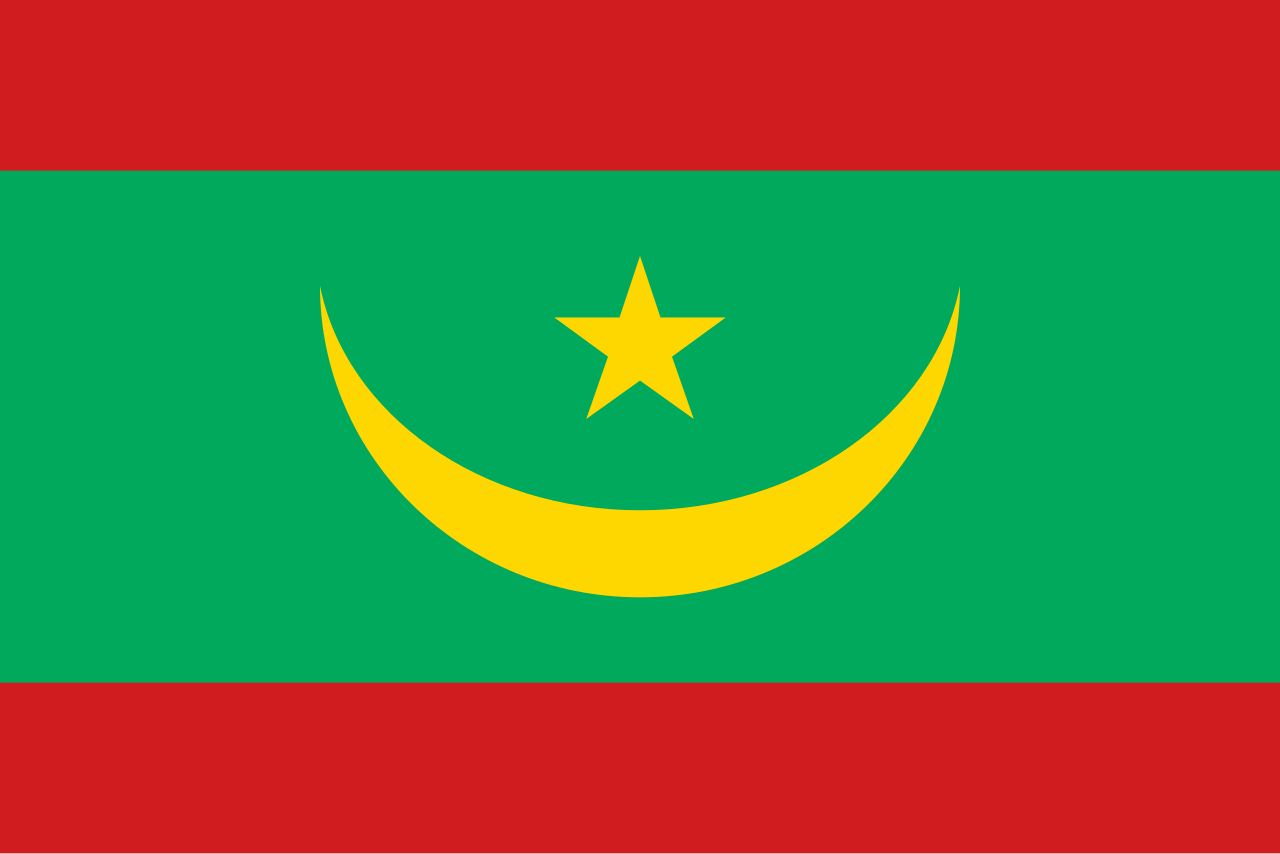
Mauritania
Sign in to saveAlso known as Islamic Republic of Mauritania, Muritanya, Agawej, Gànnaar, Murutaane, Moritani, mr, Gannaar
Mauritania, officially the Islamic Republic of Mauritania, is a country in Northwest Africa. It is bordered by the Atlantic Ocean to the west, Western Sahara to the north and northwest, Algeria to the northeast, Mali to the east and southeast, and Senegal to the southwest. By land area Mauritania is the 11th-largest country in Africa and the 28th-largest in the world; 90% of its territory is in the Sahara desert. Most of its population of some 4.3 million live in the temperate south of the country; roughly a third of the population is concentrated in the capital and largest city, Nouakchott, o
OverviewAI-generated
Mauritania, officially the Islamic Republic of Mauritania, is a sovereign country in Africa. Its capital is Nouakchott. The nation shares borders with Western Sahara, Algeria, Mali, and Senegal. It is a member of the United Nations, the League of Arab States, the World Trade Organization, and the African Union. The country’s name derives from the Moors and Mauretania.
The population is recorded as 4,927,532 or 5,169,395, with an area of 1,030,700. The currency is the Mauritanian ouguiya, and the top-level Internet domain is .mr. Administrative entities include Adrar, Assaba, Brakna, and Dakhlet Nouadhibou. The head of government has included Moktar Ould Daddah, Ahmed Ould Bouceif, Ahmad Salim uld Sidi, and Mohamed Khouna Ould Haidalla. The telephone country code is 222.
Synthesized by Vinony from 67 facts across 9 sources: Wikidata, REST Countries, Openweathermap, Open Meteo, World Bank, OpenStreetMap, PubMed, Vinony graph, Geo. Generated from structured data (not the Wikipedia text) and checked against those facts — may still contain errors.
Weather now
7-day forecast
via Open-Meteo
Country
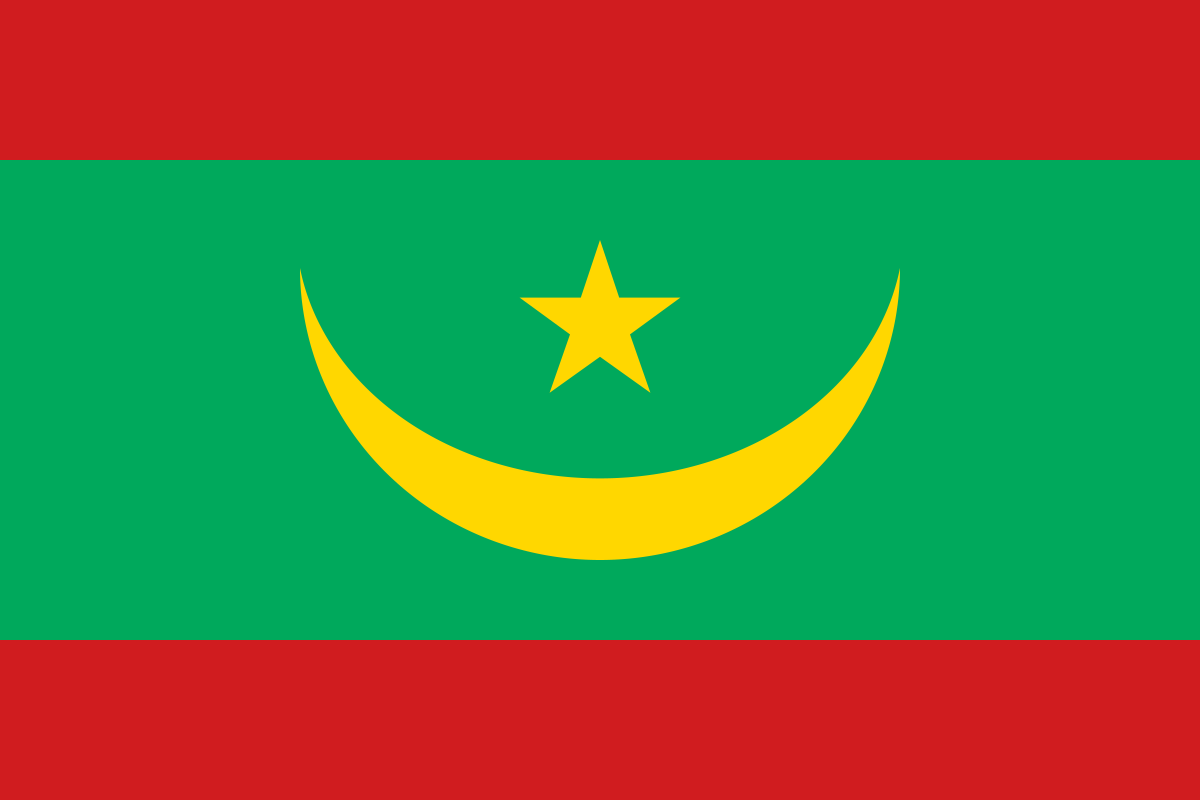
- Capital
- Nouakchott
- Population
- 4,927,532
- Region
- Africa · Western Africa
- Demonym
- Mauritanian
- Currencies
- MRU (UM)
- Languages
- Arabic
- Calling code
- +222
- Drives on
- Right
- Gini
- 32.6 (2014)
- FIFA code
- MTN
- TLD
- .mr
- Timezones
- UTC
- Borders
- DZA, MLI, SEN, ESH
via REST Countries
Indicators · World Bank
- GDP
- $10.9B(2024)
- Population
- 5,169,395(2024)
- Life expectancy
- 68.7 yrs(2024)
- Unemployment
- 10.3 %(2025)
- Urban population
- 60.6 %(2024)
- Internet users
- 45.8 %(2024)
- Forest area
- 0.3 %(2023)
- Renewable energy
- 19.6 %(2022)
via World Bank Open Data · CC BY 4.0
Air quality
- PM2.5
- 44.7 µg/m³
- PM10
- 101.5 µg/m³
Wikipedia views (30d)
109,825 totalvia Wikimedia Pageviews API
Key facts
- Country.conventional_long_name
- Islamic Republic of Mauritania
- Country.common_name
- Mauritania
- Country.image_flag
- Flag of Mauritania.svg
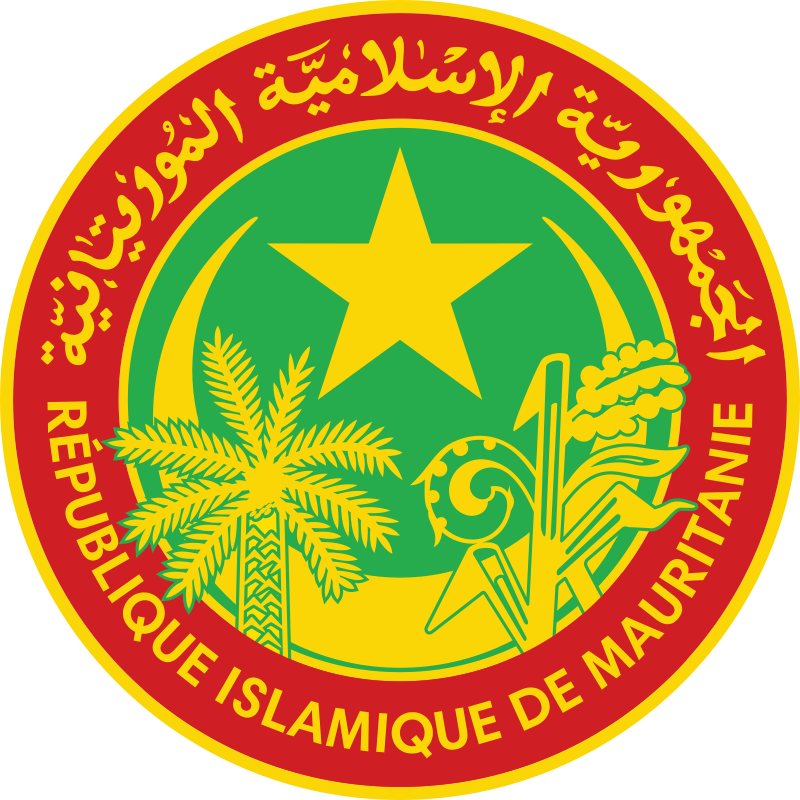
- Country.image_coat
- Seal of Mauritania (2018).svg
- Country.coa_size
- 90
- Country.symbol_type
- Seal
- Country.national_motto
- "Honour, Fraternity, Justice"
- Country.national_anthem
- "National Anthem of Mauritania"
- Country.capital
- Nouakchott
- Country.largest_city
- capital
- Country.official_languages
- Arabic
- Country.languages_type
- Recognised national languages
- Country.demonym
- Mauritanian
- Country.government_type
- Unitary semi-presidential Islamic republic
- Country.leader_title1
- President
- Country.leader_name1
- Mohamed Ould Ghazouani
- Country.leader_title2
- Prime Minister
- Country.leader_name2
- Mokhtar Ould Djay
via Wikipedia infobox
Research
1,233 papers- Malaria prevalence in Mauritania: a systematic review and meta-analysis.Malaria journal · 2023El Moustapha I, Ouldabdallahi Moukah M, Ould Ahmedou Salem MS et al.DOI: 10.1186/s12936-023-04569-4
- Crimean-Congo Hemorrhagic Fever, Mauritania.Emerging infectious diseases · 2020Boushab BM, Kelly M, Kébé H et al.DOI: 10.3201/eid2604.191292
- Mauritania.Department of State publication. Background notes series · 1992United States. Department of State. Bureau of Public Affairs. Office of Public Communication
- Mauritania.Department of State publication. Background notes series · 1987United States. Department of State. Bureau of Public Affairs
- [Mauritania].Jeune Afrique (Paris, France : 1980) · 1996
- Mauritania.Population today · 1989De Sherbinin A
- Conditions for health system resilience in the response to the COVID-19 pandemic in Mauritania.ReviewBMJ global health · 2023Accoe K, Criel B, Ag Ahmed MA et al.DOI: 10.1136/bmjgh-2023-013943
- Malaria in Mauritania: retrospective and prospective overview.ReviewMalaria journal · 2015Lekweiry KM, Salem MS, Basco LK et al.DOI: 10.1186/s12936-015-0607-5
via PubMed
Wikidata facts
- Instance of
- country
- Named after
- Mauretania
- Official name
- الجمهورية الإسلامية الموريتانية
- Demonym
- Máratánach
- Country
- Mauritania
- Contains
- Adrar
- Continent
- Africa
- Capital
- Nouakchott
- Official language
- Arabic
- Currency
- Mauritanian ouguiya
- Population
- 4736139
- Area
- 1030700
- Body of water
- Atlantic Ocean
- Head of government
- Moctar Ould Djay
- Head of state
- Mohamed Ould Ghazouani
- Legislature
- National Assembly
- Shares border with
- Francoist Spain
- Highest point
- Kediet ej Jill
- Image
- Flag map of Mauritania.svg
- Life expectancy
- 63.238
- Nominal GDP
- 10375460680
- Unemployment rate
- 31
- Calling code
- +222
Show 59 more facts
- Licence plate code
- RIM
- Electrical plug type
- Europlug
- Mains voltage
- 220
- Motto
- Honneur, Fraternité, Justice
- Coat of arms
- Seal of Mauritania
- top-level Internet domain
- .mr
- Commons category
- Mauritania
- member of
- African Continental Free Trade Area
- topic's main category
- Category:Mauritania
- category for people born here
- Category:Births in Mauritania
- category for films shot at this location
- Category:Films shot in Mauritania
- category of associated people
- Category:Mauritanian people
- Commons gallery
- موريتانيا / Mauritanie
- lowest point
- Sebkha de Ndrhamcha
- mobile country code
- 609
- driving side
- right
- geography of topic
- Geography of Mauritania
- age of majority
- 18
- marriageable age
- 18
- topic's main Wikimedia portal
- Portal:Mauritania
- short name
- RIM
- diplomatic relation
- Germany
- office held by head of state
- President of Mauritania
- category for people who died here
- Category:Deaths in Mauritania
- history of topic
- history of Mauritania
- number of out-of-school children
- 482365
- located in/on physical feature
- North Africa
- total fertility rate
- 4.603
- maritime identification digits
- 654
- inception
- 1960-11-28
- Unicode character
- 🇲🇷
- replaces
- French West Africa
- central bank
- Central Bank of Mauritania
- language used
- Malay
- VAT rate
- 14
- BTI Status Index
- 4.3
- BTI Governance Index
- 4
- economy of topic
- economy of Mauritania
- demographics of topic
- demographics of Mauritania
- native label
- Moritani Silaamin Jamaane
- different from
- Mauretania
- madhhab
- Malikism
- Democracy Index
- 3.92
- Human Development Index
- 0.556
- P11012
- France Prešeren
- hashtag
- Mauritania
- on focus list of Wikimedia project
- Wikipedia:Vital articles/Level/4
- Happy Planet Index score
- 34.7
- Gini coefficient
- 32.6
- Inequality-adjusted Human Development Index
- 0.389
- P12749
- Liguria
- birth rate
- 32.953
- male population
- 2321228
- death rate
- 7.203
- rural population
- 2040187
- female population
- 2414911
- urban population
- 2695952
Sources (15)
via Wikidata · CC0
Travel guide
Understand
Southwestern Mauritania was once home to the Ghana Empire, one of the earliest urbanised civilisations to emerge in western Africa, with its capital at Koumbi Saleh. Mauritania is an Islamic Republic, and the people in the North have a reputation as being very conservative and quite reserved. The southern part of the country is filled with friendly people, and they are very welcoming, if a little unused to tourists. For people from outside the Maghreb there is a risk of kidnapping, especially in the more remote northern and eastern parts. Travelling to Mauritania is becoming easier, with charter flights from France to Atar through the winter. Guides and tourist agencies are quite easy to find.
Get in
thumb|375px|A map showing the visa requirements of Mauritania, with countries in green having visa-free access.
Get around
thumb|The train snakes through the Mauritanian desert.
Make sure to have plenty of passport copies for travelling between towns. It’s not uncommon to give away up to 5-10 passport copies a day to police at checkpoints.
See
thumb|Great Friday mosque in [[Chinguetti.]] The Adrar massif in the north is full of stunning desert scenery. Take a 4x4 off-piste across rocky terrain and through narrow canyons to explore the lush, hidden oases which have provided water and refuge to traders crossing the Sahara for centuries. The Adrar contains two of the country's magnificent historical cities. Chinguetti was once a trading centre and centre of Islamic scholarship whose architecture remains unchanged in nearly a millennium. Along with Ouadane and a few other small towns, it is a UNESCO World Heritage Site. And do not miss the world's longest train either just for a glimpse or to hop into an iron ore car filled with Mauritanians for the 12-hour journey from the Adrar to the coast. The remains of the Almoravid capital Azoughui, and rock paintings, are draws of the Adrar. thumb|Ancient city of Ouadane Much of the central coastline is part of Parc National du Banc d'Arguin, home to millions of migrating birds each year. At Nouamgar, you can watch the unique spectacle of local tribesmen communicating with dolphins to round up teams of fish into shallow waters for them to be netted.
In the southeast, the oasis city of Oualata was the southern end of most trans-Sahara trading routes in the 13th & 14th centuries. The city has colourful buildings, many of which feature intricate geometric designs. The city is a UNESCO World Heritage Site and also boasts a manuscript museum with examples of ancient scrolls in fine…
Do
Visiting the Hamoni library in Chinguetti
Eat
thumb|A woman with a plate of camel couscous sure to delight your taste buds! Mauritanian cuisine is often overlooked in favour of the more recognisable cuisines of North Africa and the Middle East. Don't let that stop you from fully experiencing Mauritanian gastronomy; Mauritanian cuisine is a unique blend of flavours and incorporates African, Arab, and French influences.
There is a decent variety of restaurants in Nouakchott with dishes costing from UM100 to 250. Most restaurants in the capital offer much the same menu - simple pizzas, hamburgers, sandwiches and salads. There is a string of restaurants on the road from the Stade Olympique to the French Embassy. Good ones include Pizza Lina, Café Liban and Le Petit Café. The Sahara Café, on the other side of the stadium, is also a good place for pizza, sandwiches or Lebanese dishes, and has some of the best reasonably-priced food in town. Near Marche Capitale, there is a street of sandwich shops that offer near-identical menus, the best of which is the Prince (which taxi drivers know by name). thumb|Tea time at home. Outside of Nouakchott, it is possible to find a hamburger in Atar. Otherwise, the choice is local dishes: fish and rice (chebujin) in the south and rice and meat or couscous in the north. Hole-in-the-wall restaurants can be found everywhere and serve meals from UM 20-50. Mechui, or grilled sheep, is also delicious if a little more expensive. Look for carcasses hanging by the side of the road. Some fruit can be…
Drink
Despite being an Islamic country there are a few fun bars in the capital. Drinking can be expensive, with a beer costing up to US$6. There is a nightclub inside the French Embassy compound. For the non-French, try the Salamander or the trashy (but open late) Club VIP. Next door to VIP is the Casablanca, a more low-key bar with live music on the weekends. It is illegal to import alcohol beyond 0.5 litres, which must be declared.
Sleep
All ranges of accommodation are available, with the highest class hotels available only in Nouakchott and Atar. "Auberges" and campsites can rent beds/mattresses for as little as UM 150 in the Adrar and Nouadhibou.
There is usually at least one hotel in the regional capitals in the rest of the country, although they can be expensive for what you are getting. If possible, make friends with a local and try to get invited to stay with their family. As long as you don't mind sleeping on the ground on a foam mat, sleeping/eating near animals or using a latrine, you will probably end up having a pleasant and memorable stay.
Stay safe
thumb|Fishing boats in Banc d'Arguin National Park The area near Western Sahara is heavily mined, and travel through this area is highly inadvisable. Border areas lining Algeria and Mali are notorious for banditry. The single paved road coming from Morocco is perilous, having been the site of Al Qaeda in the Islamic Maghreb (AQIM) kidnappings. If you must travel on this path, it is best to do so in a tight caravan. In other areas, one should avoid flaunting wealth or expensive wares. Daunting though it may seem, a bit of research and common sense will ensure a pleasant trip in Mauritania.
Check your embassy or consulate travel advisories carefully. Due to attacks on Westerners, most Western nations advise great caution. Resident expatriates travel between cities by day, in groups and on major routes.
There are certain parts of Mauritania that have been closed to tourists by the Mauritanian armed forces (usually in the eastern and northern portions of the country). Most of these places have little to offer/interest tourists, but occasionally historic sites like Chinguetti or Ouadane are included. Check what regions are closed before you plan your trip.
Stay healthy
For the majority of Westerners, the local water in any part of the country (including Nouakchott) is not safe to drink. Visitors should drink only bottled water if they don't have access to some type of water purifying or filtration system. The Sahara is a very dry climate. You may become dehydrated quite easily, and not be aware of it. The best rule of thumb is to be sure that you have urinated three times each day, at reasonable intervals. In the hottest part of the year, this might mean drinking several litres of water each day.
Malaria is endemic in the southern part of the country, and visitors should always use a mosquito net there. Mosquitoes are less common in the dry desert in the north of the country, but exist year-round in the south, if a bit less prevalent during the dry season (December-May).
Travel guide from Wikivoyage (CC BY-SA 4.0)
~40 min read
Encyclopedic overview
45 sectionsContents
- Etymology
- History
- Early history
- Colonial history
- Conflict with Western Sahara
- Ould Daddah era (1960–1978)
- CMRN and CMSN military governments (1978–1984)
- Ould Taya's rule (1984–2005)
- August 2005 military coup
- 2007 presidential elections
- 2008 military coup
- 2008–2018
- 2019–present
- Geography
- Wildlife
- Government and politics
- Military
- Administrative divisions
- Economy
- Demographics
- Largest cities
- Religion
- Languages
- Health
- Education
- Human rights
- Modern slavery
- Culture
- Traditional arts and handicrafts
- Music
- Cinema and media
- Literature
- Sports
- Cuisine
- See also
- References
- Citations
- General and cited references
- Explanatory notes
- Further reading
- External links
- Government
- History
- Tourism
- Maps
Mauritania, officially the Islamic Republic of Mauritania, is a country in Northwest Africa. It is bordered by the Atlantic Ocean to the west, Western Sahara to the north and northwest, Algeria to the northeast, Mali to the east and southeast, and Senegal to the southwest. By land area Mauritania is the 11th-largest country in Africa and the 28th-largest in the world; 90% of its territory is in the Sahara desert. Most of its population of some 4.3 million live in the temperate south of the country; roughly a third of the population is concentrated in the capital and largest city, Nouakchott, on the Atlantic coast.
The country's name derives from Mauretania, the Latin name for a region in the ancient Maghreb. It extended from central present-day Algeria to the Atlantic. Berbers occupied what is now Mauritania by the beginning of the 3rd century CE. Groups of Arab tribes migrated to this area in the late 7th century, bringing with them Islam, Arab culture, and the Arabic language. In the early 20th century, Mauritania was colonized by France as part of French West Africa. It achieved independence in 1960. However, the country has since experienced recurrent coups and periods of military dictatorship. The 2008 Mauritanian coup d'état was led by General Mohamed Ould Abdel Aziz, who won subsequent presidential elections in 2009 and 2014. He was succeeded by General Mohamed Ould Ghazouani following the 2019 elections, in what was considered the country's first peaceful transition of power since independence. Mauritania has a poor human rights record, particularly because of its perpetuation of slavery; the 2018 Global Slavery Index estimates there are about 90,000 slaves in the country (or 2.1% of the population).
Excerpted from Wikipedia’s “Mauritania” article, available under the CC BY-SA 4.0 licence.
Gallery (39)
On the map
4 mapped locations
Available in 252 languages
- Español
- Français
- Deutsch
- 中文
- 日本語
- Русский
- Português
- Italiano
- العربية
- हिन्दी
- Abkhazian
- Achinese
- Adyghe
- Afrikaans
- Akan
- Albanian
- Albanian
- Amharic
Show 233 more
- ami
- Angika
- Aragonese
- Aramaic
- Armenian
- Arpitan
- Asturian
- azb
- Azerbaijani
- Bahasa Indonesia
- Balinese
- Bambara
- Bangla
- Banjar
- Bashkir
- Basque
- bat_smg
- Bavarian
- be_x_old
- Belarusian
- Betawi
- Bhojpuri
- Bikol
- Bishnupriya
- Bislama
- Bosnian
- Breton
- Bulgarian
- Buriat
- Burmese
- Catalan
- cbk_zam
- cdo
- Cebuano
- Central Kurdish
- Chechen
- Chuvash
- Cornish
- Corsican
- Crimean Tatar
- Croatian
- Czech
- dag
- Danish
- Divehi
- dty
- Egyptian Arabic
- Esperanto
- Estonian
- Ewe
- Extremaduran
- Faroese
- Fiji Hindi
- Filipino
- Finnish
- fiu_vro
- Fon
- Frafra
- Fula
- Gagauz
- Galician
- Ganda
- gcr
- Georgian
- Gilaki
- Gorontalo
- gpe
- Greek
- Guarani
- Haitian Creole
- Hakka Chinese
- Hausa
- Hawaiian
- Hebrew
- Hungarian
- Icelandic
- Ido
- Igbo
- Iloko
- Inari Sami
- Interlingua
- Interlingue
- Irish
- Jamaican Creole English
- Javanese
- Kabyle
- kai
- Kannada
- Kanuri
- Kara-Kalpak
- Karachay-Balkar
- Kazakh
- kbp
- kge
- Khmer
- Kikuyu
- Kinyarwanda
- Kongo
- Kotava
- Kurdish
- Kyrgyz
- Ladino
- Latin
- Latvian
- Lezghian
- Ligurian
- Limburgish
- Lingala
- Lingua Franca Nova
- Lithuanian
- lld
- Lombard
- Low German
- Lower Sorbian
- Luxembourgish
- Macedonian
- Madurese
- Malagasy
- Malay
- Malayalam
- Maltese
- Manipuri
- Manx
- Māori
- Marathi
- Mazanderani
- Minangkabau
- Mingrelian
- Mirandese
- Moksha
- Mongolian
- Moroccan Arabic
- N’Ko
- Navajo
- nds_nl
- Nederlands
- Nepali
- Newari
- Northern Frisian
- Northern Sami
- Northern Sotho
- Norwegian
- Norwegian Nynorsk
- Novial
- nup
- Obolo
- Occitan
- Old English
- olo
- Oromo
- Ossetic
- Pampanga
- Papiamento
- Pashto
- Piedmontese
- Polski
- Punjabi
- Quechua
- Romanian
- Samoan
- Sango
- Sanskrit
- Santali
- Sardinian
- Saterland Frisian
- Scots
- Scottish Gaelic
- Serbian
- Serbian (Latin)
- Shan
- Shona
- Sicilian
- Silesian
- simple
- Sindhi
- Sinhala
- Slovak
- Slovenian
- Somali
- Southern Sotho
- Standard Moroccan Tamazight
- Sundanese
- Svenska
- Swahili
- Swati
- szy
- Tachelhit
- Tajik
- Talysh
- Tamil
- Taroko
- Tatar
- tay
- Telugu
- Tibetan
- Tiếng Việt
- Tigrinya
- Toki Pona
- Tsonga
- Tumbuka
- Türkçe
- Turkmen
- Udmurt
- Ukrainian
- Upper Sorbian
- Urdu
- Uyghur
- Uzbek
- Venetian
- Veps
- Volapük
- Walloon
- Waray
- Welsh
- Western Frisian
- Western Mari
- Western Panjabi
- Wolof
- Wu Chinese
- Xhosa
- Yakut
- Yiddish
- Yoruba
- Zaza
- Zeelandic
- zh_classical
- zh_min_nan
- zh_yue
- Zhuang
- Zulu
- فارسی
- ไทย
- 한국어
via Wikidata sitelinks · CC0