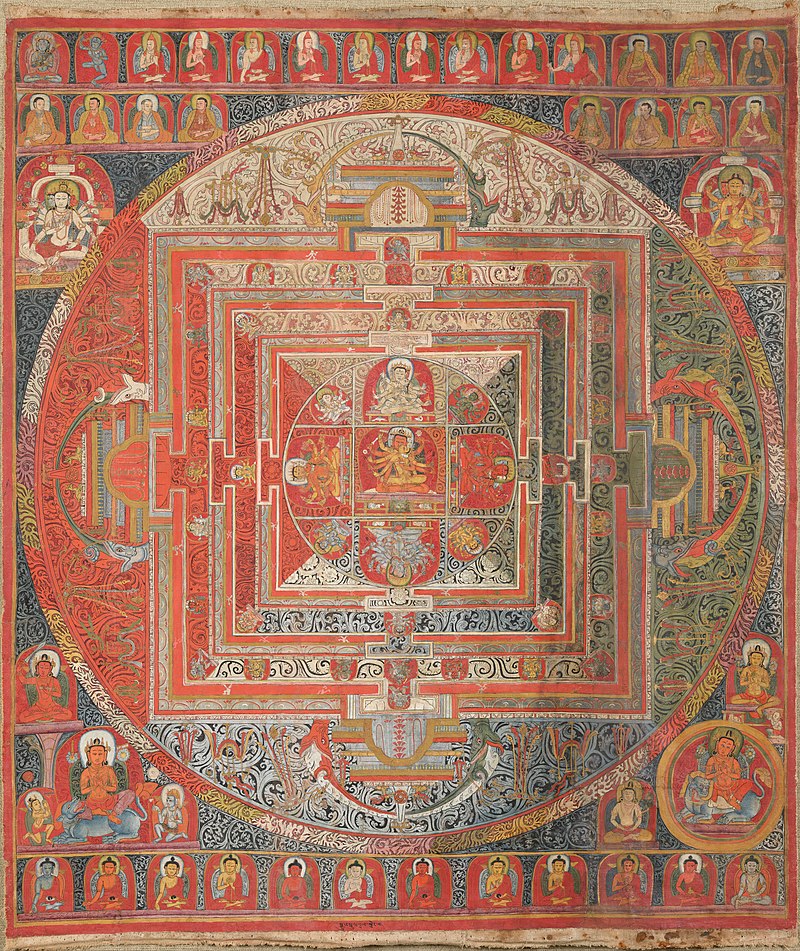
File:Manjuvajramandala_con_43_divinità_-_Unknown_-_Google_Cultural_Institute.jpg · Wikimedia Commons · See Wikimedia Commons
mandala
Sign in to saveupright=1.35|thumb|Thangka painting of Manjuvajra mandala upright=1.35|thumb|The Womb Realm mandala. The center square represents the young stage of Vairocana. He is surrounded by eight Buddhas and [[bodhisattvas (clockwise from top: Ratnasambhava, Samantabhadra, Saṅkusumitarāja, Manjushri, Amitābha, Avalokiteśvara, Amoghasiddhi and Maitreya)]]
A mandala is a geometric design, often circular or square, used in Buddhist art and practice that typically depicts spiritual figures and cosmic realms arranged in a structured pattern. Mandalas serve as visual representations of Buddhist cosmology and as meditation focuses to help practitioners deepen their spiritual understanding and practice.
AI-generated from the Wikipedia summary — may contain errors.
Wikidata facts
- Instance of
- symbol
- Image
- Mandala Bellamy.JPG
Show 6 more facts
- native label
- 취집
- Commons category
- Mandalas
- facet of
- Hinduism
- topic's main category
- Category:Mandalas
- Commons gallery
- Mandala
- different from
- mancala
via Wikidata · CC0
~23 min read
Encyclopedic overview
28 sectionsContents
- Hinduism
- Buddhism
- Vajrayana
- Visualisation of Vajrayana teachings
- Mount Meru
- Wisdom and impermanence
- Five Buddhas
- Practice
- Offerings
- Theravada Buddhism
- Shingon Buddhism
- Nichiren Buddhism
- Pure Land Buddhism
- Bodhimandala
- Sand mandalas
- Western psychological interpretations
- In architecture
- In science
- In art
- In archaeology
- In politics
- In contemporary use
- Gallery
- See also
- Citations
- General sources
- Further reading
- External links
upright=1.35|thumb|Thangka painting of Manjuvajra mandala upright=1.35|thumb|The Womb Realm mandala. The center square represents the young stage of Vairocana. He is surrounded by eight Buddhas and [[bodhisattvas (clockwise from top: Ratnasambhava, Samantabhadra, Saṅkusumitarāja, Manjushri, Amitābha, Avalokiteśvara, Amoghasiddhi and Maitreya)]]
A mandala (, ) is a geometric configuration of symbols. In various spiritual traditions, mandalas may be employed for focusing attention of practitioners and adepts, as a spiritual guidance tool, for establishing a sacred space and as an aid to meditation and trance induction. In the Eastern religions of Hinduism, Buddhism, Jainism and Shinto it is used as a map representing deities, or especially in the case of Shinto, paradises, kami or actual shrines.
Excerpted from Wikipedia’s “mandala” article, available under the CC BY-SA 4.0 licence.
Gallery (36)
Available in 62 languages
- Español
- Français
- Deutsch
- 中文
- 日本語
- Русский
- Português
- Italiano
- العربية
- हिन्दी
- Afrikaans
- Armenian
- Assamese
- Azerbaijani
- Bahasa Indonesia
- Bangla
- Banjar
- Basque
Show 43 more
- Belarusian
- Bulgarian
- Catalan
- Czech
- Danish
- Esperanto
- Estonian
- Finnish
- Galician
- Georgian
- Hebrew
- Hungarian
- hyw
- Javanese
- Kannada
- Kazakh
- Kikuyu
- Latvian
- Lithuanian
- Lombard
- Luxembourgish
- Malay
- Nederlands
- Norwegian
- Polski
- Punjabi
- Romanian
- Serbian
- simple
- Slovak
- Slovenian
- Sundanese
- Svenska
- Tibetan
- Tiếng Việt
- Türkçe
- Ukrainian
- Urdu
- Welsh
- Western Frisian
- فارسی
- ไทย
- 한국어
via Wikidata sitelinks · CC0