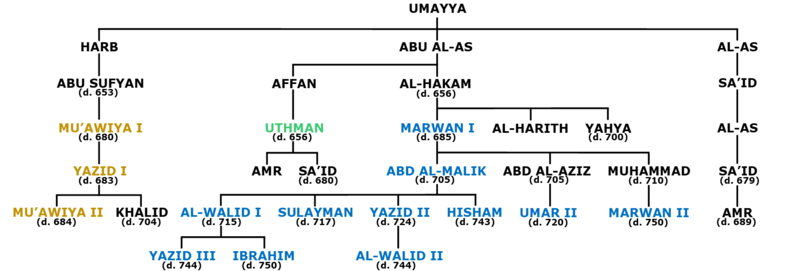
File:Abbreviated_Umayyad_Family_Tree.png · Wikimedia Commons · See Wikimedia Commons
Marwan I
Sign in to saveFourth Umayyad caliph from 684 to 685
OverviewAI-generated
Marwan I (623–685) was an Arab politician and caliph of the Umayyad Caliphate. Born in Mecca, he served as a wali and held the position of Governor of Madina. He was a member of the companions of the Prophet and practiced Islam. Marwan I participated in the Battle of the Camel, the Battle of al-Harrah, and the Battle of Marj al-Rahit. He died in Damascus.
His father was Al-Hakam ibn Abi al-As. Marwan I was married to Fakhitah bint Abi Hashim and Umme Muhammad binte Abdullah. Their children included Abd al-Malik ibn Marwan, Abd al-Aziz ibn Marwan, Bishr ibn Marwan, and Muhammad ibn Marwan. He had siblings Al-Harith ibn al-Hakam and Yahya ibn al-Hakam. Other relatives included Khalid ibn Yazid and Marwan II.
Synthesized by Vinony from 31 facts across 5 sources: Wikidata, Crossref, Open Library, MusicBrainz, Vinony graph. Generated from structured data (not the Wikipedia text) and checked against those facts — may still contain errors.
Wikidata facts
- Instance of
- human
- Part of
- companions of the Prophet
- Gender
- male
- Citizenship
- Umayyad Caliphate
- Place of birth
- Mecca
- Place of death
- Damascus
- Father
- Al-Hakam ibn Abi al-As
- Occupation
- caliph
- Position held
- Governor of Madina
- Languages spoken
- Arabic
- Religion
- Islam
- Family
- Umayyad dynasty
- Conflict
- Battle of Marj al-Rahit
- Image
- مروان بن الحكم.png
Show 6 more facts
- date of birth
- 0623-03-28
- date of death
- 0685-05-07
- ethnic group
- Arabs
- name in native language
- مروان بن الحكم
- described by source
- Brockhaus and Efron Encyclopedic Dictionary
- relative
- Khalid ibn Yazid
via Wikidata · CC0
~34 min read
Encyclopedic overview
Marwan ibn al-Hakam ibn Abi al-As ibn Umayya (Arabic: مروان بن الحكم بن أبي العاص بن أمية, romanized: Marwān ibn al-Ḥakam ibn Abī al-ʿĀṣ ibn Umayya; 623 or 626 – April/May 685), commonly known as Marwan I, was the fourth Umayyad caliph, ruling for less than a year in 684–685. He founded the Marwanid ruling house of the Umayyad dynasty, which replaced the Sufyanid house after its collapse in the Second Fitna and remained in power until 750.
During the reign of his cousin, the third Rashidun caliph Uthman (r. 644–656), Marwan took part in a military campaign against the Byzantine exarchate of Africa (in central North Africa), where he acquired significant war spoils. He also served as Uthman's governor in Fars (southwestern Iran) before becoming the caliph's katib (secretary or scribe). He was wounded fighting the rebel siege of Uthman's house, in which the caliph was slain. In the ensuing civil war between the fourth Rashidun caliph Ali (r. 656–661) and the largely Qurayshite partisans of Aisha, Marwan sided with the latter at the Battle of the Camel. Marwan later served as governor of Medina under his distant kinsman Mu'awiya I (r. 661–680), founder of the Umayyad Caliphate. During the reign of Mu'awiya's son and successor Yazid I (r. 680–683), Marwan organized the defense of the Umayyad realm in the Hejaz (western Arabia) against the local opposition, which included prominent companions of Muhammad as well as Muhammad's own clan, the Banu Hashim, who revolted under the banner of Muhammad’s grandson, Husayn ibn Ali. After Yazid died in November 683, Abd Allah ibn al-Zubayr, a Mecca-based rebel and companion of Muhammad, declared himself Caliph and expelled Marwan, who took refuge in Syria, the center of Umayyad rule. With the death of the last Sufyanid caliph Mu'awiya II in 684, Marwan, encouraged by the ex-governor of Iraq Ubayd Allah ibn Ziyad, volunteered his candidacy for the caliphate during a summit of pro-Umayyad tribes in Jabiya. The tribal nobility, led by Ibn Bahdal of the Banu Kalb, elected Marwan and together they defeated the pro-Zubayrid Qays tribes at the Battle of Marj Rahit in August of that year.
Excerpted from Wikipedia’s “Marwan I” article, available under the CC BY-SA 4.0 licence.