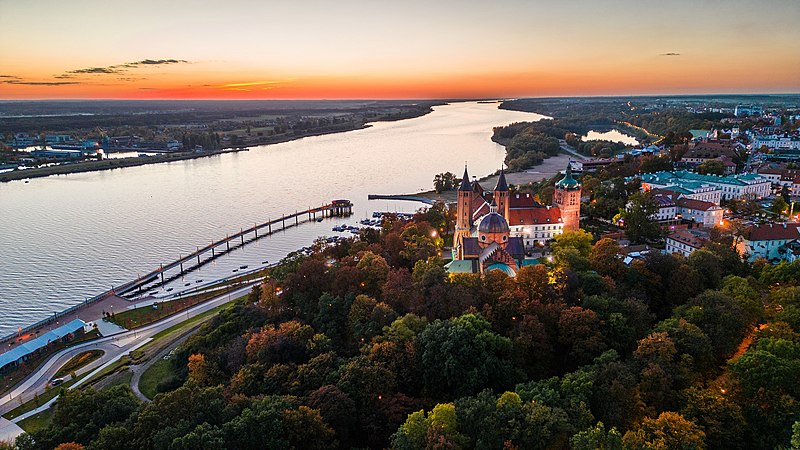
File:Płock_panorama.jpg · Wikimedia Commons · See Wikimedia Commons
Masovia
Sign in to saveMazovia or Masovia ( ) is a historical region in mid-north-eastern Poland. It spans the North European Plain, roughly between Łódź and Białystok, with Warsaw being the largest city and Płock being the capital of the region. Throughout the centuries, Mazovia developed a separate sub-culture featuring diverse folk songs, architecture, dress and traditions different from those of other Poles.
Key facts
- Settlement.native_name
- Mazowsze
- Settlement.native_name_lang
- pl
- Settlement.settlement_type
- Historical region
- Settlement.image_map
- Mazowieckie płockie rawskie.png
- Settlement.map_caption
- Three historical Mazovian voivodeships in comparison with contemporary Polish voivodeships
- Settlement.image_shield
- POL województwo mazowieckie IRP COA.svg
- Settlement.subdivision_type
- Country
- Settlement.seat_type
- Largest city
- Settlement.seat
- Warsaw
- Settlement.timezone
- CET
- Settlement.utc_offset
- +1
- Settlement.timezone_DST
- CEST
- Settlement.utc_offset_DST
- +2
- Settlement.blank_name_sec2
- Primary airports
- Settlement.blank_info_sec2
- Warsaw Chopin AirportWarsaw Modlin Airport
- Settlement.blank1_name_sec2
- Highways
- Settlement.blank1_info_sec2
- 32px|link=A2 autostrada (Poland) 32px|link=Expressway S7 (Poland) 32px|link=Expressway S8 (Poland) 32px|link=Expressway S17 (Poland) 32px|link=Expressway S61 (Poland)
via Wikipedia infobox
Wikidata facts
- Instance of
- historical region
- Country
- Poland
- Located in
- Masovian Voivodeship
- Capital
- Płock
- Image
- Płock panorama.jpg
Show 3 more facts
- Commons category
- Masovia
- topic's main category
- Category:Mazovia
- P8168
- Mycena epipterygia
via Wikidata · CC0
~21 min read
Encyclopedic overview
16 sectionsContents
- Geography
- History
- Middle Ages
- Modern period
- World War II
- Recent history
- Culture
- Mazovian dialect
- Local cuisine
- Economy
- Tourism
- Sports
- Main cities and towns
- See also
- External links
- References
Mazovia or Masovia ( ) is a historical region in mid-north-eastern Poland. It spans the North European Plain, roughly between Łódź and Białystok, with Warsaw being the largest city and Płock being the capital of the region. Throughout the centuries, Mazovia developed a separate sub-culture featuring diverse folk songs, architecture, dress and traditions different from those of other Poles.
Historical Mazovia existed from the Middle Ages until the partitions of Poland and consisted of three voivodeships with the capitals in Warsaw, Płock, and Rawa. The main city of the region was Płock, which was even the capital of Poland from 1079 to 1138; however, in Early Modern Times Płock lost its importance to Warsaw, which became the capital of Poland. From 1138, Mazovia was governed by a separate branch of the Piast dynasty. When the last ruler of the independent Duchy of Mazovia died, it was fully incorporated into the Polish Crown in 1526. During the Polish–Lithuanian Commonwealth, over 20% of the Mazovian population was categorized as petty nobility. Between 1816 and 1844, the Mazovian Governorate was established, encompassing the southern part of the region, along with Łęczyca Land and south-eastern Kuyavia. The former inhabitants of Mazovia are the Masurians, who since the Late Middle Ages settled in neighboring southern Prussia, a region later called Masuria, where they converted to Protestantism in the Reformation era, thus leaving Catholicism, to which their relatives from Mazovia still adhered.
Excerpted from Wikipedia’s “Masovia” article, available under the CC BY-SA 4.0 licence.