
File:Max_Ernst_1968.jpg · Wikimedia Commons · See Wikimedia Commons
Max Ernst
Sign in to saveAlso known as Maximilian Ernst, Mx Ernst, Erunsuto, Ernst Max, Max Ernest
German artist (1891–1976)
OverviewAI-generated
Max Ernst (1891–1976) was a male painter, sculptor, poet, and graphic artist associated with the Dada and surrealism movements. Born in Brühl, Germany, he held citizenship in Germany, France, the United States, and Cuba. His notable work includes *The Elephant Celebes*. Ernst was a member of The Blue Rider and the College of 'Pataphysics. He received the Venice Biennale award.
He worked in Cologne, New York City, Paris, and Seillans. His spouses included Peggy Guggenheim and Luise Straus-Ernst, while his unmarried partners included Leonora Carrington, Meret Oppenheim, and Gala Dalí. Ernst spoke German, English, and French. He died in the 7th arrondissement of Paris.
Synthesized by Vinony from 45 facts across 9 sources: Wikidata, Crossref, Open Library, MusicBrainz, Last.fm, Firecrawl, Europeana Sparql, TMDb, Vinony graph. Generated from structured data (not the Wikipedia text) and checked against those facts — may still contain errors.
Person · Open Library
- Born
- 2 April 1891
- Died
- 1 April 1976
- Works
- 153
Top works
- Max Ernst, Druckgrafik
- Histoire naturelle
- Sept microbes
- Max Ernst, lithographies 1966-1976
- 24 Frottagen
via Open Library + Wikidata
Film & TV
Brühl, Germany
Max Ernst was born on April 2, 1891 in Brühl, Germany. He was an actor and writer, known for The Golden Age (1930), Maximiliana oder die widerrechtliche Ausübung der Astronomie (1966) and Dreams That Money Can Buy (1947). He was married to Dorothea Tanning, Peggy Guggenheim, Marie-Berthe Aurenche and Luise Straus. He died on April 1, 1976 in Paris, France.
Known for
- tvSSFBM EHKL — Himself (archive footage)2001
- Max Ernst: My Vagabonds - My Restlessness1991
- Coup de Torchon — Le soldat mexicain (dans le film publicitaire "Galeries Barbès")1981
- Europe After the Rain — Self1978
- Laocoon & Sons: The Story of the Transformation of Esmeralda del Rio1975
- How Many Colours Has a Hand? — Self1971
- Max Ernst, Une Semaine de Bonte — Himself1969
- Die widerrechtliche Ausübung der Astronomie — Self - Narrator (voice)1967
- Max Ernst: Journey into the Subconscious — Self, Narrator1964
- Luis Buñuel : Un cinéaste de notre temps — Self1964
via TMDB
Described at
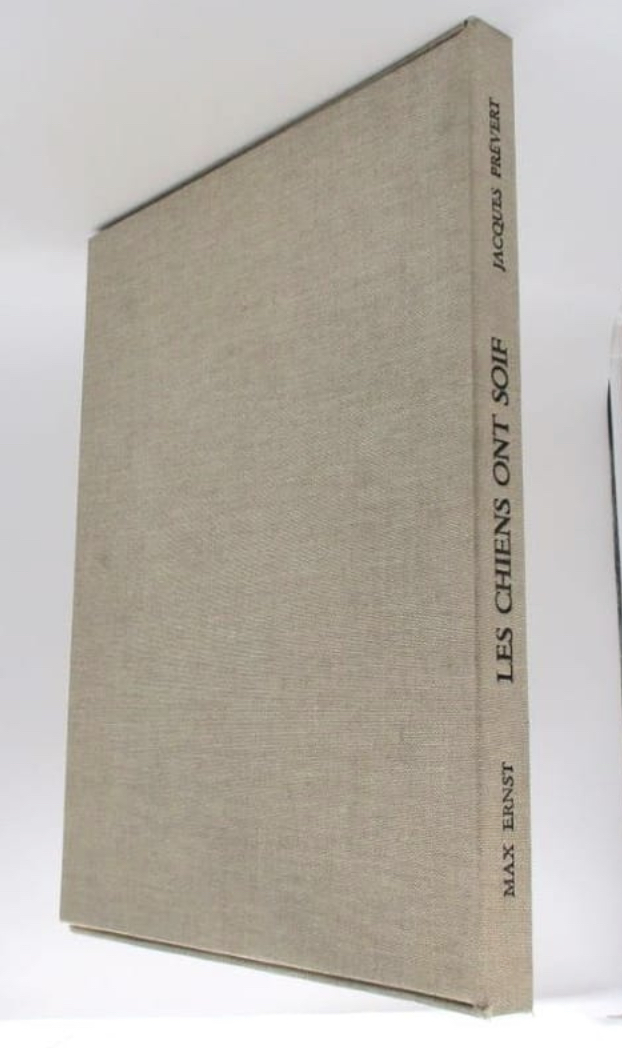
Édition · Max Ernst — 1964 · Au Pont des Arts, Paris.
galerielws.com →Prévert met ici en scène une assemblée d'oiseaux partageant leurs griefs à l'encontre des humains. Il invente des aphorismes d'oiseaux célèbres, à la fois absurdes et drôles mais toujours poétiques. Les Chiens ont soif est le seul livre d'artiste issu de la collaboration de Prévert et d'Ernst. L'édition originale illustrée comporte deux eaux-fortes originales en couleurs signées, accompagnées de vingt-cinq lithographies en couleurs réalisées d’après les dessins originaux de Max Ernst et portées sur pierre par Mourlot.
Excerpt from a page describing this subject · 1,641 chars · not written by Vinony
Wikidata facts
- Instance of
- human
- Family name
- Ernst
- Gender
- male
- Citizenship
- Germany
- Place of birth
- Brühl
- Place of death
- 7th arrondissement of Paris
- Child
- Jimmy Ernst
- Educated at
- University of Bonn
- Languages spoken
- French
- Native language
- French
- Field of work
- collaging
- Genre
- abstract art
- Movement
- surrealism
- Image
- Max Ernst 1968.jpg
- Work location
- Honolulu
Show 13 more facts
- Commons category
- Max Ernst
- date of birth
- 1891-04-02
- date of death
- 1976-04-01
- member of
- College of 'Pataphysics
- topic's main category
- Category:Max Ernst
- unmarried partner
- Gala Dalí
- name in native language
- Max Ernst
- Commons Creator page
- Max Ernst
- place of detention
- Les Milles concentration camp
- writing language
- French
- P8168
- Inverse
- birth name
- Maximilian Maria Ernst
- described at URL
- galerielws.com/editions/aux-petits-agneaux
Sources (15)
via Wikidata · CC0
Works in European collections
11 objects attributed to Max Ernst, held across European museums, libraries & archives · via Europeana

~19 min read
Encyclopedic overview
Max Ernst (/ɜːrnst/; German: [ɛʁnst] 2 April 1891 – 1 April 1976) was a German-born painter, sculptor, printmaker, graphic artist, and poet. A prolific artist, Ernst was a primary pioneer of the Dada movement and surrealism in Europe. He had no formal artistic training, but his experimental attitude toward the making of art resulted in his invention of frottage—a technique that uses pencil rubbings of textured objects and relief surfaces to create images—and grattage, an analogous technique in which paint is scraped across canvas to reveal the imprints of the objects placed beneath. Ernst is noted for his unconventional drawing methods as well as for creating novels and pamphlets using the method of collages. He served as a soldier for four years during World War I, which left him shocked, traumatised and critical of the modern world. During World War II he was designated an "undesirable foreigner" while living in France.
Ernst was born in Brühl. He began painting in 1909 while studying at the University of Bonn, and later joined the Die Rheinischen Expressionisten group of artists. Ernst's work often featured ironic juxtapositions of grotesque elements with cubist and expressionist motifs. He had a fascination with birds, often including his alter ego, Loplop, a bird, in his work. He eventually settled in France and achieved financial success in the 1950s. He died in Paris on 1 April 1976.
Excerpted from Wikipedia’s “Max Ernst” article, available under the CC BY-SA 4.0 licence.
Gallery (10)
Available in 63 languages
- Español
- Français
- Deutsch
- 中文
- 日本語
- Русский
- Português
- Italiano
- العربية
- Afrikaans
- Albanian
- Aragonese
- Armenian
- Bahasa Indonesia
- Basque
- Belarusian
- Bulgarian
- Catalan
Show 44 more
- Croatian
- Czech
- Danish
- Egyptian Arabic
- Esperanto
- Estonian
- Finnish
- Galician
- Georgian
- Greek
- Hebrew
- Hungarian
- Icelandic
- Ido
- Irish
- Latvian
- Lithuanian
- Luxembourgish
- Macedonian
- Mirandese
- Nederlands
- Norwegian
- Norwegian Nynorsk
- Occitan
- Piedmontese
- Polski
- Quechua
- Romanian
- Serbian
- Serbian (Latin)
- Sicilian
- simple
- Slovak
- Svenska
- Tamil
- Tiếng Việt
- Türkçe
- Ukrainian
- Welsh
- Western Panjabi
- Wu Chinese
- فارسی
- ไทย
- 한국어
via Wikidata sitelinks · CC0