File:Melting_icecubes.gif · Wikimedia Commons · See Wikimedia Commons
melting
Sign in to saveAlso known as thawing, fusion, fusing
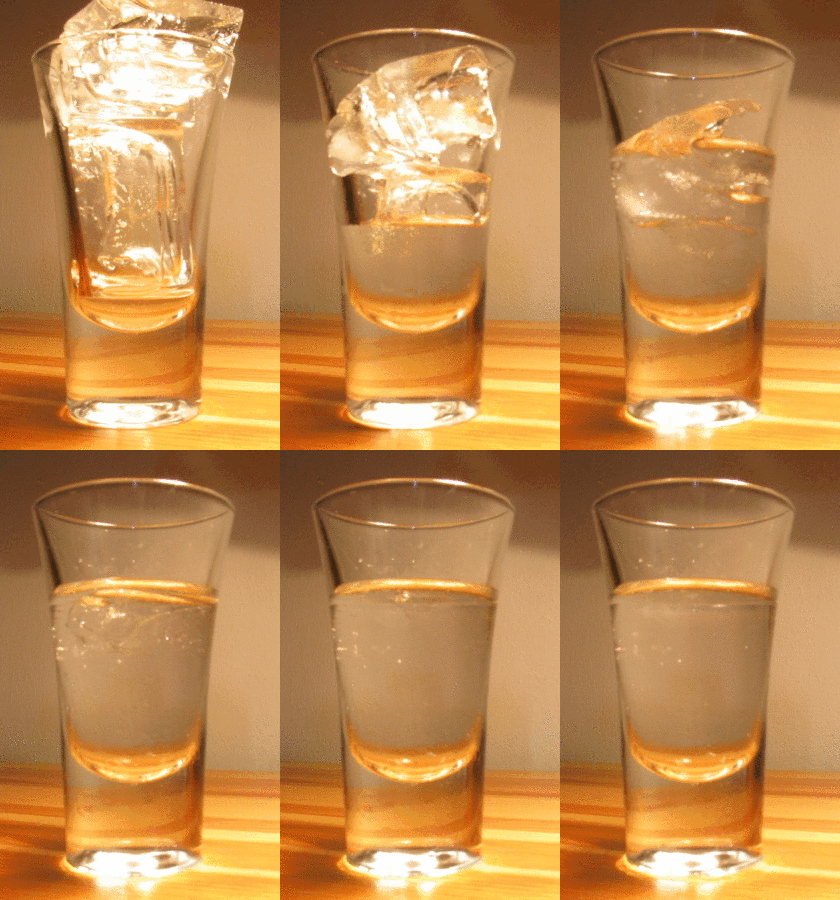
thumb|Melting ice cubes illustrate the process of fusion.|321x321px
Melting is the process by which a solid material, like ice, transforms into a liquid when heat is applied to it. This physical change matters because it affects how substances behave in our environment and is fundamental to many natural processes and human applications.
AI-generated from the Wikipedia summary — may contain errors.
Wikidata facts
- Subclass of
- phase change
- Image
- Phase change - en.svg
Show 8 more facts
- studied by
- thermodynamics
- permanent duplicated item
- melting
- Commons category
- Melting
- opposite of
- freezing
- has characteristic
- melting point
- different from
- smelting
- on focus list of Wikimedia project
- Wikipedia:Vital articles/Level/4
- maintained by WikiProject
- WikiProject Mathematics
via Wikidata · CC0
~6 min read
Encyclopedic overview
9 sectionsContents
- First order phase transition
- Criteria
- Supercooling
- Glasses
- Related concept
- Table
- See also
- References
- External links
thumb|Melting ice cubes illustrate the process of fusion.|321x321px
Melting, or fusion, is a physical process that results in the phase transition of a substance from a solid to a liquid. This occurs when the internal energy of the solid increases, typically by the application of heat or pressure, which increases the substance's temperature to the melting point. At the melting point, the ordering of ions or molecules in the solid breaks down to a less ordered state, and the solid melts to become a liquid.
Excerpted from Wikipedia’s “melting” article, available under the CC BY-SA 4.0 licence.
Gallery (3)
Available in 76 languages
- Español
- Français
- Deutsch
- 中文
- 日本語
- Русский
- Português
- Italiano
- العربية
- हिन्दी
- Albanian
- Angika
- Armenian
- Azerbaijani
- Bahasa Indonesia
- Basque
- Belarusian
- Bikol
Show 57 more
- Bulgarian
- Catalan
- cdo
- Central Kurdish
- Chuvash
- Croatian
- Czech
- Danish
- Erzya
- Esperanto
- Estonian
- Finnish
- Galician
- Greek
- Guarani
- Hebrew
- Hungarian
- Kannada
- Kazakh
- Latin
- Latvian
- Lithuanian
- Low German
- Macedonian
- Malay
- Malayalam
- Nederlands
- Norwegian
- Norwegian Nynorsk
- Occitan
- Oromo
- Piedmontese
- Polski
- Romanian
- Serbian
- Serbian (Latin)
- Shona
- simple
- Slovak
- Slovenian
- Svenska
- Swahili
- Tajik
- Tamil
- Tiếng Việt
- Türkçe
- Ukrainian
- Urdu
- Uzbek
- Walloon
- Waray
- Wu Chinese
- zh_min_nan
- zh_yue
- فارسی
- ไทย
- 한국어
via Wikidata sitelinks · CC0