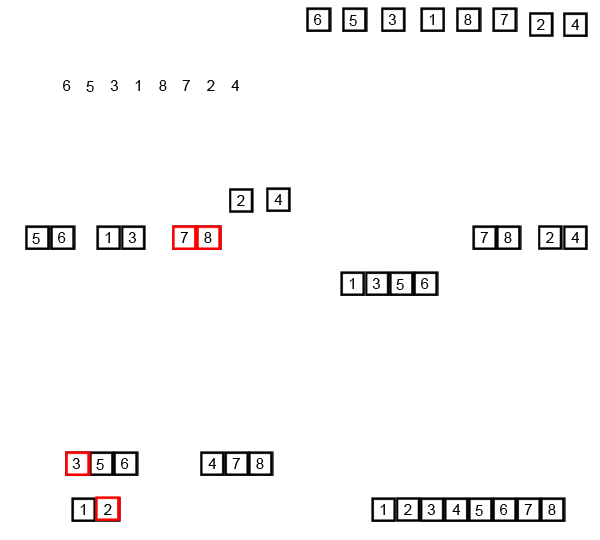
File:Merge-sort-example-300px.gif · Wikimedia Commons · See Wikimedia Commons
merge sort
Sign in to saveAlso known as mergesort, MergeSort
worst-case optimal stable divide and conquer comparison sorting algorithm
Key facts
- Class
- Sorting algorithm
- Data structure
- Array
- Worst case performance
- O ( n log n ) {\displaystyle O(n\log n)}
- Best case performance
- Ω ( n log n ) {\displaystyle \Omega (n\log n)} typical, Ω ( n ) {\displaystyle \Omega (n)} natural variant
- Average performance
- Θ ( n log n ) {\displaystyle \Theta (n\log n)}
- Worst case space complexity
- O ( n ) {\displaystyle O(n)} total with O ( n ) {\displaystyle O(n)} auxiliary, O ( 1 ) {\displaystyle O(1)} auxiliary with linked lists
via Wikipedia infobox
Wikidata facts
- Instance of
- divide-and-conquer algorithm
- Subclass of
- sorting algorithm
- Image
- Merge sort algorithm diagram.svg
Show 7 more facts
- discoverer or inventor
- John von Neumann
- Stack Exchange tag
- stackoverflow.com/tags/mergesort
- uses
- merge algorithm
- Commons category
- Merge sort
- derivative work
- Timsort
- time of discovery or invention
- 1945-00-00
- maintained by WikiProject
- WikiProject Mathematics
via Wikidata · CC0
~36 min read
Encyclopedic overview
In computer science, merge sort (also commonly spelled as mergesort or merge-sort) is an efficient and general purpose comparison-based sorting algorithm. Most implementations of merge sort are stable, which means that the relative order of equal elements is the same between the input and output. Merge sort is a divide-and-conquer algorithm that was invented by John von Neumann in 1945. A detailed description and analysis of bottom-up merge sort appeared in a report by Goldstine and von Neumann as early as 1948.
Algorithm
Excerpted from Wikipedia’s “merge sort” article, available under the CC BY-SA 4.0 licence.