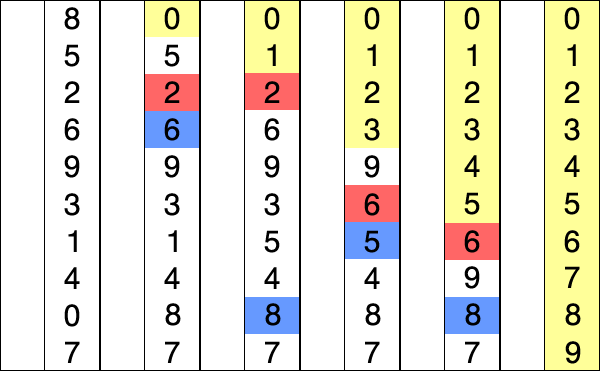
File:Selection-Sort-Animation.gif · Wikimedia Commons · See Wikimedia Commons
Key facts
- Class
- Sorting algorithm
- Data structure
- Array
- Worst case performance
- O ( n 2 ) {\displaystyle O(n^{2})} comparisons, O ( n ) {\displaystyle O(n)} swaps
- Best case performance
- O ( n 2 ) {\displaystyle O(n^{2})} comparisons, O ( 1 ) {\displaystyle O(1)} swap
- Average performance
- O ( n 2 ) {\displaystyle O(n^{2})} comparisons, O ( n ) {\displaystyle O(n)} swaps
- Worst case space complexity
- O ( 1 ) {\displaystyle O(1)} auxiliary
- Optimal
- No
via Wikipedia infobox
Wikidata facts
- Instance of
- comparison sort
Show 4 more facts
- Stack Exchange tag
- stackoverflow.com/tags/selection-sort
- Commons category
- Selection sort
- maintained by WikiProject
- WikiProject Mathematics
Sources (2)
via Wikidata · CC0
~10 min read
Encyclopedic overview
In computer science, selection sort is an in-place comparison sorting algorithm. It has a O(n) time complexity, which makes it inefficient on large lists, and generally performs worse than the similar insertion sort. Selection sort is noted for its simplicity and has performance advantages over more complicated algorithms in certain situations, particularly where auxiliary memory is limited.
The algorithm divides the input list into two parts: a sorted sublist of items which is built up from left to right at the front (left) of the list and a sublist of the remaining unsorted items that occupy the rest of the list. Initially, the sorted sublist is empty and the unsorted sublist is the entire input list. The algorithm proceeds by finding the smallest (or largest, depending on sorting order) element in the unsorted sublist, exchanging (swapping) it with the leftmost unsorted element (putting it in sorted order), and moving the sublist boundaries one element to the right.
Excerpted from Wikipedia’s “selection sort” article, available under the CC BY-SA 4.0 licence.