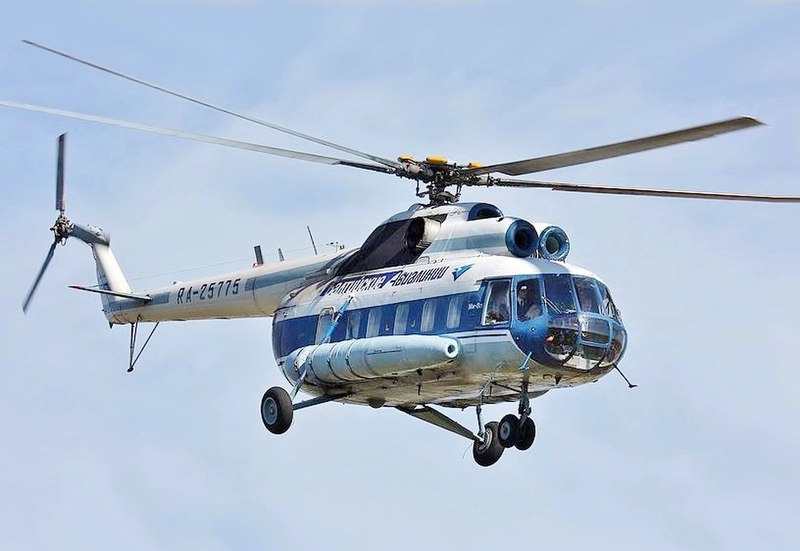
File:Mil_Mi-8P,_Baltic_Airlines_(cropped).jpg · Wikimedia Commons · See Wikimedia Commons
The Mil Mi-8 is a family of transport helicopters that has been widely used for moving cargo and passengers. It matters because it became one of the most commonly deployed helicopters in the world, serving military and civilian needs across many countries.
AI-generated from the Wikipedia summary — may contain errors.
Wikidata facts
- Country
- Djibouti
- Operator
- Afghan Armed Forces
- Country of origin
- Soviet Union
- Developer
- Mil Moscow Helicopter Plant
- Manufacturer
- Ulan-Ude Aviation Plant
- Designed by
- Mikhail Mil
- Image
- Mi-8-JH01.jpg
- Height
- 5.65
- Length
- 18.17
Show 12 more facts
- military designation
- H-40
- first flight
- 1961-07-07
- armament
- 3M11 Falanga
- Commons gallery
- Mil Mi-8
- Commons category
- Mil Mi-8
- powered by
- Klimov TV2-117
- NATO reporting name
- Hip
- service entry
- 1965-00-00
- total produced
- 12000
- derivative work
- Mil Mi-14
- maximum operating altitude
- 4500
- cruise speed
- 230
Sources (8)
via Wikidata · CC0
~29 min read
Encyclopedic overview
The Mil Mi-8 (Russian: Ми-8, NATO reporting name: Hip) is a family of medium twin-turbine helicopters, originally designed by the Soviet Central Aerohydrodynamic Institute (TsAGI) in the 1960s and introduced into the Soviet Air Force in 1968. Russian production of the aircraft model still continues as of 2024. In addition to its most common role as a transport helicopter, the Mi-8 is also used as an airborne command post, armed gunship, and reconnaissance platform.
The Mi-8 is the world's most-produced helicopter, with over 17,000 units used by over 50 countries. As of 2015, when combined with the related Mil Mi-17, the two helicopters are the third most common operational military aircraft in the world.
Excerpted from Wikipedia’s “Mil Mi-8” article, available under the CC BY-SA 4.0 licence.