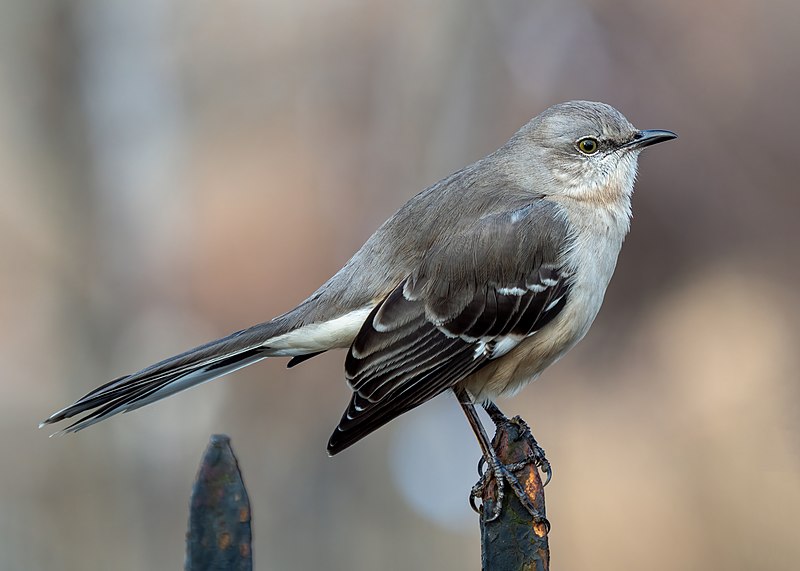
File:Mockingbird_in_Bay_Ridge_(85082).jpg · Wikimedia Commons · See Wikimedia Commons
OverviewAI-generated
Mimus polyglottos, commonly known as the Northern Mockingbird, is a species of bird within the family Mimidae. It belongs to the genus Mimus and is classified under the order Passeriformes, class Aves, phylum Chordata, and kingdom Animalia. The species was described by Linnaeus in 1758. Its IUCN conservation status is listed as Least Concern.
This diurnal bird has a mass of 48. Its main food sources include tomatoes, Araneae, wasps, and bees. Records indicate its presence in the United States and Mexico. The taxon is accepted by WoRMS and has been documented in various institutions, including UTEP, DMNH, MSB, DMNS, and CUMV.
Synthesized by Vinony from 38 facts across 7 sources: Wikidata, GBIF, IUCN Red List, Gbif Occ, WoRMS, iDigBio, Vinony graph. Generated from structured data (not the Wikipedia text) and checked against those facts — may still contain errors.
Species
Least ConcernNorthern mockingbird
SPECIES
- KingdomAnimalia
- PhylumChordata
- ClassAves
- OrderPasseriformes
- FamilyMimidae
via GBIF · IUCN
Museum specimens
- Specimen records
- 4,775
- With media
- 366
- Family
- Mimidae
- Collections
- UTEP, DMNH, MSB, DMNS, CUMV, MLZ
- Recorded in
- United States, Mexico
Bird sounds
- call· United States· quality A
- dawn song, song· United States· quality A
- song· United States· quality A
- song· Mexico· quality A
via Xeno-canto
Wikidata facts
- Instance of
- taxon
- Parent taxon
- Mimus
- Mass
- 48
- Image
- Northern Mockingbird (Mimus polyglottos) - Knoxville, TN.jpg
Show 11 more facts
- taxon rank
- species
- IUCN conservation status
- Least Concern
- taxon name
- Mimus polyglottos
- Commons category
- Mimus polyglottos
- Commons gallery
- Mimus polyglottos
- main food source
- tomato
- taxon common name
- northern mockingbird
- diel cycle
- diurnality
- short name
- M. polyglottos
- described by source
- New International Encyclopedia
- taxon author citation
- (Linnaeus, 1758)
Sources (3)
via Wikidata · CC0
~26 min read
Encyclopedic overview
The northern mockingbird (Mimus polyglottos) is a mockingbird commonly found in North America, of the family Mimidae. The species is also found in some parts of the Caribbean, as well as on the Hawaiian Islands. It is typically a permanent resident across much of its range, but northern mockingbirds may move farther south during inclement weather or prior to the onset of winter. The northern mockingbird has gray to brown upper feathers and a paler belly. Its tail and wings have white patches which are visible in flight.
The species is known for its ability to mimic bird calls and other types of sound, including artificial and electronic noises. Studies have shown its ability to identify individual humans and treat them differently based on learned threat assessments. It is an omnivore and consumes fruit, invertebrates, and small vertebrates. It is often found in open areas, open woodlands and forest edges, and is quite common in urbanized areas. The species breeds from southeastern Canada throughout the United States to the Greater Antilles. It is listed as a species of least concern by the International Union for Conservation of Nature.
Excerpted from Wikipedia’s “Mimus polyglottos” article, available under the CC BY-SA 4.0 licence.