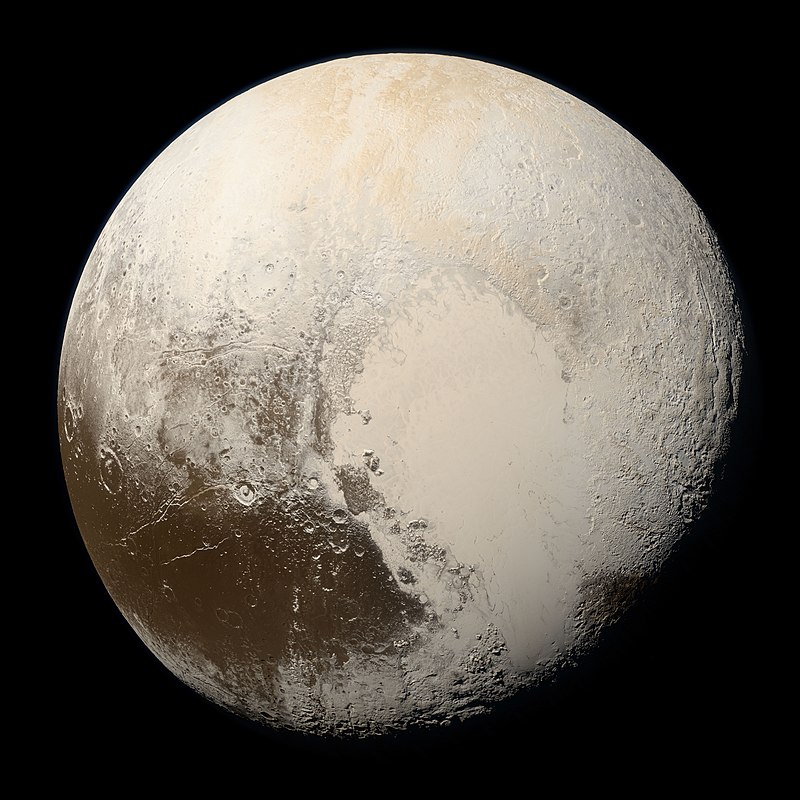
File:Pluto_in_True_Color_-_High-Res.jpg · Wikimedia Commons · See Wikimedia Commons
minor planet
Sign in to saveastronomical object in direct orbit around the Sun that is neither a planet nor a comet
A minor planet is a small rocky object that orbits directly around the Sun, but doesn't qualify as either a planet or a comet. Studying minor planets helps scientists understand the composition and history of our solar system, and tracking their orbits is important for detecting any that might pose a collision risk to Earth.
AI-generated from the Wikipedia summary — may contain errors.
Research
608 papers- Minor planet satellites.Science (New York, N.Y.) · 1981VAN Flandern TCDOI: 10.1126/science.211.4479.297
- A disintegrating minor planet transiting a white dwarf.Nature · 2015Vanderburg A, Johnson JA, Rappaport S et al.DOI: 10.1038/nature15527
- THE MINOR PLANET DQ.Science (New York, N.Y.) · 1898Hussey WJDOI: 10.1126/science.8.202.673
- Microbial Life in Impact Craters.ReviewCurrent issues in molecular biology · 2020Cockell CS, Osinski G, Sapers H et al.DOI: 10.21775/cimb.038.075
- Prebiotic Chemistry of Pluto.Astrobiology · 2019Cruikshank DP, Materese CK, Pendleton YJ et al.DOI: 10.1089/ast.2018.1927
- J'accuse.TheScientificWorldJournal · 2000DOI: 10.1100/tsw.2000.15
- The big splash.Nature · 2007DOI: 10.1038/449001b
- The unlikely matters.Nature · 2008DOI: 10.1038/4531143a
via PubMed
Wikidata facts
- Subclass of
- small Solar System body
- Part of
- planetary system
- Image
- Ceres Earth Moon Comparison.png
Show 8 more facts
- topic's main category
- Category:Minor planets
- topic has template
- Template:Infobox asteroid
- different from
- asteroid
- has list
- list of minor planets
- Commons category
- Asteroids
- on focus list of Wikimedia project
- Wikipedia:Vital articles/Level/4
- exact match
- purl.obolibrary.org/obo/ENVO_01000809
- studied by
- planetary science
Sources (6)
via Wikidata · CC0
~21 min read
Encyclopedic overview
According to the International Astronomical Union (IAU), a minor planet is an astronomical object in direct orbit around the Sun that is exclusively classified as neither a planet nor a comet. Before 2006, the IAU officially used the term minor planet, but that year's meeting reclassified minor planets and comets into small Solar System bodies (SSSBs) and dwarf planets, including into the respective categories comets and Pluto, which were generally not considered minor planets. In contrast to the eight official planets of the Solar System, all minor planets fail to clear their orbital neighborhood.
Minor planets include asteroids (near-Earth objects, Earth trojans, Mars trojans, Mars-crossers, main-belt asteroids and Jupiter trojans), as well as distant minor planets (Uranus trojans, Neptune trojans, centaurs and trans-Neptunian objects), most of which reside in the Kuiper belt and the scattered disc. As of February 2026, there are 1,520,238 known objects, divided into 887,103 numbered, with only one of them recognized as a dwarf planet (secured discoveries) and 633,135 unnumbered minor planets, with only five of those officially recognized as a dwarf planet.
Excerpted from Wikipedia’s “minor planet” article, available under the CC BY-SA 4.0 licence.