
File:Vesta_in_natural_color.jpg · Wikimedia Commons · See Wikimedia Commons
Vesta
Sign in to saveAlso known as (4) Vesta, asteroid Vesta
second largest asteroid of the main asteroid belt
Vesta is the second largest asteroid in the main asteroid belt between Mars and Jupiter. It matters because studying it helps scientists understand the early formation of our solar system and the composition of rocky bodies in space.
AI-generated from the Wikipedia summary — may contain errors.
Picture of the Day · NASA
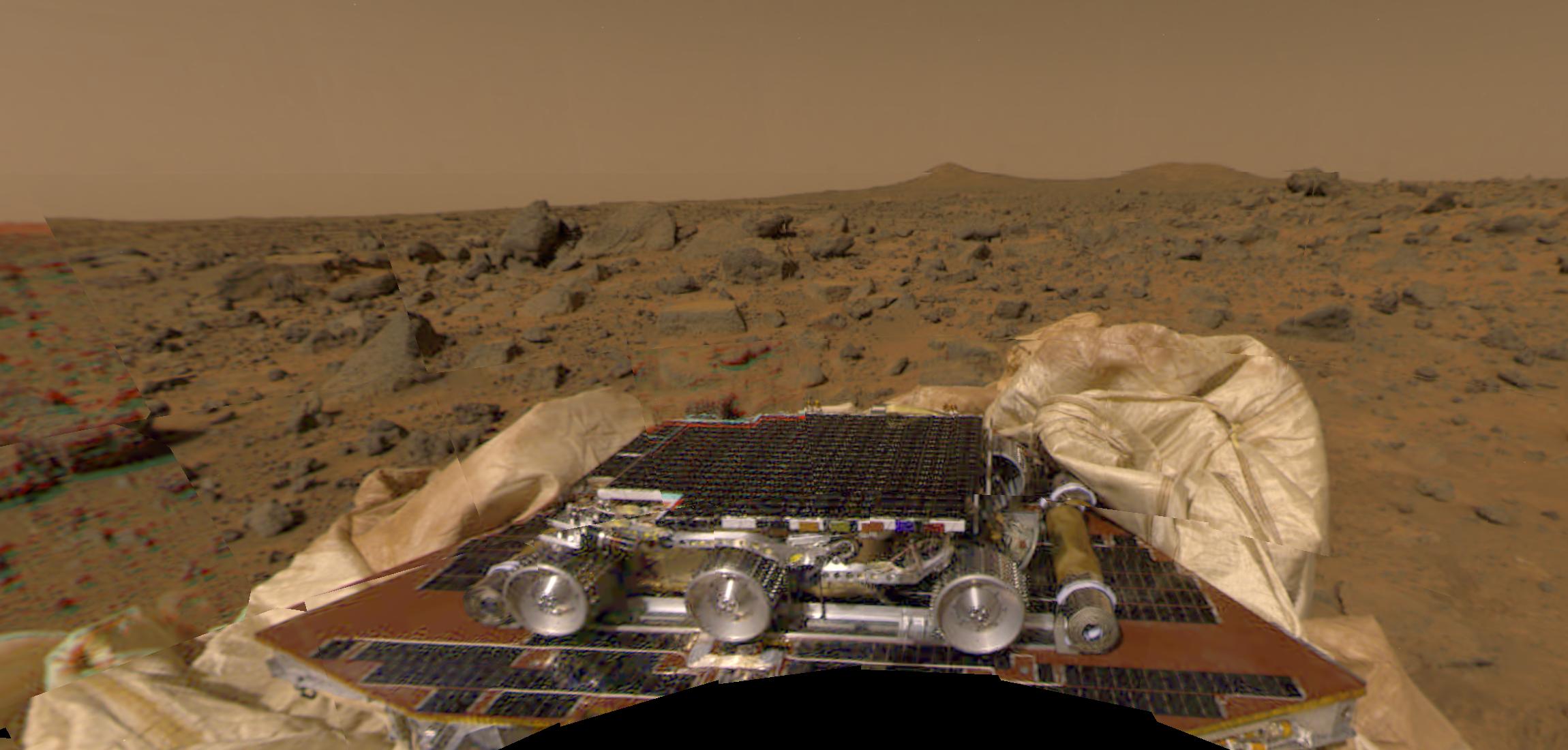
Pathfinder on Mars
2026-07-04
On July 4th, 1997, using its own array of fireworks, a parachute, and a cocoon of airbags, the Mars Pathfinder spacecraft bounced like a giant beach ball at least 15 times before it came to rest on the surface of Mars at 10:07 AM Pacific Daylight Time. After its then novel airbag-assisted landing sequence was completed, Pathfinder transmitted this color mosaic to mission operators on Earth. In the scene from another world, the Mars Sojourner robot rover is visible in the foreground, crouched on top of the unfolded Pathfinder. About the size of a large house cat, the six-wheeled, solar-powered Sojourner became the first successful Martian rover. Surrounding Pathfinder are deflated airbags and the rock-strewn terrain of the Ares Vallis floodplain. In the distance Martian hills appear against a dusty brownish sky. The Pathfinder lander was subsequently renamed the Carl Sagan Memorial Station.
via NASA APOD
Wikidata facts
- Area
- 866000
- Diameter
- 522.77
- Radius
- 262.7
- Mass
- 2590.76
- Orbital period
- 1325.536646992478
- Image
- Dawn-image-070911.jpg
- Height
- 446.4
- Width
- 557.2
- Length
- 572.6
Show 22 more facts
- Commons category
- Vesta (asteroid)
- time of discovery or invention
- 1807-03-29
- Unicode character
- ⚶
- orbital inclination
- 7.144060599543863
- volume as quantity
- 74600000
- apparent magnitude
- 5.1
- temperature
- 270
- Commons gallery
- (4) Vesta
- density
- 3.46
- albedo
- 0.4228
- surface gravity
- 0.22
- provisional designation
- A807 FA
- absolute magnitude
- 3.25
- rotation period
- 5.3421276322
- orbital eccentricity
- 0.09016764504738634
- semi-major axis of an orbit
- 2.361541280084789
- periapsis
- 2.148606664177354
- apoapsis
- 2.574475895992224
- longitude of ascending node
- 103.7022980342142
- argument of periapsis
- 151.5371488873794
- mean anomaly
- 26.80967220901607
- time of periapsis
- 2460901.785547203
Sources (9)
via Wikidata · CC0
~35 min read
Article
Vesta (minor-planet designation: 4 Vesta) is one of the largest objects in the asteroid belt, with a mean diameter of 525 kilometres (326 mi). It was discovered by the German astronomer Heinrich Wilhelm Matthias Olbers on 29 March 1807 and is named after Vesta, the virgin goddess of home and hearth from Roman mythology.
Vesta is thought to be the second-largest asteroid, both by mass and by volume, after the dwarf planet Ceres. Measurements give it a nominal volume only slightly larger than that of Pallas (about 5% greater), but it is 25% to 30% more massive. It constitutes an estimated 9% of the mass of the asteroid belt. Vesta is the only known remaining rocky protoplanet of the kind that formed the terrestrial planets. Numerous fragments of Vesta were ejected by collisions one and two billion years ago that left two enormous craters occupying much of Vesta's southern hemisphere. Debris from these events has fallen to Earth as howardite–eucrite–diogenite (HED) meteorites, which have been a rich source of information about Vesta.
Gallery (18)
Available in 95 languages
- Español
- Français
- Deutsch
- 中文
- 日本語
- Русский
- Português
- Italiano
- العربية
- हिन्दी
- Afrikaans
- Albanian
- Albanian
- Armenian
- Asturian
- Azerbaijani
- Bahasa Indonesia
- Basque
Show 76 more
- be_x_old
- Belarusian
- Breton
- Bulgarian
- Catalan
- Central Kurdish
- Chechen
- Church Slavic
- Croatian
- Czech
- Danish
- Egyptian Arabic
- Esperanto
- Estonian
- Filipino
- Finnish
- Galician
- Georgian
- Greek
- Hebrew
- Hungarian
- Ido
- Interlingua
- Irish
- Javanese
- Kazakh
- Khmer
- Komi
- Latin
- Latvian
- Limburgish
- Lingua Franca Nova
- Lithuanian
- Lombard
- Low German
- Luxembourgish
- Macedonian
- Malay
- Malayalam
- Mazanderani
- Mingrelian
- Nederlands
- Norwegian
- Norwegian Nynorsk
- nup
- Occitan
- Polski
- Romanian
- Scots
- Serbian
- Serbian (Latin)
- Sicilian
- simple
- Slovak
- Slovenian
- Sundanese
- Svenska
- Tajik
- Tamil
- Tatar
- Tiếng Việt
- Türkçe
- Tyap
- Ukrainian
- Urdu
- Uzbek
- Waray
- Welsh
- Western Panjabi
- Wu Chinese
- zh_classical
- zh_min_nan
- zh_yue
- فارسی
- ไทย
- 한국어
via Wikidata sitelinks · CC0