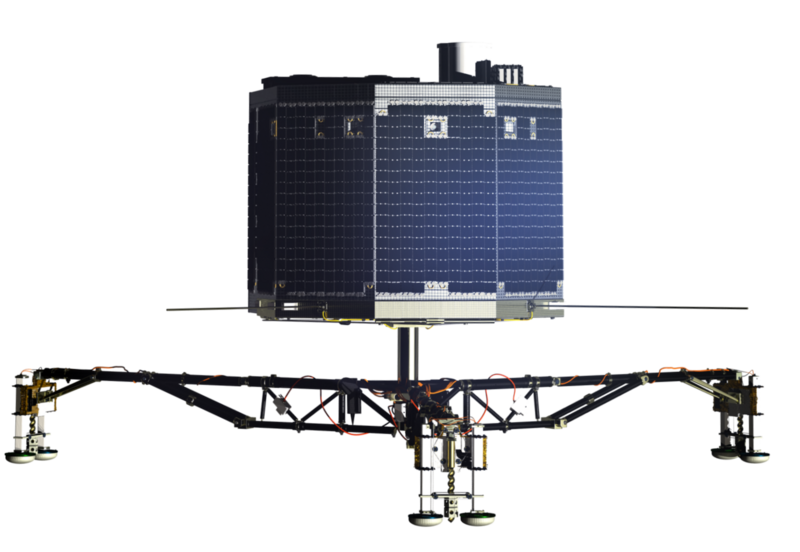
File:Philae_lander_(transparent_bg).png · Wikimedia Commons · See Wikimedia Commons
Philae
Sign in to saverobotic European Space Agency lander that accompanied the Rosetta spacecraft
Philae is a small robotic lander built by the European Space Agency that traveled to a comet as part of the Rosetta spacecraft mission. It matters because it represented an ambitious attempt to land on and study a comet up close, which had never been successfully done before.
AI-generated from the Wikipedia summary — may contain errors.
Official website
Rosetta | rendezvous with a comet
rosetta.esa.int →Link to the official site · 2,803 chars · not written by Vinony
Wikidata facts
- Instance of
- lander
- Part of
- Rosetta
- Named after
- Philae obelisk
- Operator
- European Space Agency
- Mass
- 97.9
- Official website
- rosetta.esa.int
- Image
- Philae lander (transparent bg).png
- Height
- 0.8
- Width
- 1
- Length
- 1
Show 8 more facts
- Commons category
- Philae (spacecraft)
- UTC date of spacecraft launch
- 2004-03-02
- UTC date of spacecraft landing
- 2014-11-12
- start point
- ELA-3
- located on astronomical body
- 67P/Churyumov–Gerasimenko
- launch contractor
- Arianespace
- nominal power output
- 32
- social media followers
- 341774
Sources (3)
via Wikidata · CC0
~32 min read
Encyclopedic overview
Philae (/ˈfaɪliː/ or /ˈfiːleɪ/) was a robotic European Space Agency lander that accompanied the Rosetta spacecraft until it separated to land on comet 67P/Churyumov–Gerasimenko, ten years and eight months after departing Earth. On 12 November 2014, Philae touched down on the comet, but it bounced when its anchoring harpoons failed to deploy and a thruster designed to hold the probe to the surface did not fire. After bouncing off the surface twice, Philae achieved the first-ever "soft" (nondestructive) landing on a comet nucleus, although the lander's final, uncontrolled touchdown left it in a non-optimal location and orientation.
Despite the landing problems, the probe's instruments obtained the first images from a comet's surface. Several of the instruments on Philae made the first in-situ analysis of a comet nucleus, sending back data regarding the composition of the surface and outgassing from the subsurface. In October 2020, scientific journal Nature published an article revealing what Philae had discovered while it was operational on the surface of 67P/Churyumov–Gerasimenko.
Excerpted from Wikipedia’s “Philae” article, available under the CC BY-SA 4.0 licence.