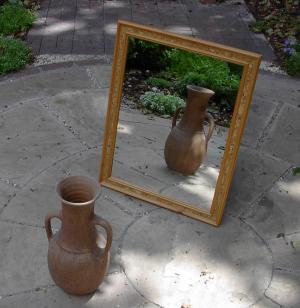
File:Mirror.jpg · Wikimedia Commons · See Wikimedia Commons
A mirror is a reflective surface that bounces light back to create an image, with the angle at which light hits the mirror matching the angle at which it reflects away. Mirrors matter because they're useful tools in everyday life—from personal grooming to scientific applications—and the principle of reflection they demonstrate is fundamental to how light behaves.
AI-generated from the Wikipedia summary — may contain errors.
Wikidata facts
- Part of
- optical instrument
- Has part
- glass
- Image
- Mirror-vase.jpg
- Has use
- mirror image
Show 9 more facts
- described by source
- Encyclopædia Britannica 11th edition
- Commons category
- Mirrors
- topic's main category
- Category:Mirrors
- Commons gallery
- Mirror
- exact match
- wordnet-rdf.princeton.edu/wn31/103732475-n
- Unicode character
- 🪞
- different from
- Mirror
- on focus list of Wikimedia project
- Wikipedia:Vital articles/Level/4
- P8168
- crest factor
Sources (2)
via Wikidata · CC0
Article · Deutsch
Ein Spiegel (von lateinisch speculum „Spiegel, Abbild“, zu lateinisch specere „sehen“) ist eine reflektierende Fläche – glatt genug, dass reflektiertes Licht nach dem Reflexionsgesetz seine Parallelität behält und somit ein Abbild entstehen kann. Die Rauheit der Spiegelfläche muss dafür kleiner sein als etwa die halbe Wellenlänge des Lichts. Eine rauere weiße Fläche remittiert ebenfalls alles Licht, jedoch wird dieses hierbei ungeordnet in alle Richtungen gestreut. Auch nicht sichtbare elektromagnetische Wellen und Schallwellen können an geeigneten Flächen gespiegelt werden („Reflexion“). Die Transparenz und Absorption (halbtransparent, nicht-transparent, wellenlängenabhängige Transparenz oder Absorption) des Spiegels hat Einfluss auf Helligkeit und Farbe des Spiegelbildes. Ferner wird niemals die gesamte Energie gespiegelt, es gibt immer einen Verlust – der Reflexionsgrad ist immer kleiner als 100 %.
Abstract from DBpedia / Wikipedia · CC BY-SA
Gallery (52)
Available in 136 languages
- Español
- Français
- Deutsch
- 中文
- 日本語
- Русский
- Português
- Italiano
- العربية
- हिन्दी
- Afrikaans
- Akan
- Albanian
- Aragonese
- Aramaic
- Armenian
- Asturian
- azb
Show 117 more
- Azerbaijani
- Bahasa Indonesia
- Balinese
- Bangla
- Banjar
- Basque
- bat_smg
- be_x_old
- Belarusian
- Betawi
- Bikol
- Bosnian
- Breton
- Bulgarian
- Burmese
- Catalan
- cdo
- Central Kurdish
- Chechen
- Chuvash
- Croatian
- Czech
- dag
- Danish
- Egyptian Arabic
- Erzya
- Esperanto
- Estonian
- Fijian
- Filipino
- Finnish
- fiu_vro
- Galician
- Georgian
- Greek
- Guarani
- Haitian Creole
- Hebrew
- Hungarian
- hyw
- Ido
- Iloko
- Irish
- Javanese
- Kabyle
- Kannada
- Kashmiri
- Kazakh
- Kikuyu
- Kurdish
- Latin
- Latvian
- Limburgish
- Lithuanian
- Lombard
- Macedonian
- Malay
- Malayalam
- Marathi
- Mirandese
- nah
- nds_nl
- Nederlands
- Nepali
- Newari
- Northern Frisian
- Norwegian
- Norwegian Nynorsk
- nrm
- Occitan
- Oromo
- Pashto
- Pennsylvania German
- Polski
- Punjabi
- Quechua
- Romanian
- rsk
- Rusyn
- Santali
- Serbian
- Serbian (Latin)
- Shona
- Sicilian
- simple
- Sindhi
- Sinhala
- Slovak
- Slovenian
- Sundanese
- Svenska
- Tajik
- Tamil
- Telugu
- Tiếng Việt
- Toki Pona
- Tongan
- Tulu
- Türkçe
- Ukrainian
- Urdu
- Uzbek
- Veps
- Waray
- Wayuu
- Welsh
- Western Panjabi
- Wu Chinese
- Yakut
- Yiddish
- Yoruba
- zh_min_nan
- zh_yue
- Zulu
- فارسی
- ไทย
- 한국어
via Wikidata sitelinks · CC0