File:Kingdoms_around_Israel_830_map.svg · Wikimedia Commons · See Wikimedia Commons
Moab
Sign in to saveAlso known as Moabite
Moab () was an ancient Levantine kingdom whose territory is today located in southern Jordan. The land is mountainous and lies alongside much of the eastern shore of the Dead Sea. The existence of the Kingdom of Moab is attested to by numerous archaeological findings, most notably the Mesha Stele, which describes the Moabite victory over an unnamed son of King Omri of Israel, an episode also noted in 2 Kings 3. The Moabite capital was Dibon. According to the Hebrew Bible, Moab was often in conflict with its Israelite neighbours to the west.
Moab was an ancient kingdom located in what is now southern Jordan, east of the Dead Sea, whose existence is confirmed by archaeological evidence including the famous Mesha Stele. It matters historically because it provides insight into the ancient Levantine world and its interactions with neighboring kingdoms like Israel, as documented in both archaeological records and biblical texts.
AI-generated from the Wikipedia summary — may contain errors.
Key facts
- Country.religion
- Canaanite religion
- Country.native_name
- 𐤌𐤀𐤁
- Country.conventional_long_name
- Kingdom of Moab
- Country.common_name
- Moab
- Country.capital
- Dibon
- Country.common_languages
- Moabite
- Country.status
- Monarchy
- Country.year_start
- c. 13th century BCE
- Country.event_end
- Collapsed
- Country.year_end
- c. 400 BCE
- Country.image_map
- Kingdoms around Israel 830 map.svg
- Country.image_map_caption
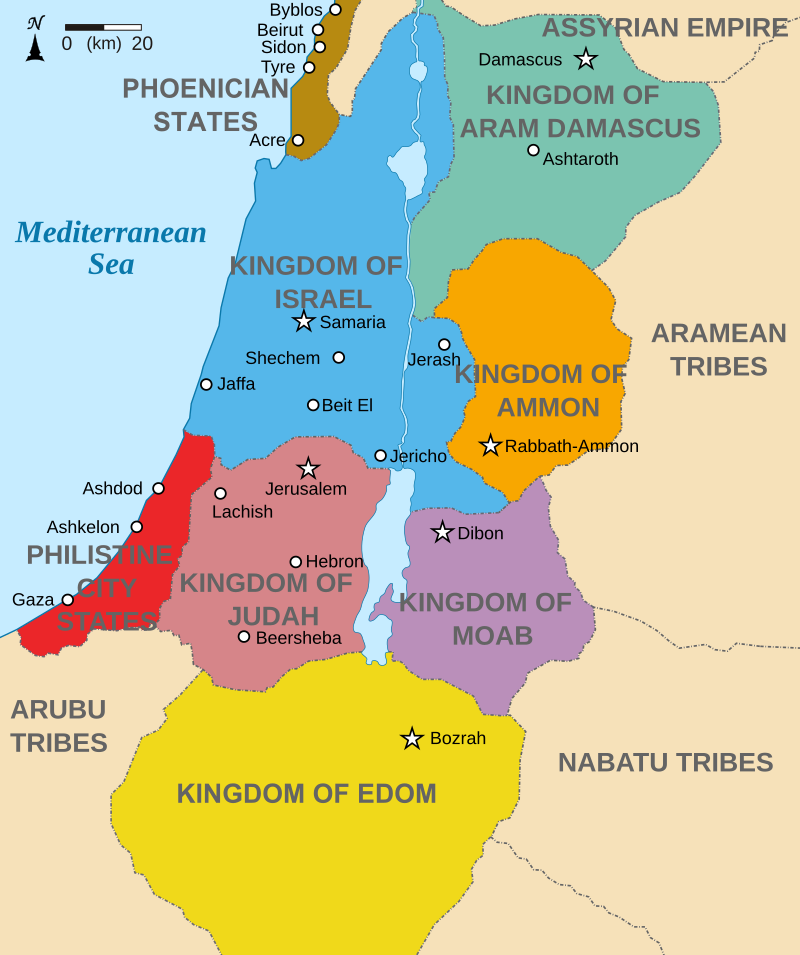
- A theoretical map of Canaan around 830 BCE. Moab is shown in purple on this map, between the Arnon and Zered rivers.
- Country.today
- Jordan, Israel
via Wikipedia infobox
Wikidata facts
Show 7 more facts
- Commons category
- Moab
- topic's main category
- Category:Moab
- different from
- Moab
- language used
- Moabite
- dissolved, abolished or demolished date
- 0400-00-00
- inception
- 1300-00-00
- native label
- מוֹאָב
via Wikidata · CC0
~19 min read
Encyclopedic overview
20 sectionsContents
- Etymology
- Geography
- History
- Bronze Age
- Iron Age
- Decline
- 19th-century travellers
- Biblical narratives
- In Jewish tradition
- Boundaries in the Hebrew Bible
- Religion
- Language
- List of rulers
- Iron Age
- [[Assyria]]n period
- Explanatory notes
- See also
- References
- Further reading
- External links
Moab () was an ancient Levantine kingdom whose territory is today located in southern Jordan. The land is mountainous and lies alongside much of the eastern shore of the Dead Sea. The existence of the Kingdom of Moab is attested to by numerous archaeological findings, most notably the Mesha Stele, which describes the Moabite victory over an unnamed son of King Omri of Israel, an episode also noted in 2 Kings 3. The Moabite capital was Dibon. According to the Hebrew Bible, Moab was often in conflict with its Israelite neighbours to the west.
==Etymology== The etymology of the word Moab is uncertain. The earliest gloss is found in the Koine Greek Septuagint () which explains the name, in obvious allusion to the account of Moab's parentage, as ἐκ τοῦ πατρός μου ("from my father"). Other etymologies which have been proposed regard it as a corruption of "seed of a father", or as a participial form from "to desire", thus connoting "the desirable (land)".
Excerpted from Wikipedia’s “Moab” article, available under the CC BY-SA 4.0 licence.
Gallery (14)
On the map
3 mapped locations