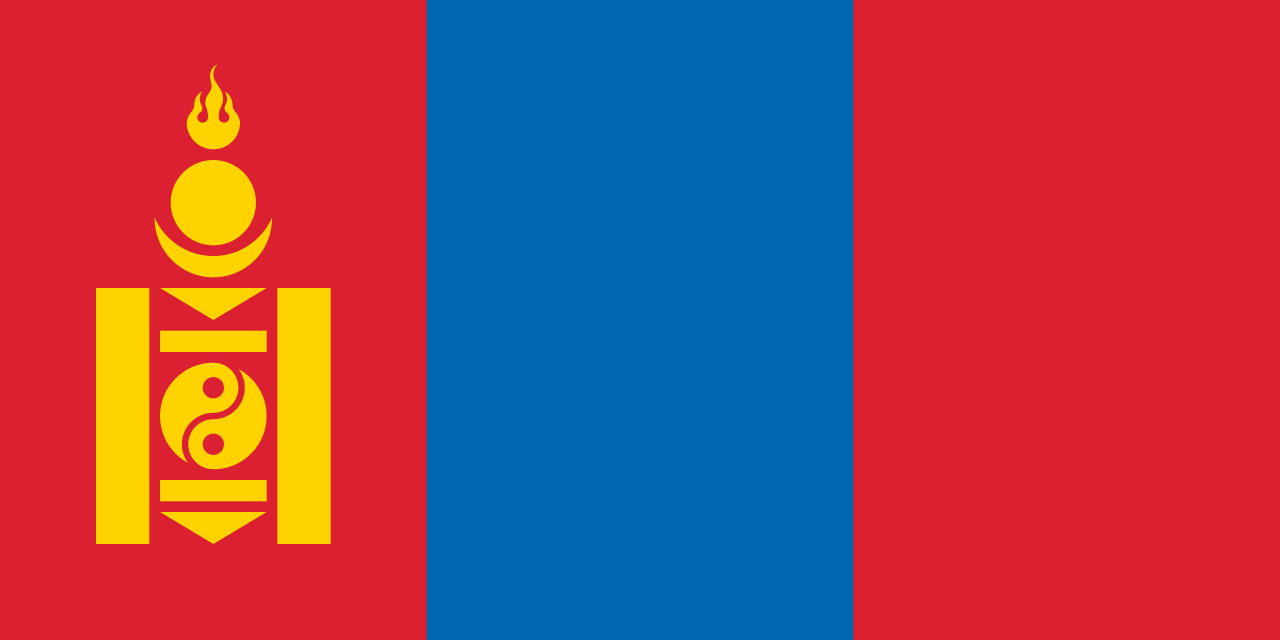
Mongolia
Sign in to saveAlso known as Mongol State, State of Mongolia
Mongolia is a landlocked country in the East Asia region. It is bordered by Russia to the north and China to the south, and covers an area of , making it the 18th-largest country in the world and the second largest landlocked country after Kazakhstan, as well as the largest landlocked country that does not border an inland sea. With a population of 3.5 million, Mongolia is the world's most sparsely populated sovereign state, excluding partially unrecognized Western Sahara. The country constitutes a significant portion of the Mongolian Plateau, and its natural environment is characterized
OverviewAI-generated
Mongolia is a landlocked sovereign state located in Eastern Asia. It shares borders with China and Russia. The capital is Ulaanbaatar, also referred to as Ulan Bator. The official language is Mongolian, and the currency is the Mongolian tögrög. The country is named after the Mongols. Its highest point is Hüiten Peak.
The population is recorded as 3,544,835 or 3,524,788. The area covers 1,564,110 square kilometers. Urbanization accounts for 70.9566040039062 percent of the population. Internet users comprise 85.12349701 percent. The GDP is 23,794,540,024.5132 USD. Life expectancy is 72.3980487804878 years. Unemployment is 5.233 percent. Forest area is 9.09172405879304 percent. Renewable energy is 3 percent.
Mongolia is a member of the United Nations, World Trade Organization, Organization for Security and Co-operation in Europe, and International Bank for Reconstruction and Development. It uses the top-level Internet domain .mn and telephone country code +976. Timezones are UTC+07:00 and UTC+08:00. The country contains administrative entities including Ulaanbaatar, Arkhangai Province, Bayan-Ölgii Province, and Bayankhongor Province.
Synthesized by Vinony from 68 facts across 9 sources: Wikidata, REST Countries, Openweathermap, Open Meteo, World Bank, OpenStreetMap, PubMed, Vinony graph, Geo. Generated from structured data (not the Wikipedia text) and checked against those facts — may still contain errors.
Weather now
7-day forecast
via Open-Meteo
Country
- Capital
- Ulan Bator
- Population
- 3,544,835
- Region
- Asia · Eastern Asia
- Demonym
- Mongolian
- Currencies
- MNT (₮)
- Languages
- Mongolian
- Calling code
- +976
- Drives on
- Right
- Gini
- 32.7 (2018)
- FIFA code
- MNG
- TLD
- .mn
- Timezones
- UTC+07:00 · +1 more
- Borders
- CHN, RUS
via REST Countries
Indicators · World Bank
- GDP
- $23.8B(2024)
- Population
- 3,524,788(2024)
- Life expectancy
- 72.4 yrs(2024)
- Unemployment
- 5.2 %(2025)
- Urban population
- 71 %(2024)
- Internet users
- 85.1 %(2024)
- Forest area
- 9.1 %(2023)
- Renewable energy
- 3 %(2021)
via World Bank Open Data · CC BY 4.0
Place details
- Locality
- Мандалговь
- Region
- Дундговь ᠳᠤᠮᠳᠠ ᠭᠣᠪᠢ
- Country
- Монгол улс ᠮᠤᠩᠭᠤᠯ ᠤᠯᠤᠰ
via OpenStreetMap · GeoNames
Wikipedia views (30d)
168,020 totalvia Wikimedia Pageviews API
Key facts
- Country.Gini_year
- 2018
- Country.Gini
- 32.7
- Country.HDI_year
- 2022
- Country.conventional_long_name
- Mongolia
- Country.native_name
- (Mongolian)
- Country.common_name
- Mongolia
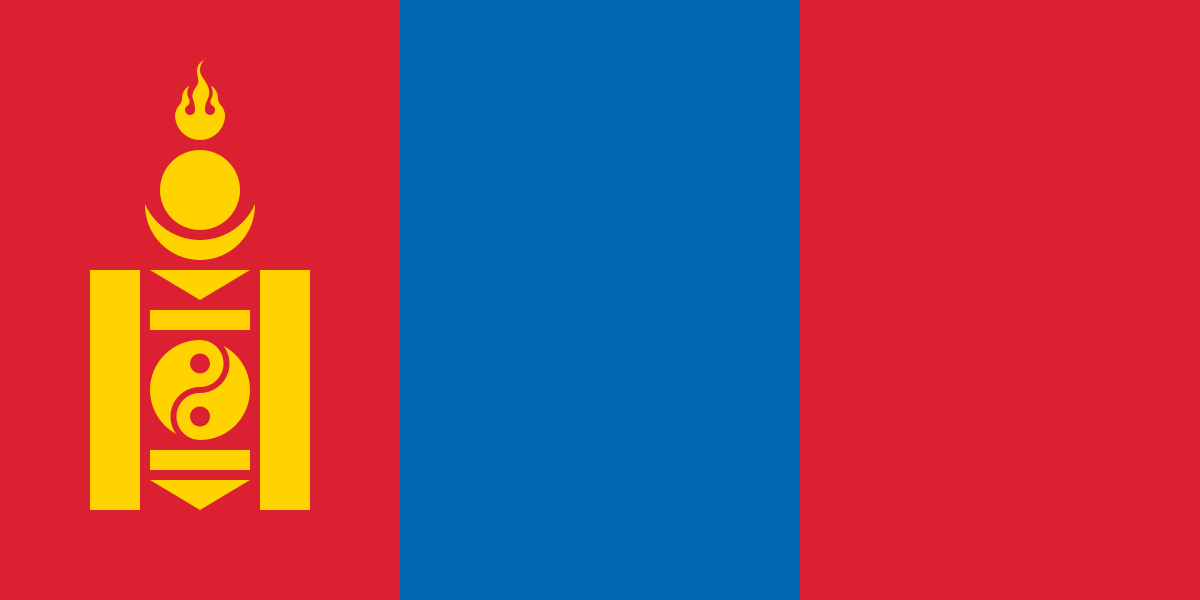
- Country.image_flag
- Flag of Mongolia.svg
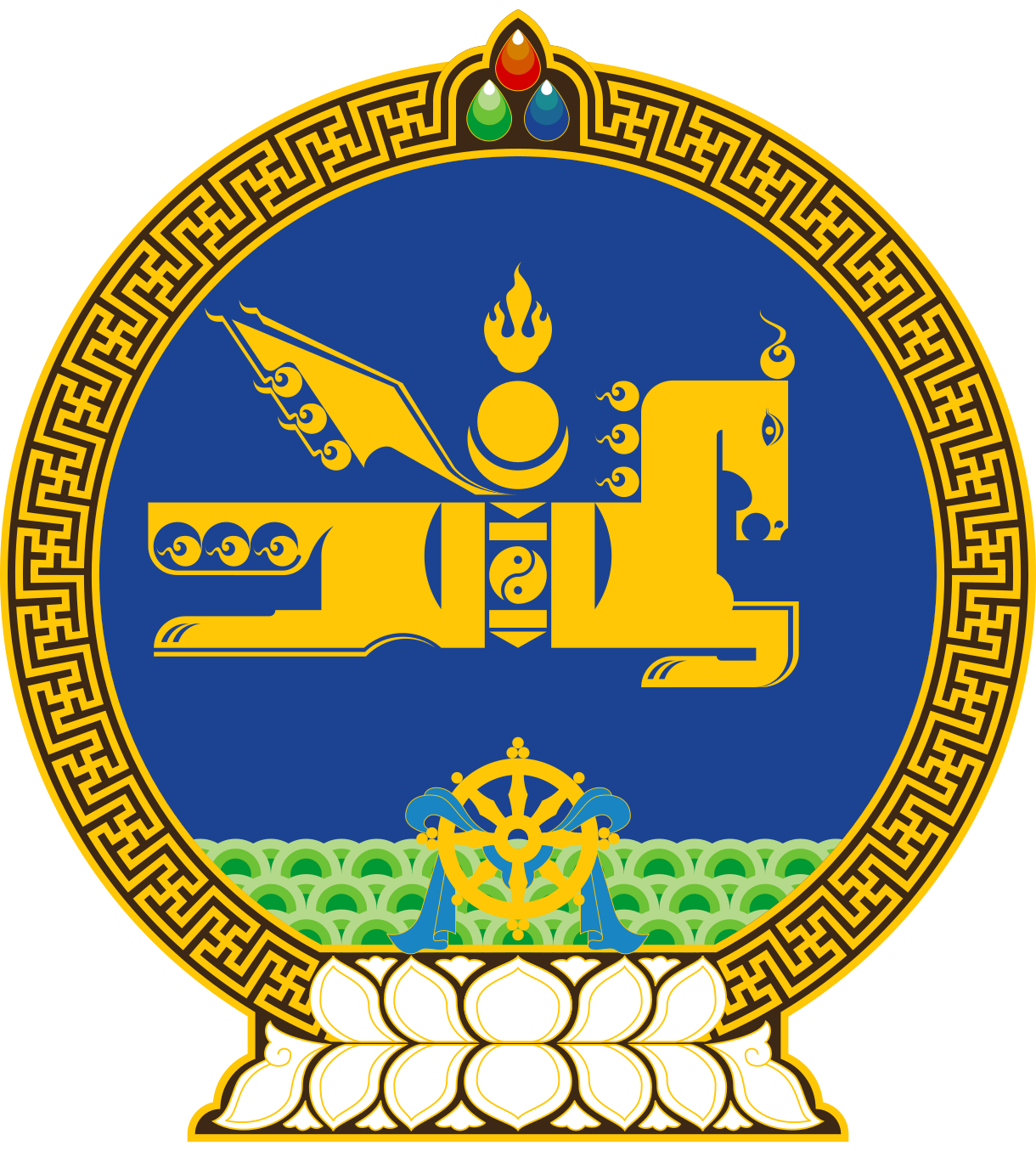
- Country.image_coat
- State emblem of Mongolia.svg
- Country.symbol_type
- Emblem
- Country.other_symbol_type
- State seal
- Country.other_symbol
- border|90px
- Country.image_map
- Mongolia (orthographic projection).svg
- Country.national_anthem
- "National Anthem of Mongolia"File:The National Anthem of Mongolia.ogg
- Country.official_languages
- Mongolian
- Country.languages_type
- Official scripts
- Country.ethnic_groups
- 95.6% Mongols 3.8% Kazakhs 0.6% other
- Country.ethnic_groups_year
- 2020
- Country.demonym
- Mongolian, Mongol
via Wikipedia infobox
Research
32,165 papers- The Growing Problem of Radiologist Shortage: Mongolia's Perspective.Korean journal of radiology · 2023Dagvasumberel G, Bold B, Dagvasumberel MDOI: 10.3348/kjr.2023.0787
- Hypertension in Mongolia: an overview.ReviewEthnicity & disease · 2013Enkh-Oyun T, Kotani K, Davaalkham D et al.
- Hard ticks and tick-borne pathogens in Mongolia-A review.ReviewTicks and tick-borne diseases · 2019Černý J, Buyannemekh B, Needham T et al.DOI: 10.1016/j.ttbdis.2019.101268
- Mongolia: Failure of Total Banning of Asbestos.Annals of global health · 2023Damiran N, Frank ALDOI: 10.5334/aogh.4035
- Mongolia Gerbils Are Broadly Susceptible to Hepatitis E Virus.Viruses · 2022Zhang W, Ami Y, Suzaki Y et al.DOI: 10.3390/v14061125
- Horses and nomads in Mongolia.Primates; journal of primatology · 2019Matsuzawa TDOI: 10.1007/s10329-019-00746-9
- Dairying transformed Mongolia.Nature ecology & evolution · 2020Yang YDOI: 10.1038/s41559-019-1082-0
- Mongolia.Department of State publication. Background notes series · 1987United States. Department of State. Bureau of Public Affairs
via PubMed
Wikidata facts
- Instance of
- country
- Named after
- Mongols
- Official name
- Mongolia
- Demonym
- Mongolinnen
- Country
- Mongolia
- Contains
- Zavkhan Province
- Continent
- Asia
- Capital
- Ulaanbaatar
- Official language
- Mongolian
- Currency
- Mongolian tögrög
- Population
- 3409939
- Area
- 1564116
- Elevation
- 1528
- Head of government
- Uchral Nyam-Osor
- Head of state
- Khurelsukh Ukhnaa
- Form of government
- parliamentary system
- Legislature
- State Great Khural
- Shares border with
- Russia
- Highest point
- Hüiten Peak
- Official website
- www.gov.mn
- Image
- Gurvger.jpg
- Life expectancy
- 73
- Nominal GDP
- 16810883361
Show 66 more facts
- Unemployment rate
- 5
- Calling code
- +976
- Licence plate code
- MGL
- Mains voltage
- 220
- Motto
- Crwydrwch a Phrofwch Mongolia
- Flag
- flag of Mongolia
- Coat of arms
- Emblem of Mongolia
- top-level Internet domain
- .mn
- Commons category
- Mongolia
- topic's main category
- Category:Mongolia
- category for people who died here
- Category:Deaths in Mongolia
- category for people born here
- Category:Births in Mongolia
- topic's main Wikimedia portal
- Portal:Mongolia
- category for films shot at this location
- Category:Films shot in Mongolia
- category of associated people
- Category:Mongolian people
- diplomatic relation
- Hungary
- public holiday
- Tsagaan Sar
- driving side
- right
- replaces
- Chinese Empire
- Commons gallery
- Монгол улс
- lowest point
- Hoh Nuur
- mobile country code
- 428
- geography of topic
- Geography of Mongolia
- GS1 country code
- 865
- marriageable age
- 18
- short name
- Mongolei
- office held by head of government
- Prime Minister of Mongolia
- executive body
- Government of Mongolia
- number of out-of-school children
- 102494
- office held by head of state
- President of Mongolia
- has characteristic
- free country
- located in/on physical feature
- East Asia
- total fertility rate
- 1.93
- maritime identification digits
- 457
- inception
- 1992-02-12
- Unicode character
- 🇲🇳
- central bank
- Bank of Mongolia
- native label
- ᠮᠣᠩᠭᠣᠯ ᠤᠯᠤᠰ
- history of topic
- history of Mongolia
- VAT rate
- 10
- BTI Status Index
- 6.45
- BTI Governance Index
- 5.9
- economy of topic
- economy of Mongolia
- demographics of topic
- demographics of Mongolia
- different from
- Mongol heartland
- Democracy Index
- 6.42
- official observer status in organization
- Shanghai Cooperation Organisation
- topic has template
- Template:First-level divisions of Mongolia
- Human Development Index
- 0.739
- P11012
- Kuwait
- category for honorary citizens of entity
- Q19473223
- hashtag
- mongolia
- on focus list of Wikimedia project
- Wikipedia:Vital articles/Level/4
- Happy Planet Index score
- 24.5
- Gini coefficient
- 32.7
- Inequality-adjusted Human Development Index
- 0.644
- social media followers
- 43535
- P12749
- North Rhine-Westphalia
- birth rate
- 20.447
- male population
- 1685387
- death rate
- 5.479
- rural population
- 1055872
- female population
- 1712979
- urban population
- 2342494
- P8168
- Rawaki Island
Sources (15)
via Wikidata · CC0
Travel guide
Understand
Mongolia is one of the world's largest landlocked countries, second only to Kazakhstan and is surrounded by two of the world's largest countries: China and Russia. It was the center of the Mongol Empire, the largest contiguous empire in world history. With only 1.7 people per square kilometre, Mongolia has the lowest population density of any independent country.
The country is nicknamed the "Land of Blue Skies," and with good reason. There are said to be about 250 sunny days throughout each year. The weather is bitterly cold during the winter, dropping down to -40°C in some parts. With many types of terrain — from desert to verdant mountains — the weather during the summer varies from region to region, but is generally hot. Outside of the Gobi desert, this time of year is marked with much rain in some areas, and it can become quite cool at night.
For several letters, the ISO 9 standard transliteration of Cyrillic is not widely used and there is no consensus either in Mongolia nor in Wikivoyage. Particularly, the same Cyrillic letter "х" is transliterated "h" or "kh", the letter "ө" is transliterated "ô", "ö", "o" or "u", but Latin "o" is also the transliteration of the Cyrillic "о", and Latin "u" is also the transliteration of Cyrillic "у" and "ү" (the latter should be transliterated "ù" according to ISO 9, but this is rarely done). So, if you can't find a name as you wrote it, try other spellings.
Mongolia may have geopolitical, cultural and geographical meani…
Get in
Historically, Mongolia had a reputation for being a very difficult country to visit. Until the mid-1990s, you had to solicit an invitation letter from someone living in Mongolia to visit Mongolia.
Lately, the visa rules have been relaxed and most people can enter the country without a visa. The Mongolian government declared the 2023-2024 tourist season the "Year of Mongolia", relaxing visa requirements for many countries, including all major Western nations. Whether this will become a permanent change is yet to be seen.
Get around
If you plan to travel around the countryside without a guide, take a GPS and some maps. The "Mongolia Road Atlas" is available in many book shops, it has over 60 pages and covers the whole country: there is a Latin-character version and Cyrillic-character version, in the countryside most people won't understand the Latin version. More detailed maps are available at the Mongolian Government Map Store. These maps are 1:500,000. Also, some other special-purpose maps and a good map of downtown Ulaanbaatar. The map store is on Ih Toiruu St. Go west from the State Department Store on the main street, called Peace, Peace and Friendship, or Ekhtavan Ave., two blocks to the large intersection with traffic lights, turn right (north) and the map store is about halfway along the block. There is an Elba electronic appliance store set back from the street, a yellow and blue building, the next building is a 4-story, Russian-style office building, the map store entrance is on the west side, toward the south end of the building. It lines up with the north wall of the Elba building.
Whichever the method of long-distance travel, keep in mind that everything in Mongolia has a tendency to break down. Don't be shocked if part of the suspension breaks and the driver jerry-rigs a carved wooden block in the place of a mount. For more serious breakdowns, it can easily take an entire day or longer for somebody to come along and help, so leave plenty of slack in itineraries. Finally, Mongolians are rat…
See
thumb|Monk at the Gandan Monastery
Mongolia is a big country that has been beyond the reach of travellers and the normal trappings of civilization until the 21st century. Even today it can be difficult to travel between the few places that 'exist'. There is little noteworthy architecture in the country. Except for the short-lived capital of the Mongol Empire at Karakorum (Kharkhorin), the descendants of Genghis Khan left little evidence of their power inside their native homeland. Genghis Khan, who leveled cities from the Yellow Sea to the Caspian, was said to have only built one permanent building during his life, a warehouse to store his stupendous amount of loot.
Do
thumb|Mongolian honor guard Experiencing the culture and having a meal or spending the night with a nomadic family are authentic Mongolian experiences. Whether you go just outside of the capital or fly to the far corners of the country, this is the most memorable part of any trip. There are some variations on the experience, depending on the tribal group.
The Trans-Siberian Railway passes through the country. Also follow the path of Marco Polo across Europe and Asia into Mongolia to visit the ancient capital of the Mongol Empire in Karakorum.
Mongolia is the least densely populated country in the world and has very little development of any kind outside of the capital and a few small towns. There often aren't even roads connecting these towns. This pristine setting means that Mongolia has wide open spaces for experiencing the outdoors for those who want adventure. Traveling across this vast country is often an adventure in itself with tourists and adventurers alike going by car, motorcycle, bike, horse, camel, or foot. Most often this means camping on the shore of a river or with a nomadic family or in small roadside hotels in provincial towns. Along the way or on one of the many wild rivers and nature preserves, there is great fishing, particularly fly-fishing during the summer. Climbing the mountains in the west is popular as well as photographing the wildlife, flora, or the multitude of birds living or migrating through Mongolia.
Canoe down some of Mongolia's major rive…
Eat
thumb|The Mongolian trifecta: khuushuur fried dumplings on the left, buuz steamed dumplings on the right, and pieces of boiled mutton on top
Anywhere you find people in Mongolia, you will also smell the scent of boiled mutton, the principal dish of Mongolia. A typical herder in the countryside will eat little else, flavored only with a little salt. Vegetables and spices are very limited, and even flour may be in short supply, since the climate is poorly suited to agriculture.
Restaurants, canteens and tea shops in Mongolia also have a mutton-centric menu, revolving around three dishes: buuz (бууз) — Steamed dumplings stuffed with meat, often called the national dish of Mongolia. Derived from the Chinese baozi. A set of 6 usually costs 1,200-2,000 ₮. khuushuur (хуушууp) — Deep-fried stuffed flatbread with meat and onion, originally a festive dish but now ubiquitous. 3 or 4 will fill you up. tsuivan (цуйван) — Fried noodles with meat and a few token vegetables, often served with ketchup on the side. Around 2,000-4,000 ₮ a serve.
Horse, yak and beef are also eaten, and dairy products like byaslag (бяслаг), a mild, paneer-like fresh cheese, and öröm (өрөм), clotted cream, are also common. Aaruul (ааруул) dried curds are also a common snack: these are typically rock hard and have to be eaten by slowly dissolving them in your mouth, which eventually turns them into lumps of cheesy putty.
thumb|Preparing a marmot as boodog
For special occasions, bood…
Drink
thumb|A milk pail in Mongolia
The most common drink in Mongolia is salted milk tea (сүүтэй цай süütei tsai), which is essentially a cup of boiled milk and water, sometimes with a couple pieces of tea leaf and/or a pinch of salt thrown in for good measure. A cup of this and a bowl of dried snacks is the first thing served when you visit a ger, and it accompanies food at restaurants as well. The tea can be bulked up into a meal by adding in some toasted millet, rice, meat or bansh. You might want to build up your tolerance by drinking lots of milk in preparation for your stay because they don't drink much else, except perhaps boiled water if you specially request it during a longer stay. Also, most traditional nomadic foods such as dried yogurt and the like require acclimatization to milk as well. Cold drinks don't actually exist in the countryside (unless you intend to drink straight out of a river, generally not recommended).
thumb|A glass of homemade airag, prepared in the blue plastic barrel in the background
The national drink, though, is airag (айраг). Essentially the same as the Central Asian kumiss, this is a summer seasonal drink made from fermented mare's milk, and is certainly an acquired taste. The alcohol content is less than that of beer, but can have noticeable effects. Be careful, if you aren't accustomed to drinking sour milk products, the first time might give you diarrhea as your stomach gets accustomed to it. This should only happen the first time though.…
Sleep
Some western-style accommodation is available in Ulaanbaatar, but it goes for western prices. There are a few nice guest houses in UB for less than US$10 per night (even as cheap as 3,000 ₮ if you're willing to share a room), but they are crowded during the tourist season and hard to get into.
Out in the countryside, most of the hotels are rundown Soviet-era leftovers. A better option is tourist ger, set up by entrepreneurial locals. Staying at one of these costs about ₮5000 per person per night. They often include breakfast and dinner as well. When staying in one of these guest ger, the usual gift-giving customs can be skipped.
Finally, there are also ger-camps. Set up by tour companies, they do occasionally rent out space to independent travellers. Unfortunately, they tend to be both expensive (US$35 per person per night with 3 meals) and out of the way. To stay at a ger camp, use the online booking portals iHotel and Mongolian Ger Camps Network.
Except for the cities and larger towns, all land is publicly owned. This means you can pitch a tent pretty much anywhere. Courtesy dictates that you keep your distance from existing nomad encampments. Common sense dictates that you don't pitch a tent in the middle of or too close to a road.
Nowadays, there are more than 300 hotels in Mongolia and these are graded between 1 and 5 stars. Hotels holding 3 stars or more are for tourist service and must obtain permission in order to operate. The Accommodation Grading Committee,…
Stay safe
thumb|Sunset in Ulaanbaatar
Mongolia is mostly a safe country to visit, but take care in nights and when alcohol is involved, and if venturing out away from shelter with risks of harsh weather. Women should be aware of problems common in conservative regions.
Aggressive dogs may run in packs. Be wary of them since they are not likely to be as tame as domestic dogs elsewhere. Most fenced yards and gers have a guard dog that is usually all bark and no bite, though it is advised to make it aware of you so as to not surprise it, and carry a rock in case it does charge you.
Manhole covers — or more precisely, the lack of such covers — is a surprisingly common cause of injuries among foreigners and (especially drunk) tourists. In smaller cities and outlying areas of the capital, there are many missing or poorly placed covers. Avoid stepping on any manhole and pay attention to where you walk.
Stay healthy
thumb|Air pollution in Ulaanbaatar Nomads' dogs may have rabies. As a precaution, consider having a rabies shot before coming. Marmots should not be eaten at certain times of the year because they can carry bubonic plague. That said, the disease is carried by the marmot's fleas so the afflicted tend to be fur traders, and marmot is not a mainstream dish even in Mongolia. Hepatitis and tuberculosis are common throughout Mongolia. Tap water is unsafe to drink.
Travel guide from Wikivoyage (CC BY-SA 4.0)
~40 min read
Encyclopedic overview
44 sectionsContents
- Etymology
- History
- Prehistory and antiquity
- Early states
- Mongol empire to early 20th century
- Modern history
- Mongolian People's Republic
- Cold War
- Post-Cold War
- Geography
- Climate
- Environmental issues
- Wildlife
- Government and politics
- Administrative divisions
- Foreign relations
- Embassies
- Military
- Legal system
- Economy
- Mineral industry
- Agriculture
- Communications
- Energy
- Transportation
- Demographics
- Major cities
- Languages
- Religion
- Education
- Health
- Culture
- Architecture
- Visual arts
- Music
- Media
- Cuisine
- Sports and festivals
- In film
- See also
- Notes
- References
- Further reading
- External links
Mongolia is a landlocked country in the East Asia region. It is bordered by Russia to the north and China to the south, and covers an area of 1,564,116 square kilometers (603,909 square miles), making it the 18th-largest country in the world and the second largest landlocked country after Kazakhstan, as well as the largest landlocked country that does not border an inland sea. With a population of 3.5 million, Mongolia is the world's most sparsely populated sovereign state, excluding partially unrecognized Western Sahara. The country constitutes a significant portion of the Mongolian Plateau, and its natural environment is characterized by grassy steppe, mountains to the north and west, and the Gobi Desert to the south. Ulaanbaatar, the capital and largest city, is home to roughly half of the country's population.
The territory of modern-day Mongolia has been ruled by various nomadic empires, including the Xiongnu, the Xianbei, the Rouran, the First Turkic Khaganate, the Second Turkic Khaganate, the Uyghur Khaganate and others. In 1206, Genghis Khan founded the Mongol Empire, which became the largest contiguous land empire in history. His grandson Kublai Khan conquered China proper and established the Yuan dynasty. After the collapse of the Yuan, the Mongols retreated to Mongolia and resumed their earlier pattern of factional conflict, except during the era of Dayan Khan and Tumen Zasagt Khan.
Excerpted from Wikipedia’s “Mongolia” article, available under the CC BY-SA 4.0 licence.
Gallery (59)
On the map
3 mapped locations
Available in 261 languages
- Español
- Français
- Deutsch
- 中文
- 日本語
- Русский
- Português
- Italiano
- العربية
- हिन्दी
- Abkhazian
- abstract
- Achinese
- Adyghe
- Afrikaans
- Albanian
- Albanian
- Amharic
Show 242 more
- ami
- Angika
- Aragonese
- Armenian
- Arpitan
- Assamese
- Asturian
- Awadhi
- azb
- Azerbaijani
- Bahasa Indonesia
- Balinese
- Bangla
- Bashkir
- Basque
- bat_smg
- Batak Toba
- Bavarian
- be_x_old
- Belarusian
- Betawi
- Bhojpuri
- Bikol
- Bishnupriya
- Bislama
- blk
- Bosnian
- Breton
- Buginese
- Bulgarian
- Buriat
- Burmese
- Catalan
- cbk_zam
- cdo
- Cebuano
- Central Dusun
- Central Kurdish
- Chechen
- Cherokee
- Church Slavic
- Chuvash
- Cornish
- Corsican
- Crimean Tatar
- Croatian
- Czech
- dag
- Danish
- Divehi
- dty
- Dzongkha
- Egyptian Arabic
- Erzya
- Esperanto
- Estonian
- Ewe
- Extremaduran
- Faroese
- Fiji Hindi
- Fijian
- Filipino
- Finnish
- fiu_vro
- Fula
- Gagauz
- Galician
- gcr
- Georgian
- Gilaki
- Goan Konkani
- Gorontalo
- Greek
- Guarani
- Gujarati
- Haitian Creole
- Hakka Chinese
- Hausa
- Hawaiian
- Hebrew
- Hungarian
- Iban
- Icelandic
- Ido
- Iloko
- Inari Sami
- Ingush
- Interlingua
- Interlingue
- Irish
- Jamaican Creole English
- Javanese
- Kabardian
- Kabyle
- Kannada
- Kara-Kalpak
- Karachay-Balkar
- Kashmiri
- Kashubian
- Kazakh
- kbp
- kge
- Khmer
- Kikuyu
- Kinyarwanda
- Komi
- Kongo
- Kurdish
- Kyrgyz
- Ladino
- Lao
- Latin
- Latvian
- Lezghian
- Ligurian
- Limburgish
- Lingala
- Lingua Franca Nova
- Lithuanian
- lld
- Lojban
- Lombard
- Low German
- Lower Sorbian
- Luxembourgish
- Macedonian
- Madurese
- Maithili
- Malagasy
- Malay
- Malayalam
- Maltese
- Manipuri
- Manx
- Māori
- Marathi
- Mari
- Mazanderani
- Minangkabau
- Mingrelian
- Mirandese
- Moksha
- Mongolian
- Moroccan Arabic
- Navajo
- nds_nl
- Nederlands
- Nepali
- Newari
- Northern Frisian
- Northern Sami
- Norwegian
- Norwegian Nynorsk
- Novial
- nrm
- Occitan
- Odia
- Old English
- olo
- Oromo
- Ossetic
- Pampanga
- Papiamento
- Pashto
- Picard
- Piedmontese
- Polski
- Punjabi
- Quechua
- Romanian
- Rusyn
- Samoan
- Sanskrit
- Santali
- Sardinian
- Scots
- Scottish Gaelic
- Serbian
- Serbian (Latin)
- Shan
- Shona
- Sicilian
- Silesian
- simple
- Sindhi
- Sinhala
- Slovak
- Slovenian
- Somali
- Sranan Tongo
- Sundanese
- Svenska
- Swahili
- Swati
- szy
- Tajik
- Talysh
- Tamil
- Taroko
- Tatar
- tay
- Telugu
- Tetum
- Tibetan
- Tiếng Việt
- Tigrinya
- Toki Pona
- Tongan
- Tumbuka
- Türkçe
- Turkmen
- Tuvinian
- Tyap
- Udmurt
- Ukrainian
- Upper Sorbian
- Urdu
- Uyghur
- Uzbek
- Venetian
- Veps
- Volapük
- Waray
- Welsh
- West Flemish
- Western Frisian
- Western Mari
- Western Panjabi
- Wolof
- Wu Chinese
- Yakut
- Yiddish
- Yoruba
- Zaza
- Zeelandic
- zh_classical
- zh_min_nan
- zh_yue
- Zhuang
- فارسی
- ไทย
- 한국어
via Wikidata sitelinks · CC0