
Montenegro
Sign in to saveMontenegro is a country in Southeast Europe, on the Balkan Peninsula. Its 25 municipalities have a total population of 633,158 people in an area of 13,883 km2 (5,360 sq mi). It is bordered by Serbia to the northeast, Bosnia and Herzegovina to the northwest, Kosovo to the east, Albania to the southeast, and Croatia to the west, and has a coastline along the Adriatic Sea to the southwest. The capital and largest city is Podgorica, while Cetinje is the Old Royal Capital and cultural centre.
OverviewAI-generated
Montenegro is a sovereign state and country located in Southeast Europe. Its capital is Podgorica, and it shares borders with Bosnia and Herzegovina, Serbia, Albania, and Croatia. The highest point in the country is Zla Kolata. The official languages are Montenegrin, Serbian, Croatian, and Bosnian, and the currency is the euro.
The country has a population of 623,327 and covers an area of 13,812. It is a republic with a legislative body known as the Parliament of Montenegro. Montenegro is a member of the United Nations, the Council of Europe, the World Trade Organization, and the Organization for Security and Co-operation in Europe. Its top-level Internet domain is .me, and its telephone country code is +382.
Synthesized by Vinony from 67 facts across 9 sources: Wikidata, REST Countries, Open Meteo, Openweathermap, World Bank, OpenStreetMap, PubMed, Vinony graph, Geo. Generated from structured data (not the Wikipedia text) and checked against those facts — may still contain errors.
Weather now
cached 18h ago7-day forecast
via Open-Meteo
Country

- Capital
- Podgorica
- Population
- 623,327
- Region
- Europe · Southeast Europe
- Demonym
- Montenegrin
- Currencies
- EUR (€)
- Languages
- Montenegrin
- Calling code
- +382
- Drives on
- Right
- Gini
- 38.5 (2016)
- FIFA code
- MNE
- TLD
- .me
- Timezones
- UTC+01:00
- Borders
- ALB, BIH, HRV, UNK, SRB
via REST Countries
Indicators · World Bank
- GDP
- $8.3B(2024)
- Population
- 623,525(2024)
- Life expectancy
- 77.9 yrs(2024)
- Unemployment
- 13.6 %(2025)
- Urban population
- 65.5 %(2024)
- Internet users
- 88.9 %(2024)
- Forest area
- 61.5 %(2023)
- Renewable energy
- 39.6 %(2021)
via World Bank Open Data · CC BY 4.0
Wikipedia views (30d)
196,078 totalvia Wikimedia Pageviews API
Key facts
- Country.conventional_long_name
- Montenegro
- Country.common_name
- Montenegro
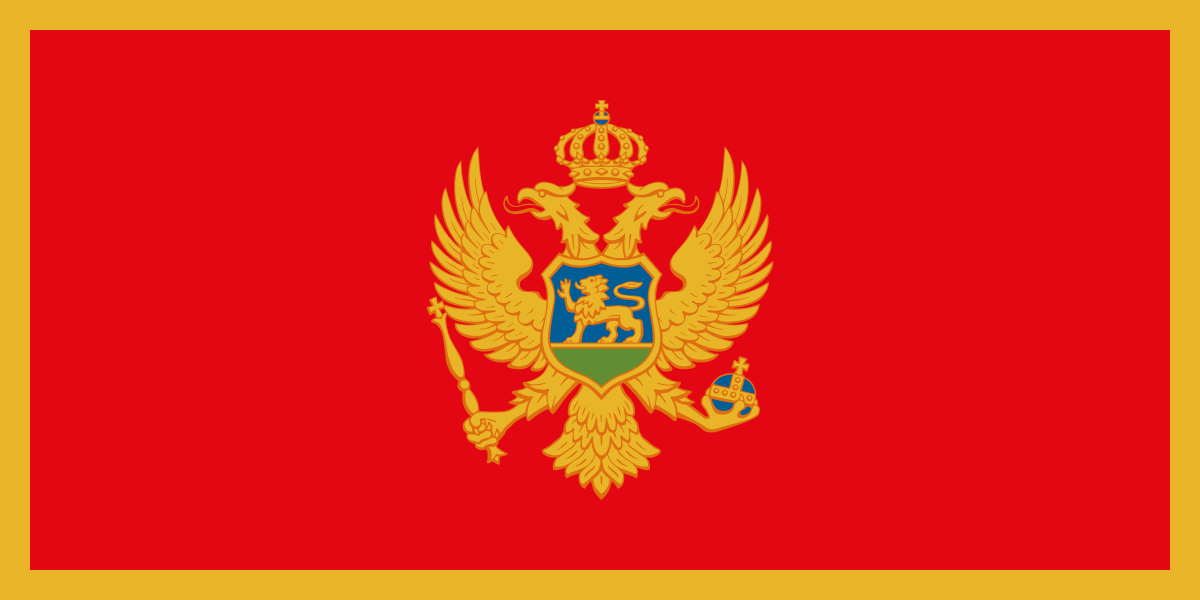
- Country.image_flag
- Flag of Montenegro.svg
- Country.image_coat
- Coat of arms of Montenegro.svg
- Country.coa_size
- 80
- Country.national_anthem
- ()center
- Country.image_map
- Europe-Montenegro.svg
- Country.capital
- Podgorica
- Country.largest_city
- capital
- Country.official_languages
- Montenegrin
- Country.languages2_type
- Languages in official use
- Country.ethnic_groups_year
- 2023 census
- Country.religion_year
- 2023 census
- Country.demonym
- Montenegrin
- Country.government_type
- Unitary parliamentary republic
- Country.leader_title1
- President
- Country.leader_name1
- Jakov Milatović
- Country.leader_title2
- Prime Minister
via Wikipedia infobox
Research
7,577 papers- Measles outbreak, Montenegro January-July 2018: Lessons learned.Journal of medical virology · 2022Mugoša B, Ceccarelli G, Begić S et al.DOI: 10.1002/jmv.27377
- Nationwide epidemiological study of epilepsy in Montenegro.Epilepsy & behavior : E&B · 2024Gluscevic S, Vujsic S, Ristic A et al.DOI: 10.1016/j.yebeh.2024.110065
- Cervical cancer mortality trend in Montenegro-1990-2018.European journal of public health · 2025Nedović Vuković M, Barjaktarović Labović S, Jakšić M et al.DOI: 10.1093/eurpub/ckaf059
- Montenegro skin test: Distracted by the promise of modernity?Revista da Sociedade Brasileira de Medicina Tropical · 2023Barbeitas MMDOI: 10.1590/0037-8682-0492-2022
- Competence development as critical issue for successful performance in HPC technology environment: A case study of Montenegro.ReviewTechnology and health care : official journal of the European Society for Engineering and Medicine · 2023Malisic B, Tinaj SDOI: 10.3233/THC-229017
- Radon in schools of Montenegro.Radiation protection dosimetry · 2025Vukotic P, Zekic R, Svrkota N et al.DOI: 10.1093/rpd/ncaf009
- [The Montenegro intradermo-reaction].Revista brasileira de oto-rino-laringologia · 1945BARBOSA JF
- Bladder Cancer Mortality Trend in Montenegro: 1990-2021.Iranian journal of public health · 2025Vukovic MMN, Terzic ZS, Golubovic MM et al.
via PubMed
Wikidata facts
- Named after
- Lovćen
- Official name
- Црна Гора
- Demonym
- Montenegrinerinnen
- Country
- Montenegro
- Contains
- Berane Municipality
- Continent
- Europe
- Capital
- Cetinje
- Official language
- Albanian
- Currency
- euro
- Population
- 612267
- Area
- 13883
- Body of water
- Mediterranean Sea
- Head of government
- Milojko Spajić
- Head of state
- Jakov Milatović
- Form of government
- republic
- Legislature
- Parliament of Montenegro
- Anthem
- Oj, svijetla majska zoro
- Shares border with
- Kosovo
- Highest point
- Zla Kolata
- Official website
- www.gov.me
- Image
- R-1 regional road (Montenegro) 07.jpg
- Life expectancy
- 76
- Nominal GDP
- 6095978868
- Unemployment rate
- 19
Show 61 more facts
- Calling code
- +382
- Licence plate code
- MNE
- Electrical plug type
- Schuko
- Mains voltage
- 230
- Motto
- Harddwch gwyllt
- Coat of arms
- Coat of arms of Montenegro
- topic's main Wikimedia portal
- Portal:Montenegro
- top-level Internet domain
- .me
- Commons category
- Montenegro
- topic's main category
- Category:Montenegro
- category for people who died here
- Category:Deaths in Montenegro
- category for people born here
- Category:Births in Montenegro
- category for films shot at this location
- Category:Films shot in Montenegro
- category of associated people
- Category:Montenegrin people
- diplomatic relation
- Albania
- history of topic
- history of Montenegro
- IPA transcription
- t͡sr̩̂ːnaː ɡɔ̌ra
- Commons gallery
- Црна Гора / Crna Gora
- lowest point
- Adriatic Sea
- mobile country code
- 297
- inception
- 2006-06-03
- driving side
- right
- geography of topic
- Geography of Montenegro
- GS1 country code
- 389
- trunk prefix
- 0
- office held by head of government
- Prime Minister of Montenegro
- executive body
- Government of Montenegro
- office held by head of state
- President of Montenegro
- total fertility rate
- 1.689
- maritime identification digits
- 262
- category for people buried here
- Category:Burials in Montenegro
- located in/on physical feature
- Balkans
- replaces
- Serbia and Montenegro
- Unicode character
- 🇲🇪
- native label
- Црна Гора
- central bank
- Central Bank of Montenegro
- language used
- Montenegrin
- VAT rate
- 21
- BTI Status Index
- 6.96
- BTI Governance Index
- 6.23
- economy of topic
- economy of Montenegro
- demographics of topic
- demographics of Montenegro
- topic has template
- Template:Montenegro topics
- different from
- Montenegro
- Democracy Index
- 6.67
- Human Development Index
- 0.832
- P11012
- Brittany
- hashtag
- Montenegro
- on focus list of Wikimedia project
- Wikipedia:Vital articles/Level/4
- Happy Planet Index score
- 41.3
- Gini coefficient
- 29.4
- Inequality-adjusted Human Development Index
- 0.756
- P12749
- arthropod
- birth rate
- 11.4
- male population
- 300543
- death rate
- 11.5
- rural population
- 196496
- female population
- 316670
- urban population
- 420717
Sources (15)
via Wikidata · CC0
Travel guide
Get in
Most foreign tourists enter Montenegro directly by air, by road from Croatia, or occasionally by sea from Italy. Land routes from Bosnia, Serbia, Kosovo, and Albania are mainly used by tourists from those respective countries.
thumb|450px|Visa policy of Montenegro
See
While Montenegro may be a small country, it has so much diverse history and nature to see. There are stunning mountainous landscapes, dramatic coastlines, historic monuments and truly beautiful walled towns. The Montenegro coast is just as gorgeous as that of its better known neighbour, Croatia, and it is for good reason that its main tourist destinations get crowded in summer. Nevertheless, if you can't visit at another time, don't let their popularity hold you back. Even the largest of cruise ship crowds will not stop you from enjoying this country's magnificent Riviera and Medieval coast towns, especially if you're willing to get up early and do your sightseeing ahead of the others.
Of the country's many churches and monasteries, the Serbian Orthodox Ostrog Monastery deserves special attention. It's spectacularly located against a practically vertical background, some 10 km from Danilovgrad. Founded in the 17th century, it's one of the most visited pilgrimage destinations on the Balkans and boasts a magnificent view over the Bjelopavlići plain.
Eat
thumb|Njeguški pršut Apart from the hotels located in towns and summer resorts offering half-board and full-board accommodation, and those along the roads and communication lines such as restaurants, pizza places, taverns, fast food restaurants and cafes, there is a choice of national restaurants offering traditional Montenegrin cuisine.
In addition to the standard European and Mediterranean cuisine, Montenegro offers a variety of healthy food products and local specialities.
Cold hors-d'oeuvres include the famous njeguški pršut (smoked ham) and njeguški cheese, pljevaljski cheese, mushrooms, donuts and dried bleak. The main courses specific for the northern mountainous region are boiled lamb, lamb cooked in milk, cicvara in fresh milk cream (buttered corn porridge), boiled potatoes with cheese and fresh cream. A selection of traditional recipes of the central and coastal parts will include the kastradina (dried mutton), smoked and fresh carp (from Skadar lake) and a variety of fresh sea fish and seafood dishes. Donuts served with honey and dried figs are traditional desserts in these parts of Montenegro.
Products of animal origin are supervised and approved by veterinary and health authorities according to EU standards. The restaurant scene in Montenegro is rapidly evolving and has become increasingly international and continues to attract a new diverse variety of restaurants on the coast and in Podgorica.
Stay safe
thumb|Police car in Montenegro Montenegro is generally a safe country. There is, like all countries in the world, criminal activities, but police forces are generally fast in their duties. The number is 122, as well as the international distress call 112. When travelling in the areas bordering Kosovo, it is recommended you keep to the main roads. Unexploded landmines may remain along the Kosovo border. You should also avoid areas where there is military activity.
In the resort towns such as Kotor, Budva, Sveti Stefan and Herceg Novi, beggars and pickpockets are not uncommon. As in many other European locations, beggars are part of organized crime groups. Do not give them money. Doing so may also make you a target for more aggressive approaches. Always carry your bags in the safest way, slung around your shoulder with the pouch in front (with your money carried under your clothing) where you can keep your arm or hand across it.
Sea urchins are small, globular, spiny sea creatures that cover much of the sea floor off the coast of Montenegro. This isn't a bad thing being as they only gather in super clear water. It's a good idea to wear sea socks or something to cover your feet while walking through the water. Also, if you snorkel, be careful and ensure you don't brush up against the ones on the sides of the rocks.
Montenegrins are not safe drivers. You will often feel as though you are competing for road space with aggressive drivers who have little regard for your or their …
Stay healthy
Tap water is generally drinkable, though in some small towns it may be better to avoid it.
Respect
Short pants are usually not permitted inside public institutions (hospitals, etc.) Wear modest clothing when visiting monasteries and churches.
At beaches, taking off the bottom piece of a swimsuit will likely create a stir and is generally reserved for designated nude beaches.
When toasting and clinking glasses, look the opposite person in the eyes or else it may be taken as a sign of disrespect.
Being visibly drunk is a sign of bad taste and character in Montenegro: you may be invited to drink gallons but you're expected to be able to hold it. People also usually prefer to sip their liquor instead of emptying it "bottoms-up" style. Be careful: rakija, a plum spirit, is probably going to be stronger than you expect (usually about 53% alcohol content) and will make you drunk fast!
Travel guide from Wikivoyage (CC BY-SA 4.0)
~40 min read
Encyclopedic overview
37 sectionsContents
- Etymology
- History
- Antiquity
- Arrival of the Slavs
- Early modern period
- Principality and Kingdom of Montenegro
- Kingdom of Yugoslavia
- World War II and Socialist Yugoslavia
- Montenegro within FR Yugoslavia
- Independence
- Recent history
- Geography
- Biodiversity
- Politics
- Administrative divisions
- Foreign relations
- Law
- Law enforcement, security and emergency services
- Military
- Economy
- Infrastructure
- Tourism
- Demographics
- Ethnic structure
- Languages
- Religion
- Culture
- Media
- Sport
- Cuisine
- See also
- Notes
- References
- Sources
- Further reading
- Bibliographies of Montenegro
- External links
Montenegro is a country in Southeast Europe, on the Balkan Peninsula. Its 25 municipalities have a total population of 633,158 people in an area of 13,883 km (5,360 sq mi). It is bordered by Serbia to the northeast, Bosnia and Herzegovina to the northwest, Kosovo to the east, Albania to the southeast, and Croatia to the west, and has a coastline along the Adriatic Sea to the southwest. The capital and largest city is Podgorica, while Cetinje is the Old Royal Capital and cultural centre.
Before the arrival of the Slav peoples in the Balkans in the 6th and 7th centuries CE, the area now known as Montenegro was inhabited principally by people known as Illyrians. During the Early Medieval period, three principalities were located on the territory of modern-day Montenegro: Duklja, roughly corresponding to the southern half; Travunia, the west; and Rascia proper, the north. The Principality of Zeta emerged in the 14th and 15th centuries. From the late 14th century to the late 18th century, large parts of southern Montenegro were ruled by the Venetian Republic and incorporated into Venetian Albania. The name Montenegro was first used to refer to the country in the late 15th century. After falling under Ottoman Empire rule, Montenegro gained semi-autonomy in 1696 under the rule of the House of Petrović-Njegoš, first as a theocracy and later as a secular principality. Montenegro's independence was recognised by the Great Powers at the Congress of Berlin in 1878. In 1910, the country became a kingdom. After World War I, the kingdom became part of Yugoslavia. Following the breakup of Yugoslavia, the republics of Serbia and Montenegro together proclaimed a federation. In June 2006 Montenegro declared its independence following a referendum.
Excerpted from Wikipedia’s “Montenegro” article, available under the CC BY-SA 4.0 licence.
Gallery (59)
On the map
6 mapped locations
Available in 261 languages
- Español
- Français
- Deutsch
- 中文
- 日本語
- Русский
- Português
- Italiano
- العربية
- हिन्दी
- Abkhazian
- Achinese
- Adyghe
- Afrikaans
- Albanian
- Albanian
- Amharic
- ami
Show 242 more
- Angika
- Aragonese
- Aramaic
- Armenian
- Arpitan
- Asturian
- Avaric
- azb
- Azerbaijani
- Bahasa Indonesia
- Balinese
- Bangla
- Bashkir
- Basque
- bat_smg
- Bavarian
- be_x_old
- Belarusian
- Betawi
- Bhojpuri
- Bikol
- Bishnupriya
- Bislama
- blk
- Bosnian
- Breton
- Bulgarian
- Buriat
- Burmese
- Catalan
- cbk_zam
- cdo
- Cebuano
- Central Kurdish
- Chechen
- Cherokee
- Church Slavic
- Chuvash
- Cornish
- Corsican
- Crimean Tatar
- Croatian
- Czech
- Danish
- Divehi
- dty
- Dzongkha
- Egyptian Arabic
- eml
- Erzya
- Esperanto
- Estonian
- Ewe
- Extremaduran
- Faroese
- Fiji Hindi
- Filipino
- Finnish
- fiu_vro
- Friulian
- Fula
- Gagauz
- Galician
- Ganda
- gcr
- Georgian
- Gilaki
- Goan Konkani
- Gothic
- Greek
- Guarani
- Gujarati
- Haitian Creole
- Hakka Chinese
- Hausa
- Hawaiian
- Hebrew
- Hungarian
- hyw
- Icelandic
- Ido
- Iloko
- Inari Sami
- Interlingua
- Interlingue
- Irish
- Jamaican Creole English
- Javanese
- Kabardian
- Kabyle
- Kannada
- Kara-Kalpak
- Karachay-Balkar
- Kashubian
- Kazakh
- kge
- Kinyarwanda
- Komi
- Komi-Permyak
- Kongo
- Kotava
- Kurdish
- Kyrgyz
- Ladino
- Lao
- Latgalian
- Latin
- Latvian
- Lezghian
- Ligurian
- Limburgish
- Lingala
- Lingua Franca Nova
- Lithuanian
- lld
- Lombard
- Low German
- Lower Sorbian
- Luxembourgish
- Macedonian
- Madurese
- Malagasy
- Malay
- Malayalam
- Maltese
- Manipuri
- Manx
- Māori
- map_bms
- Marathi
- Mari
- Mazanderani
- Minangkabau
- Mingrelian
- Mirandese
- Moksha
- Mongolian
- Moroccan Arabic
- Navajo
- nds_nl
- Neapolitan
- Nederlands
- Nepali
- Northern Frisian
- Northern Sami
- Norwegian
- Norwegian Nynorsk
- Novial
- nrm
- Obolo
- Occitan
- Old English
- olo
- Oromo
- Ossetic
- Pampanga
- Pangasinan
- Papiamento
- Pashto
- Picard
- Piedmontese
- Polski
- Pontic
- Punjabi
- Quechua
- roa_rup
- roa_tara
- Romanian
- Romansh
- Rusyn
- Samoan
- Sardinian
- Saterland Frisian
- Scots
- Scottish Gaelic
- Serbian
- Serbian (Latin)
- Shan
- Shona
- Sicilian
- Silesian
- simple
- Sindhi
- Sinhala
- Slovak
- Slovenian
- Somali
- Sranan Tongo
- Standard Moroccan Tamazight
- Sundanese
- Svenska
- Swahili
- Swati
- szy
- Tajik
- Talysh
- Tamil
- Taroko
- Tatar
- tay
- Telugu
- Tetum
- Tibetan
- Tiếng Việt
- Toki Pona
- Tongan
- Tsonga
- Tumbuka
- Türkçe
- Turkmen
- Tuvinian
- Udmurt
- Ukrainian
- Upper Sorbian
- Urdu
- Uyghur
- Uzbek
- Venetian
- Veps
- Volapük
- Walloon
- Waray
- Welsh
- West Flemish
- Western Frisian
- Western Panjabi
- Wolof
- Wu Chinese
- Xhosa
- Yakut
- Yiddish
- Yoruba
- Zaza
- Zeelandic
- zh_classical
- zh_min_nan
- zh_yue
- Zhuang
- Zulu
- فارسی
- ไทย
- 한국어
via Wikidata sitelinks · CC0