
File:Portrait_of_Moses_Maimonides_in_Thesaurus_antiquitatum_sacrarum.tif · Wikimedia Commons · See Wikimedia Commons
Moshe ben Maimon
Sign in to saveAlso known as Mosheh ben Maimon, Moses Maimonides, Mūsā ibn Maymūn, RaMBaM, Rabbeinu Mosheh Ben Maimon, Rambam, Maimonides
Moses ben Maimon (died 12 December 1204), commonly known as Maimonides and also referred to by the Hebrew acronym Rambam, was a Sephardic Jewish rabbi who is widely acknowledged as one of the most prolific and influential Torah scholars of the Middle Ages. Originally from Córdoba, where he was born on Passover Eve of 1135 or 1138, his family was exiled from Muslim-ruled Spain when they refused to convert to Islam shortly after the Almohad Caliphate conquered the Almoravid dynasty in 1148. Over the course of the next two decades, Maimonides resided in Fez, Acre, Jerusalem, Alexandria, and Cairo
OverviewAI-generated
Moshe ben Maimon, also known as Rambam, was a male Sephardi Jewish philosopher, physician, writer, rabbi, and astronomer. Born in Córdoba and a citizen of al-Andalus and Egypt, he practiced Rabbinic Judaism and spoke Hebrew and Arabic. His professional fields included philosophy, medicine, Torah, and Halakha. He was influenced by Avicenna, Farabi, Avempace, and Aristotle.
His notable works include the Mishneh Torah, The Guide for the Perplexed, Epistle to Yemen, and Sefer Hamitzvot. He was the father of Abraham ben Moses ben Maimon. Described in sources such as the Jewish Encyclopedia of Brockhaus and Efron and the Encyclopædia Britannica 11th edition, he was also referred to by the nicknames L’Aigle de la Synagogue and הנשר הגדול. He died on 1204-12-13 in Cairo and is buried in Tiberias.
Synthesized by Vinony from 20 facts across 2 sources: Wikidata, Europeana Sparql. Generated from structured data (not the Wikipedia text) and checked against those facts — may still contain errors.
Key facts
- Philosopher.honorific_prefix
- Rabbi
- Philosopher.name
- Moses ben Maimon
- Philosopher.image
- Portrait of Moses Maimonides in Thesaurus antiquitatum sacrarum.tif
- Philosopher.caption
- Posthumous engraving in , from which all modern portraits of Maimonides are derived,
- Philosopher.other_names
- Rambam ()
- Philosopher.birth_date
- 30 March or 6 April 1135, or 28 March or 4 April 1138
- Philosopher.birth_place
- Córdoba, Almoravid dynasty (now Spain)
- Philosopher.death_date
- 12 December 1204 (aged 66–69)
- Philosopher.death_place
- Fustat, Ayyubid Sultanate (now Egypt)
- Philosopher.children
- Abraham Maimonides (son)
- Philosopher.family
- Maimon ben Joseph (father)
- Philosopher.notable_works
- Mishneh Torah (1170–1180)The Guide for the Perplexed (1185–1190)
- Philosopher.signature
- Firma de Maimonides.svg
- Philosopher.era
- Medieval philosophy
- Philosopher.region
- Middle Eastern philosophy
- Philosopher.school_tradition
- Aristotelianism
- Philosopher.thesis_title
- <!--(or
- Philosopher.thesis1_title
- and
via Wikipedia infobox
Wikidata facts
- Instance of
- human
- Given name
- Moshe
- Gender
- male
- Citizenship
- Egypt
- Place of birth
- Córdoba
- Place of death
- Cairo
- Occupation
- physician
- Languages spoken
- Arabic
- Religion
- Rabbinic Judaism
- Field of work
- Judaism
- Image
- Maimònides.jpg
Show 14 more facts
- Commons category
- Moshe ben Maimon
- ethnic group
- Sephardi Jews
- date of death
- 1204-12-13
- topic's main category
- Category:Maimonides
- date of birth
- 1135-03-30
- name in native language
- משה בן מימון
- Commons Creator page
- Maimonides
- influenced by
- Averroes
- place of burial
- Tiberias
- nickname
- Rambam (annagramme de Rabbi Moshe ben Maymun)
- different from
- Nahmanides
- on focus list of Wikimedia project
- Wikipedia:Vital articles/Level/4
- maintained by WikiProject
- WikiProject Mathematics
- P8168
- Piliscsaba
Sources (10)
via Wikidata · CC0
Works in European collections
22 objects attributed to Moshe ben Maimon, held across European museums, libraries & archives · via Europeana

Rabi Mossei Aegyptii Dux seu Director dubita(n)tium aut perplexorum, in treis Libros diuisus, & summa accuratione Reuerendi patris Augustini Justiniani ordinis Praedicatorii Nebiensiu(m) Episcopi recognitus (etc.)
’grwt lhm’wr hgdwl
Dbry šmw’l bn r yhwdh bn tbwn zl m‘tyq hm’mr hzh mlšwn hgry ’l lšn ‘bry
“z the mš bhbyṭy” the kl mṣwtyk. - (Ydy hmḥwqy Šlmh br Yhudh w 'bdyh br Mšh)
“z the mš bhbyṭy” the kl mṣwtyk. - (Ydy hmḥwqy Šlmh br Yhudh w 'bdyh br Mšh)
’z l’ ’bwš bhkyṭy ’l kl mṣwtyk

Treaty of the Poison of Maimonide (18th century) with an alphabetical table of the pharmaceutical, Arabic and Hebrew names... translated by I.-M. Rabbinowicz
Medicine Treaties [Manuscript]
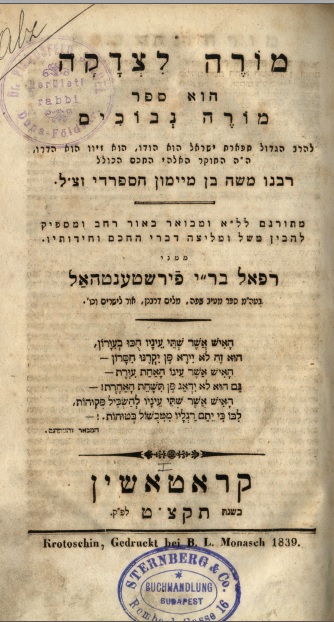
[Mŵreh nebẇqim]
S. ʼeḥad ʻašar w-hẇʼ seper neziqin... ; S. šnim ʻašar w-hẇʼ seper qinian...

De cultu divino, ex R(abi) Mosis Majemonidae II. lege, seu manu forti liber VIII. Dividitur in IX tractatus, quorum Seriem pagina e regione Elenchi posita declarabit. ... Hunc librum ex Habraeo latinum fecit, et notis illustravit Ludovicus de Compiegne de Veil

Sefer yad ha-melekh (hebr.)

Sefer seder Mishneh (Ordnung Mischne) (hebr.)

The ethics of Maimonides or Schemonah Perakim from the Arabian of Rambam and after the Ebräische german. Along with a preface for our time by Simon Falkenheim
Regimine Sanitatis“Maimonides” Tractatus
Untitled
Untitled
Untitled
Untitled
Untitled
Untitled

Untitled
~50 min read
Encyclopedic overview
40 sectionsContents
- Name
- Biography
- Early life
- Exile from Spain
- Settlement in Egypt
- Death of his brother David
- Leadership of Egypt's Jewish community
- Physician for the Ayyubid dynasty
- Death and burial place
- Ancestry and descendants
- Philosophical and theological commentary
- Nature of the God of Abraham
- Morality in character development
- The "prophetic" state
- Problem of evil in spite of God's presence
- Skepticism of astrology
- True beliefs versus necessary beliefs
- Hierarchy of righteousness (''tzedakah'')
- Biblical eschatology and events
- The Messianic era
- Resurrection of the Dead
- The World to Come
- Views on contemporary Kabbalah
- Published works
- On Judaism
- ''Mishneh Torah''
- Rabbinic law and theology
- On medicine
- ''Oath of Maimonides''
- On philosophy
- ''Treatise on Logic''
- Legacy
- Influence on Jewish scholarship
- Tributes and memorials
- See also
- Notes
- References
- Bibliography
- Further reading
- External links
Moses ben Maimon (died 12 December 1204), commonly known as Maimonides and also referred to by the Hebrew acronym Rambam, was a Sephardic Jewish rabbi who is widely acknowledged as one of the most prolific and influential Torah scholars of the Middle Ages. Originally from Córdoba, where he was born on Passover Eve of 1135 or 1138, his family was exiled from Muslim-ruled Spain when they refused to convert to Islam shortly after the Almohad Caliphate conquered the Almoravid dynasty in 1148. Over the course of the next two decades, Maimonides resided in Fez, Acre, Jerusalem, Alexandria, and Cairo before finally settling in Fustat between 1168 and 1171. During this period, he advanced his vocations and became renowned for his achievements as an astronomer, philosopher, and physician—even being appointed to serve as personal physician to Saladin of the Ayyubid Sultanate.
Most contemporary Jews as far as Iraq and Yemen acclaimed Maimonides' writings on halakha and Jewish ethics. Yet, while he rose to lead the Jewish community in Egypt, he also had many loud critics, particularly in Spain. He continued to live in Fustat until his death in 1204 and is said to have been buried in Tiberias. Accordingly, the Tomb of Maimonides in Tiberias holds importance as a Jewish pilgrimage site.
Excerpted from Wikipedia’s “Moshe ben Maimon” article, available under the CC BY-SA 4.0 licence.
Gallery (40)
Available in 87 languages
- Español
- Français
- Deutsch
- 中文
- 日本語
- Русский
- Português
- Italiano
- العربية
- हिन्दी
- Afrikaans
- Albanian
- Albanian
- Armenian
- Asturian
- azb
- Azerbaijani
- Bahasa Indonesia
Show 68 more
- Bangla
- Basque
- Belarusian
- Breton
- btm
- Bulgarian
- Catalan
- Cebuano
- Chuvash
- Croatian
- Czech
- Danish
- Egyptian Arabic
- Esperanto
- Estonian
- Filipino
- Finnish
- Galician
- Georgian
- Greek
- Hebrew
- Hungarian
- Ido
- Irish
- Kazakh
- Kurdish
- Kyrgyz
- Ladino
- Latin
- Latvian
- Lithuanian
- Macedonian
- Malagasy
- Malay
- Malayalam
- Mingrelian
- Moroccan Arabic
- Nederlands
- Norwegian
- Norwegian Nynorsk
- Occitan
- Pashto
- Polski
- Punjabi
- Romanian
- Scots
- Scottish Gaelic
- Serbian
- Serbian (Latin)
- simple
- Slovak
- Slovenian
- Svenska
- Tajik
- Tiếng Việt
- Türkçe
- Ukrainian
- Urdu
- Uzbek
- Waray
- Welsh
- Western Frisian
- Western Panjabi
- Wu Chinese
- Yiddish
- zh_yue
- فارسی
- 한국어
via Wikidata sitelinks · CC0