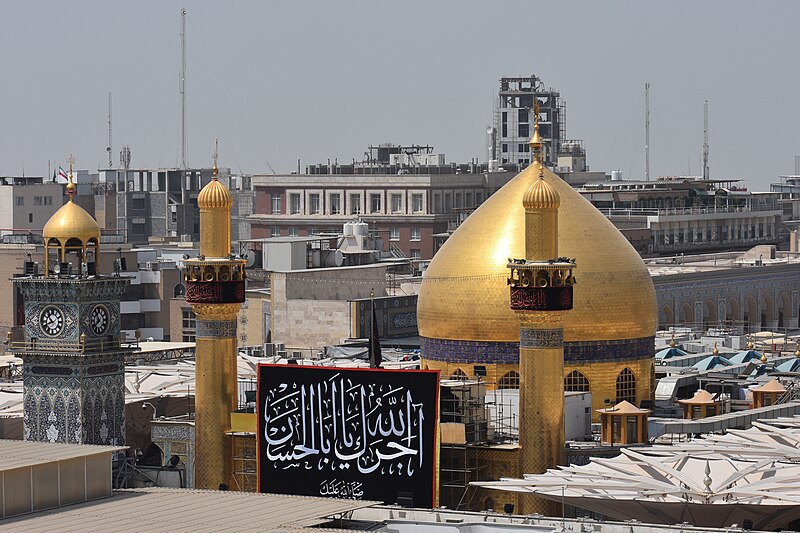
File:Shrine_of_Imam_Ali_Najaf_August_2023.jpg · Wikimedia Commons · See Wikimedia Commons
Najaf
Sign in to saveAlso known as An Najaf, Al-Najaf Al-Ashraf, An Najaf Al Ashraf
Najaf is the capital city of the eponymous Najaf Governorate in central Iraq, about 160 km (99 mi) south of Baghdad. Its estimated population in 2024 was about 1.41 million people. It is widely considered amongst the holiest cities of Shia Islam and one of its spiritual capitals, as well as the center of Shia political power in Iraq.
Najaf is a city in central Iraq, located about 160 kilometers south of Baghdad, with a population of roughly 1.41 million people as of 2024. It holds major religious and political importance as one of the holiest cities in Shia Islam and serves as a center of Shia spiritual authority and political influence in Iraq.
AI-generated from the Wikipedia summary — may contain errors.
Weather now
cached 15h ago7-day forecast
via Open-Meteo
Place details
- Region
- محافظة النجف
- Country
- العراق
- Population
- 482,576
- Timezone
- Asia/Baghdad
via OpenStreetMap · GeoNames
Key facts
- Settlement.name
- Najaf
- Settlement.other_name
- Najaf al-Ashraf, Baniqia
- Settlement.settlement_type
- Metropolis
- Settlement.imagesize
- 275
- Settlement.image_caption
- Top-bottom, L-R: Imam Ali Shrine • Khan al-Nakhilah • Najaf Souk • Khan al-Musalla • Wadi-us-Salaam • Rural Najaf • Al-Sahlah Mosque
- Settlement.pushpin_map
- Iraq
- Settlement.pushpin_label_position
- left
- Settlement.pushpin_relief
- yes
- Settlement.pushpin_map_caption
- Location of Najaf within Iraq
- Settlement.subdivision_type
- Country
- Settlement.subdivision_type1
- Governorate
- Settlement.subdivision_name1
- Najaf
- Settlement.established_date
- 791 CE
- Settlement.founder
- Hārūn al-Rashīd
- Settlement.government_type
- Mayor–council
- Settlement.leader_title
- Mayor
- Settlement.leader_title1
- Mayor
- Settlement.leader_name1
- Yusuf Kinawi
via Wikipedia infobox
Wikidata facts
- Instance of
- big city
- Official name
- النجف
- Country
- Iraq
- Located in
- Najaf Governorate
- Population
- 724700
- Elevation
- 60
- Time zone
- UTC+03:00
- Capital of
- Najaf Governorate
- Image
- ImamAliMosqueNajafIraq.JPG
Show 9 more facts
- twinned administrative body
- Qom
- Commons category
- Najaf
- topic's main category
- Category:Najaf
- category for people born here
- Category:Births in Najaf
- category for people who died here
- Category:Deaths in Najaf
- category of associated people
- Category:People from Najaf
- Commons gallery
- النجف
- native label
- النجف
- P12749
- July 29
via Wikidata · CC0
Travel guide
Understand
The city covered by this article, usually referred to outside Iraq as "Najaf", in fact consists of two cities which, over the centuries, have grown until they joined together. These are Najaf, in the west, and Kufa (sometimes spelled Kufah), in the east. Both are considered holy by Shi'a Muslims, containing the graves of various important religious figures. Additionally, many key events in the lives of these figures took place in Najaf and/or Kufa. As such, the vast majority of visitors to Najaf are Shi'a pilgrims (referred to as Zuwwar in Arabic, or Za'ir in the singular), and they usually travel in groups, guided by a religious scholar. Nonetheless, independent travel is now also possible.
Get in
There are several daily flights from the capital Baghdad as well as several cities in Iran with national carrier Iraqi Airways. Additionally, there are a limited number of international flights from hubs such as Istanbul and Dubai.
You can take shared taxis to/from Baghdad, Karbala, and other cities. Shared taxis to/from Karbala are 3,000 IQD (76km one way), to/from Nasiriyah are 15,000 IQD (256km one way), to/from Hillah are 7,500 IQD, and to/from Baghdad are 15,000 IQD (as of October 2022).
Get around
Careem (ridesharing app, owned by Uber) is available in Najaf, and takes international credit cards. Note that there are roadblocks around the Imam Ali Mosque which may require a "Careem Old City" service to get past (prices are pretty much the same as the regular Careem services though).
See
thumb|View of Imam Ali Shrine.
Najaf is renowned as the site of the Tomb of Alī ibn Abī Tālib also known as "Imām Alī" the First Imam of Shia's, the cousin and son-in-law of the prophet Muhammad who is considered to be a righteous caliph by both the Shia and the Sunni. The city is now a great center of pilgrimage from throughout the Shi'a Islamic world. It is estimated that only Mecca and Medina receive more Muslim pilgrims. As the burial site of Shia Islam's second most important figure, the Imam Ali Mosque is considered by Shias as the third holiest Islamic site.
The Imam Ali Mosque is housed in a grand structure with a gold gilded dome and many precious objects in the walls. Nearby is the Wadi-us-Salaam cemetery, reputed to be the largest in the world. It contains the tombs of several prophets and many of the devout from around the world aspire to be buried here, to be raised from the dead with Imām Alī on Judgement Day. Over the centuries, numerous hospices, schools, libraries and Sufi convents were built around the shrine to make the city the centre of Shīʻa learning and theology.
The Najaf seminary is one of the most important teaching centres in the Islamic world. Ayatollah Khomeini lectured there from 1964–1978. Many of the leading figures of the new Islamic movement that emerged in Iraq, Iran and Lebanon in the 1970s had studied at Najaf.
The Afghan city of Mazar-e Sharif also has a site which claims to be Ali's tomb and draws many pilgrims, but Najaf's claim is …
Drink
In busy areas of Najaf, there are stands selling small cups of black tea. These may cost as little as 250 Dinars, and can be served with or without sugar.
Stay safe
See the warning in the Iraq article.
Nonetheless, Najaf is one of the safest cities in Iraq. As the city is almost entirely Shi'a, ISIS and al-Qaeda have never had any popular support here. There is an extensive network of (highly effective) military and police checkpoints to keep out any would-be infiltrators, especially around areas of interest to pilgrims and tourists (such as mosques and shrines). Expect to be patted down several times before entering the inner part of a shrine.
Respect
Najaf is a holy city in Shi'a Islam, and therefore very conservative, even by Middle Eastern standards. Unlike in some of Iraq's more liberal cities, do not bother looking for alcohol here. Women are expected to wear Iranian-style chadors.
Go next
Most visitors to Najaf are Shi'a pilgrims. The pilgrimage to Iraq is called Ziyarah in Arabic, and a "complete" Ziyarah will involve visiting Karbala, Kadhimain (in Baghdad), and Samarra after Najaf, as these are the burial sites of other Imams (the twelve successors of the Prophet Muhammad, in Shi'a Islam). Other, comparatively minor, pilgrimage sites in Iraq include Hillah and Balad.
Travel guide from Wikivoyage (CC BY-SA 4.0)
~16 min read
Encyclopedic overview
23 sectionsContents
- Etymology
- History
- Prehistoric and ancient times
- Medieval and modern history
- Modern period
- Geography
- Climate
- Religious significance
- Economy
- Culture
- Religious tourism
- Sports
- Education
- Universities
- Najaf Seminary
- Infrastructure
- International relations
- Sister cities
- See also
- Notes
- References
- Further reading
- External links
Najaf is the capital city of the eponymous Najaf Governorate in central Iraq, about 160 km (99 mi) south of Baghdad. Its estimated population in 2024 was about 1.41 million people. It is widely considered amongst the holiest cities of Shia Islam and one of its spiritual capitals, as well as the center of Shia political power in Iraq.
It is the burial place of Muhammad's son in law and cousin, ‘Alī ibn Abī Tālib, and thus a major pilgrimage destination for Shia Muslims. The largest cemetery in the world (Wadi-us-Salaam) and the oldest Shi'a Islamic seminary in the world (Hawza of Najaf) are located in Najaf.
Excerpted from Wikipedia’s “Najaf” article, available under the CC BY-SA 4.0 licence.
Gallery (18)
On the map
6 mapped locations
Available in 81 languages
- Español
- Français
- Deutsch
- 中文
- 日本語
- Русский
- Português
- Italiano
- العربية
- हिन्दी
- Albanian
- Aragonese
- Aramaic
- Armenian
- azb
- Azerbaijani
- Bahasa Indonesia
- Bangla
Show 62 more
- Bashkir
- Basque
- be_x_old
- Belarusian
- Bulgarian
- Catalan
- Cebuano
- Central Kurdish
- Czech
- Danish
- Egyptian Arabic
- Esperanto
- Estonian
- Finnish
- Galician
- Georgian
- Greek
- Hausa
- Hebrew
- Hungarian
- hyw
- Irish
- Kazakh
- Kurdish
- Latvian
- Lithuanian
- Lombard
- Malay
- Malayalam
- Māori
- Marathi
- Mazanderani
- Mingrelian
- Nederlands
- Norwegian
- Norwegian Nynorsk
- Ossetic
- Polski
- Punjabi
- Romanian
- Scots
- Serbian
- Serbian (Latin)
- Silesian
- simple
- Slovenian
- Svenska
- Tajik
- Tamil
- Tatar
- Türkçe
- Ukrainian
- Urdu
- Uyghur
- Uzbek
- Waray
- Western Panjabi
- Wu Chinese
- zh_yue
- فارسی
- ไทย
- 한국어
via Wikidata sitelinks · CC0