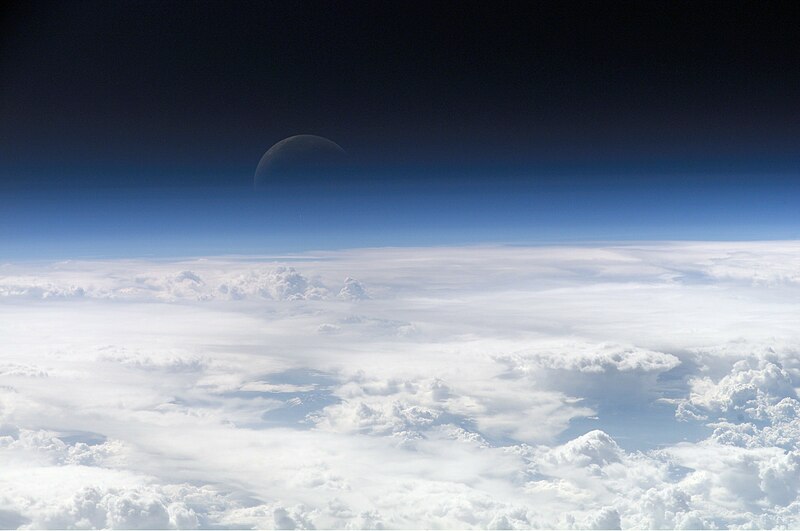
File:Top_of_Atmosphere.jpg · Wikimedia Commons · See Wikimedia Commons
nature
Sign in to saveupright=1.3|thumb|A timelapse composite panorama of different natural phenomena and environments around Mount Bromo, Indonesia.
OverviewAI-generated
Nature is a phenomenon that is part of the universe. It is said to be the same as Prakṛti and is considered the opposite of the supernatural. The subject is distinct from Natura and is characterized by patterns in nature. Its components include natural landscapes.
The topic is studied by natural history, natural science, science, and prirodovedenie. It appears in the Commons category "Nature" and has the main category Category:Nature. Associated portals include Portal:Nature, and the topic uses Template:Nature. It is listed on the focus lists for Wikipedia:List of articles all languages should have and Wikipedia:Vital articles/Level/4.
Research data from PubMed indicates a count of 2,519,827 for the query "nature." Additionally, the subject is referenced by 1,720 other encyclopedia articles. Common hashtags associated with the topic include nature, Natur, natural, and природа.
Synthesized by Vinony from 17 facts across 3 sources: Wikidata, PubMed, Vinony graph. Generated from structured data (not the Wikipedia text) and checked against those facts — may still contain errors.
Research
2,519,827 papers- Nature and mental health: An ecosystem service perspective.ReviewScience advances · 2019Bratman GN, Anderson CB, Berman MG et al.DOI: 10.1126/sciadv.aax0903
- The cognitive benefits of interacting with nature.Psychological science · 2008Berman MG, Jonides J, Kaplan SDOI: 10.1111/j.1467-9280.2008.02225.x
- The impacts of nature experience on human cognitive function and mental health.ReviewAnnals of the New York Academy of Sciences · 2012Bratman GN, Hamilton JP, Daily GCDOI: 10.1111/j.1749-6632.2011.06400.x
- Nature and human well-being: The olfactory pathway.ReviewScience advances · 2024Bratman GN, Bembibre C, Daily GC et al.DOI: 10.1126/sciadv.adn3028
- Nature Contact and Human Health: A Research Agenda.Environmental health perspectives · 2017Frumkin H, Bratman GN, Breslow SJ et al.DOI: 10.1289/EHP1663
- Nature-Based Design in Stroke Rehabilitation Environments: A Scoping Review.HERD · 2024Seale B, Davis A, Lawson J et al.DOI: 10.1177/19375867241251832
- 'Nature-based solutions' is the latest green jargon that means more than you might think.Nature · 2017DOI: 10.1038/541133b
- Nature-based interventions for physical health conditions: A systematic review and meta-analysis.Environmental research · 2024Struthers NA, Guluzade NA, Zecevic AA et al.DOI: 10.1016/j.envres.2024.119421
via PubMed
Wikidata facts
- Instance of
- phenomenon
- Part of
- universe
- Has part
- natural landscape
- Image
- Desert Electric.jpg
- Said to be same as
- Prakṛti
Show 10 more facts
- Commons category
- Nature
- topic's main category
- Category:Nature
- topic has template
- Template:Nature
- on focus list of Wikimedia project
- Wikipedia:Vital articles/Level/4
- opposite of
- supernatural
- hashtag
- природа
- studied by
- science
- has characteristic
- pattern in nature
- topic's main Wikimedia portal
- Portal:Nature
- different from
- Natura
via Wikidata · CC0
~44 min read
Encyclopedic overview
24 sectionsContents
- Etymology
- Earth
- Geology
- Geological evolution
- Historical perspective
- Atmosphere, climate, and weather
- Water on Earth
- Oceans
- Lakes and ponds
- Rivers and streams
- Wilderness
- Life
- Evolution
- Microbes
- Plants and animals
- Human interrelationship
- Human impact
- Aesthetics and beauty
- Matter and energy
- Beyond Earth
- See also
- Notes and references
- Further reading
- External links
upright=1.3|thumb|A timelapse composite panorama of different natural phenomena and environments around Mount Bromo, Indonesia.
Nature is an inherent character or constitution, particularly of the ecosphere or the universe as a whole. In this general sense nature refers to the laws, elements and phenomena of the physical world, including life. Although humans are part of nature, human activity or humans as a whole are often described as at times at odds, or outright separate and even superior to nature.
Excerpted from Wikipedia’s “nature” article, available under the CC BY-SA 4.0 licence.
Gallery (52)
Available in 174 languages
- Español
- Français
- Deutsch
- 中文
- 日本語
- Русский
- Português
- Italiano
- العربية
- हिन्दी
- abstract
- Afrikaans
- Albanian
- Albanian
- Aragonese
- Armenian
- Arpitan
- Assamese
Show 155 more
- Asturian
- Avaric
- azb
- Azerbaijani
- Bahasa Indonesia
- Bangla
- Bashkir
- Basque
- bat_smg
- Bavarian
- be_x_old
- Belarusian
- Bhojpuri
- Bosnian
- Breton
- btm
- Bulgarian
- Buriat
- Burmese
- Catalan
- Central Kurdish
- Chechen
- Chuvash
- Cornish
- Croatian
- Czech
- Danish
- Egyptian Arabic
- Erzya
- Esperanto
- Estonian
- Fiji Hindi
- Fijian
- Filipino
- Finnish
- Galician
- Ganda
- gcr
- Georgian
- Greek
- Guarani
- Gujarati
- guw
- Haitian Creole
- Hebrew
- Hungarian
- hyw
- Icelandic
- Ido
- Iloko
- Ingush
- Interlingua
- Irish
- Jamaican Creole English
- Javanese
- Kabyle
- Kannada
- Kanuri
- Kara-Kalpak
- Karachay-Balkar
- Kazakh
- Khmer
- Kurdish
- Kyrgyz
- Lao
- Latin
- Latvian
- lbe
- Lezghian
- Ligurian
- Lithuanian
- lld
- Lombard
- Low German
- Luxembourgish
- Macedonian
- Madurese
- Malagasy
- Malay
- Malayalam
- Marathi
- Mari
- Minangkabau
- Mingrelian
- Mirandese
- Mongolian
- nah
- Nederlands
- Nepali
- Newari
- Northern Frisian
- Northern Sami
- Norwegian
- Norwegian Nynorsk
- Occitan
- Oromo
- Ossetic
- Palatine German
- Papiamento
- Pashto
- Picard
- Piedmontese
- Polski
- Punjabi
- Quechua
- roa_rup
- Romanian
- Romansh
- Rusyn
- Serbian
- Serbian (Latin)
- Shona
- Sicilian
- simple
- Sindhi
- Slovak
- Slovenian
- Somali
- Sundanese
- Svenska
- Swahili
- Swati
- Tachelhit
- Tajik
- Talysh
- Tamil
- Tatar
- Telugu
- Tiếng Việt
- Toki Pona
- Tsonga
- Türkçe
- Turkmen
- Ukrainian
- Urdu
- Uzbek
- Veps
- Volapük
- Walloon
- Waray
- Welsh
- Western Panjabi
- Wu Chinese
- Xhosa
- Yakut
- Yiddish
- Yoruba
- zh_classical
- zh_min_nan
- zh_yue
- Zhuang
- Zulu
- فارسی
- ไทย
- 한국어
via Wikidata sitelinks · CC0