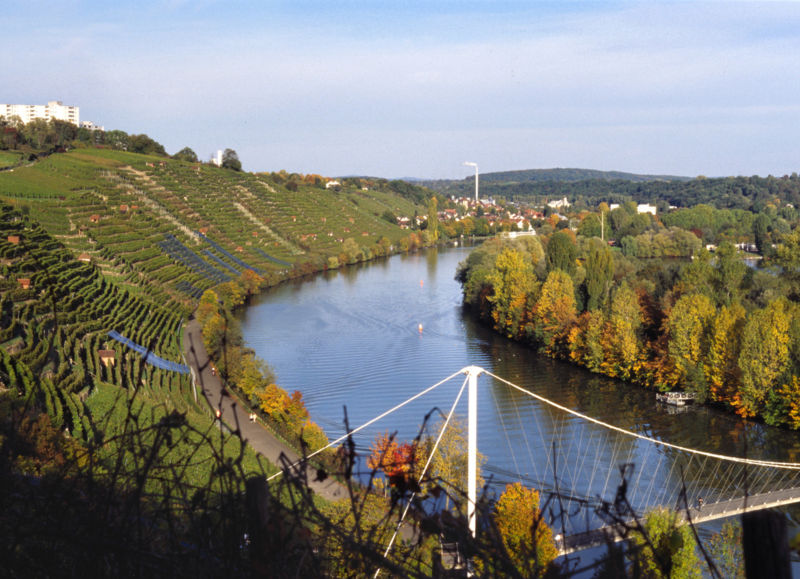
File:Zuckerle.jpg · Wikimedia Commons · See Wikimedia Commons
Neckar
Sign in to saveAlso known as NSU-Fiat
The Neckar () is a river in Germany, mainly flowing through the southwestern state of Baden-Württemberg, with a short section through Hesse. The Neckar is a major right tributary of the Rhine. Rising in the Schwarzwald-Baar-Kreis near Schwenningen in the Schwenninger Moos conservation area, at a height of above sea level, it passes through Rottweil, Rottenburg am Neckar, Kilchberg, Tübingen, Wernau, Nürtingen, Plochingen, Esslingen, Stuttgart, Ludwigsburg, Marbach, Heilbronn and Heidelberg, before discharging on average of water into the Rhine at Mannheim, at above sea level, making the Neckar
The Neckar is a major river in southwestern Germany that flows through Baden-Württemberg and into Hesse, passing through important cities like Stuttgart and Heidelberg before joining the Rhine at Mannheim. As a significant right tributary of the Rhine, it plays an important role in the region's geography and water system.
AI-generated from the Wikipedia summary — may contain errors.
Key facts
- River.name
- Neckar
- River.image
- Zuckerle.jpg
- River.image_caption
- The Neckar near Stuttgart
- River.mapframe
- yes
- River.subdivision_type1
- Country
- River.subdivision_name1
- Germany
- River.source1_location
- Black Forest
- River.mouth_location
- Rhine
- River.length_km
- 362.4
- River.basin_size_km2
- 13928
via Wikipedia infobox
Wikidata facts
- Instance of
- river
- Country
- Germany
- Located in
- Esslingen District
- Elevation
- 89
- Time zone
- UTC+02:00
- Image
- Zuckerle.jpg
- Length
- 362
Show 11 more facts
- tributary
- Itter
- mouth of the watercourse
- Rhine
- Commons category
- Neckar
- category for the water basin
- Category:Neckar basin
- topic's main category
- Category:Neckar
- Commons gallery
- Neckar
- watershed area
- 14000
- P8168
- Bolshoy Durakom
- discharge
- 140.0
- basin country
- Germany
via Wikidata · CC0
~63 min read
Encyclopedic overview
41 sectionsContents
- Etymology
- Geography
- River course
- Sources
- Tributaries
- Diagram of the tributaries with 50 plus km length
- Tributaries with 20 km length and more
- Cities and municipalities
- River history
- River landscape
- Natural landscape
- Cultural landscape
- Renaturation
- Climate
- Navigation
- Historical development
- Timber floating from 1100
- Navigation from the 16th century onward
- Continuous navigability with the Wilhelmskanal in 1821
- <span class="anchor" id="Heavy waterway"></span> Upgrading to a heavy shipping waterway between 1921 and 1968
- Today
- Harbour
- Plochingen harbour
- Stuttgart harbour
- Cannstatt harbour
- Heilbronn harbour
- Mannheim harbour
- Barrages
- Stream gauge and flood
- Freeze up
- Structures
- Mills
- Power stations
- Bridges
- Castles and palaces
- Towers
- The Neckar in literature
- Literature
- Maps
- References
- External links
The Neckar () is a river in Germany, mainly flowing through the southwestern state of Baden-Württemberg, with a short section through Hesse. The Neckar is a major right tributary of the Rhine. Rising in the Schwarzwald-Baar-Kreis near Schwenningen in the Schwenninger Moos conservation area, at a height of above sea level, it passes through Rottweil, Rottenburg am Neckar, Kilchberg, Tübingen, Wernau, Nürtingen, Plochingen, Esslingen, Stuttgart, Ludwigsburg, Marbach, Heilbronn and Heidelberg, before discharging on average of water into the Rhine at Mannheim, at above sea level, making the Neckar its 4th largest tributary, and the 10th largest river in Germany. Since 1968, the Neckar has been navigable for cargo ships via 27 locks for about upstream from Mannheim to the river port of Plochingen, at the confluence with the Fils.
From Plochingen to Stuttgart, the Neckar valley is densely populated and heavily industrialised, with several well-known companies. Between Stuttgart and Lauffen, the Neckar cuts a scenic, meandering, and in many places steep-sided, valley into fossiliferous Triassic limestones and Pleistocene travertine. Along the Neckar's valley in the Odenwald hills many castles can be found, including Hornberg Castle and in Haßmersheim; the decommissioned Obrigheim Nuclear Power Plant and Neckarwestheim Nuclear Power Plant are also located there.
Excerpted from Wikipedia’s “Neckar” article, available under the CC BY-SA 4.0 licence.
Gallery (52)
On the map
3 mapped locations
Available in 74 languages
- Español
- Français
- Deutsch
- 中文
- 日本語
- Русский
- Português
- Italiano
- العربية
- Afrikaans
- Albanian
- Albanian
- Armenian
- azb
- Azerbaijani
- Bahasa Indonesia
- Basque
- be_x_old
Show 55 more
- Belarusian
- Breton
- Bulgarian
- Catalan
- Cebuano
- Chuvash
- Corsican
- Croatian
- Czech
- Danish
- Egyptian Arabic
- Esperanto
- Estonian
- Finnish
- Galician
- Georgian
- Greek
- Hebrew
- Hungarian
- Latin
- Latvian
- Lithuanian
- Lombard
- Macedonian
- Malagasy
- Malayalam
- Marathi
- Mazanderani
- Mingrelian
- Nederlands
- Norwegian
- Norwegian Nynorsk
- Ossetic
- Palatine German
- Piedmontese
- Polski
- Romanian
- Serbian
- Serbian (Latin)
- simple
- Slovak
- Slovenian
- Svenska
- Tamil
- Tiếng Việt
- Türkçe
- Ukrainian
- Upper Sorbian
- Welsh
- Western Frisian
- Wu Chinese
- zh_min_nan
- فارسی
- ไทย
- 한국어
via Wikidata sitelinks · CC0