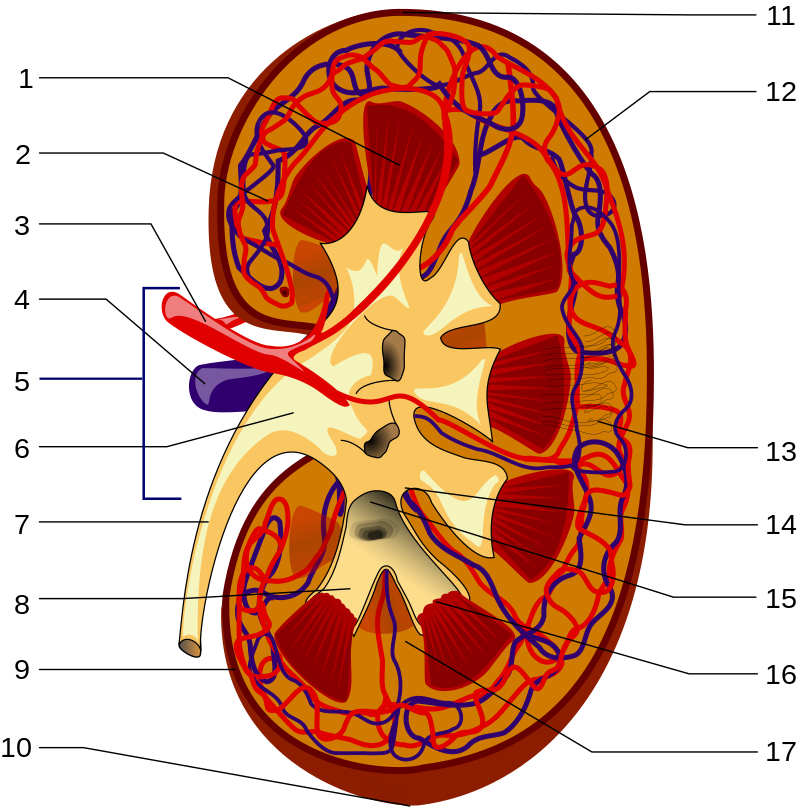
File:KidneyStructures_PioM.svg · Wikimedia Commons · See Wikimedia Commons
nephrology
Sign in to saveNephrology (from Ancient Greek νεφρός (nephrós), meaning "kidney", and λόγος (lógos), meaning "study") is a specialty for both adult internal medicine and pediatric medicine that concerns the study of the kidneys, specifically normal kidney function (renal physiology) and kidney disease (renal pathophysiology), the preservation of kidney health, and the treatment of kidney disease, from diet and medication to renal replacement therapy (dialysis and kidney transplantation). The word "renal" is an adjective meaning "relating to the kidneys", and its roots are French or late Latin. Whereas accord
Nephrology is a medical specialty focused on studying the kidneys, understanding how they normally work, treating kidney diseases, and preserving kidney health through approaches ranging from diet and medication to dialysis and transplantation. It matters because nephrologists help patients manage kidney function and disease, which are critical to overall health.
AI-generated from the Wikipedia summary — may contain errors.
Key facts
- Occupation.name
- Nephrologist
- Occupation.official_names
- Physician
- Occupation.type
- Specialty
- Occupation.activity_sector
- Medicine
- Occupation.formation
- Doctor of Medicine (M.D.) Doctor of Osteopathic medicine (D.O.) Bachelor of Medicine, Bachelor of Surgery (M.B.B.S.) Bachelor of Medicine, Bachelor of Surgery (MBChB)
- Occupation.employment_field
- Hospitals, Clinics
- Medical speciality.title
- Nephrology
- Medical speciality.image
- 250px
- Medical speciality.caption
- A human kidney (click on image for description).
- Medical speciality.system
- Urinary
- Medical speciality.diseases
- Hypertension, Kidney cancer
- Medical speciality.tests
- Kidney biopsy, Urinalysis
- Medical speciality.specialist
- Nephrologist
- Medical speciality.glossary
- Glossary of medicine
via Wikipedia infobox
Research
265,310 papers- Interventional Nephrology: Opportunities and Challenges.ReviewAdvances in chronic kidney disease · 2020Niyyar VD, Beathard GDOI: 10.1053/j.ackd.2020.05.013
- Refashioning Nephrology Education.Clinical journal of the American Society of Nephrology : CJASN · 2023Yuan CMDOI: 10.2215/CJN.0000000000000141
- Onco-Nephrology: Kidney Disease in the Cancer Patient.ReviewThe Medical clinics of North America · 2023Yarandi N, Shirali ACDOI: 10.1016/j.mcna.2023.03.007
- Nephrology Education in Private Practice: My Perspective.ReviewAdvances in chronic kidney disease · 2022Kwon KWDOI: 10.1053/j.ackd.2022.04.006
- Educating the Next-Generation Expert in Nephrology Genetics.ReviewSeminars in nephrology · 2025Lanktree MB, Shurrab S, Ejaz R et al.DOI: 10.1016/j.semnephrol.2025.151648
- Nephrology: As It Was Then, But Is Not Now.ReviewAmerican journal of kidney diseases : the official journal of the National Kidney Foundation · 2017Eknoyan GDOI: 10.1053/j.ajkd.2016.06.029
- [Transition in nephrology].ReviewInnere Medizin (Heidelberg, Germany) · 2025Pape L, Klein L, Gäckler ADOI: 10.1007/s00108-025-01917-1
- International Society of Nephrology's 0by25 initiative for acute kidney injury (zero preventable deaths by 2025): a human rights case for nephrology.Lancet (London, England) · 2015Mehta RL, Cerdá J, Burdmann EA et al.DOI: 10.1016/S0140-6736(15)60126-X
via PubMed
Wikidata facts
- Instance of
- academic discipline
- Subclass of
- medicine
- Part of
- internal medicine
Show 5 more facts
- maintained by WikiProject
- WikiProject Medicine
- OpenStreetMap tag
- healthcare:speciality=nephrology
- Commons category
- Nephrology
- topic's main category
- Category:Nephrology
- different from
- nephology
via Wikidata · CC0
~17 min read
Encyclopedic overview
12 sectionsContents
- Etymology
- Scope
- Nephrologist
- Training
- Australia and New Zealand
- United Kingdom
- United States
- Diagnosis
- Treatment
- Organizations
- References
- External links
Nephrology (from Ancient Greek νεφρός (nephrós), meaning "kidney", and λόγος (lógos), meaning "study") is a specialty for both adult internal medicine and pediatric medicine that concerns the study of the kidneys, specifically normal kidney function (renal physiology) and kidney disease (renal pathophysiology), the preservation of kidney health, and the treatment of kidney disease, from diet and medication to renal replacement therapy (dialysis and kidney transplantation). The word "renal" is an adjective meaning "relating to the kidneys", and its roots are French or late Latin. Whereas according to some opinions, "renal" and "nephro-" should be replaced with "kidney" in scientific writings such as "kidney medicine" (instead of "nephrology") or "kidney replacement therapy", other experts have advocated preserving the use of renal and nephro- as appropriate including in "nephrology" and "renal replacement therapy", respectively.
Nephrology also studies systemic conditions that affect the kidneys, such as diabetes and autoimmune disease; and systemic diseases that occur as a result of kidney disease, such as renal osteodystrophy and hypertension. A physician who has undertaken additional training and become certified in nephrology is called a nephrologist.
Excerpted from Wikipedia’s “nephrology” article, available under the CC BY-SA 4.0 licence.
Gallery (3)
Available in 72 languages
- Español
- Français
- Deutsch
- 中文
- 日本語
- Русский
- Português
- Italiano
- العربية
- हिन्दी
- Albanian
- Armenian
- Azerbaijani
- Bahasa Indonesia
- Bangla
- Basque
- be_x_old
- Belarusian
Show 53 more
- Bosnian
- Bulgarian
- Catalan
- Cebuano
- Croatian
- Czech
- Danish
- Esperanto
- Estonian
- Filipino
- Finnish
- Galician
- Georgian
- Greek
- Hebrew
- Hungarian
- Ido
- Kannada
- Kazakh
- Kurdish
- Kyrgyz
- Latin
- Latvian
- Lithuanian
- Malay
- Malayalam
- Mingrelian
- Nederlands
- Newari
- Norwegian
- Pali
- Pampanga
- Polski
- Romanian
- Sanskrit
- Serbian
- Serbian (Latin)
- simple
- Sinhala
- Slovak
- Slovenian
- Svenska
- Tamil
- Türkçe
- Ukrainian
- Urdu
- Uzbek
- Waray
- Wu Chinese
- zh_yue
- فارسی
- ไทย
- 한국어
via Wikidata sitelinks · CC0