File:Irelands_history.jpg · Wikimedia Commons · See Wikimedia Commons
Newgrange
Sign in to saveAlso known as Newgrange Passage Tomb
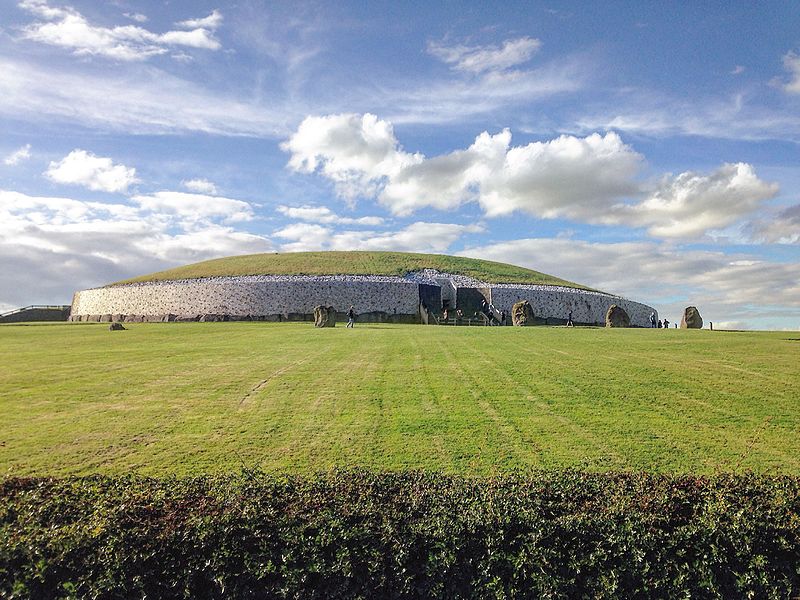
Newgrange () is a prehistoric monument in County Meath in Ireland, placed on a rise overlooking the River Boyne, west of the town of Drogheda. It is an exceptionally grand passage tomb built during the Neolithic Period, around 3100 BC, making it older than Stonehenge and the Egyptian pyramids. Newgrange is the main monument in the Brú na Bóinne complex, a World Heritage Site that also includes the passage tombs of Knowth and Dowth, as well as other henges, burial mounds and standing stones.
Key facts
- Ancient site.name
- Newgrange
- Ancient site.native_name
- Sí an Bhrú
- Ancient site.image
- Irelands history.jpg
- Ancient site.caption
- The monument in 2016
- Ancient site.map_type
- Ireland
- Ancient site.map_caption
- Location in Ireland
- Ancient site.location
- County Meath, Ireland
- Ancient site.type
- passage grave
- Ancient site.width
- 85 meters
- Ancient site.area
- 1.1 acre (0.5 hectare)
- Ancient site.material
- Stone
- Ancient site.epochs
- Neolithic
- Ancient site.excavations
- 1962–1975
- Ancient site.archaeologists
- Michael J. O'Kelly
- Ancient site.ownership
- National Monuments Service
- Ancient site.public_access
- yes (guided tour only)
- Ancient site.designation1
- WHS
- Ancient site.designation1_offname
- Brú na Bóinne
via Wikipedia infobox
Wikidata facts
- Part of
- Brú na Bóinne
- Country
- Republic of Ireland
- Located in
- County Meath
- Official website
- newgrange.com
- Image
- Irelands history.jpg
Show 5 more facts
- heritage designation
- national monument of Ireland
- Commons category
- Newgrange
- historic county
- County Meath
- native label
- Sí an Bhrú
- P12749
- Luigi Nono
via Wikidata · CC0
~33 min read
Encyclopedic overview
19 sectionsContents
- Name and etymology
- Description
- Mound and passage
- Standing stones
- Art
- Early history
- Construction
- Burials
- Purpose
- Bronze Age and Iron Age
- Mythology
- Modern history
- Antiquarianism in the 17th and 18th centuries
- Conservation, archaeological investigation and reconstruction
- Access
- Gallery
- See also
- References
- External links
Newgrange () is a prehistoric monument in County Meath in Ireland, placed on a rise overlooking the River Boyne, west of the town of Drogheda. It is an exceptionally grand passage tomb built during the Neolithic Period, around 3100 BC, making it older than Stonehenge and the Egyptian pyramids. Newgrange is the main monument in the Brú na Bóinne complex, a World Heritage Site that also includes the passage tombs of Knowth and Dowth, as well as other henges, burial mounds and standing stones.
Newgrange consists of a large circular mound with an inner stone passageway and cruciform chamber. Burnt and unburnt human bones, and possible grave goods or votive offerings, were found in this chamber. The monument has a striking façade made mostly of white quartz cobblestones, and it is ringed by engraved kerbstones. Many of the larger stones of Newgrange are covered in megalithic art. The mound is also ringed by a stone circle. Some of the material that makes up the monument came from as far as the Mournes and Wicklow Mountains. There is no agreement about its purpose, but it is believed it had religious significance. It is aligned so that the rising sun on the winter solstice shines through a "roofbox" above the entrance and floods the inner chamber. Several other passage tombs in Ireland are aligned with solstices and equinoxes, and Cairn G at Carrowkeel has a similar "roofbox". Newgrange shares similarities with some other Neolithic monuments in Western Europe; especially Gavrinis in Brittany, which has a similar preserved facing and large carved stones, Maeshowe in Orkney, with its large corbelled chamber, and Bryn Celli Ddu in Wales.
Excerpted from Wikipedia’s “Newgrange” article, available under the CC BY-SA 4.0 licence.
Gallery (28)
On the map
3 mapped locations