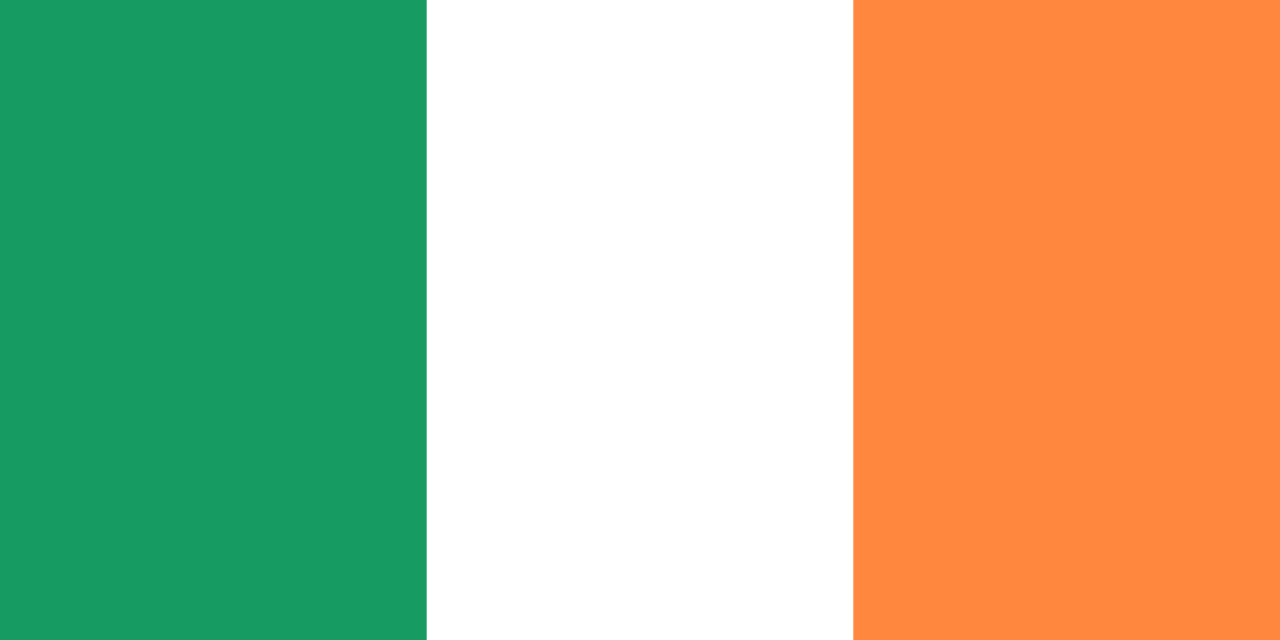
Republic of Ireland
Also known as Éire, Hibernia, Southern Ireland, Irish Republic
Ireland, also known as the Republic of Ireland, is a country in Northwestern Europe. It consists of 26 of the 32 counties of the island of Ireland, with a population of about 5.4 million. Its capital and largest city is Dublin, on the eastern side of the island, with a population of over 1.5 million. The sovereign state shares its only land border with Northern Ireland, which is part of the United Kingdom. It is otherwise surrounded by the Atlantic Ocean, with the Celtic Sea to the south, St George's Channel to the south-east and the Irish Sea to the east. It is a unitary, parliamentary republic. The legislature, the Oireachtas, consists of a lower house, Dáil Éireann; an upper house, Seanad Éireann; and an elected president who serves as the largely ceremonial head of state, but with some important powers and duties. The head of government is the Taoiseach, elected by the Dáil and appointed by the president, who appoints other government ministers.
AI overview
The Republic of Ireland is an independent country in Northwestern Europe comprising 26 of the 32 counties on the island of Ireland, with a population of about 5.4 million and its capital in Dublin. It matters as a sovereign parliamentary republic with its own government system, and it shares the island with Northern Ireland, which is part of the United Kingdom.
AI-generated from the Wikipedia summary — may contain errors.
Weather now
cached 1h ago16°overcast clouds
92% 3.2 m/s OpenWeatherMap
7-day forecast
via Open-Meteo
Country

- Capital
- Dublin
- Population
- 5,458,600
- Region
Travel guide
See
thumb | The Cliffs of Moher in County Clare Scenery in Ireland is the stuff of knights' tales. It's best where you meet a contrast: a stern crag rearing up from green fields, or a plateau ending in sea-cliffs. Ireland's mountains are old and long-weathered so they're of no great height - the highest MacGillycuddy's Reeks only reach 1038 m but rise abruptly behind the lake at Killarney. The Atlantic coast has a series of dramatic peninsulas, with the best-known at Mizen Head in Cork, Ring of Kerry, Loop Head in Clare and Connemara. Several in Mayo and Donegal are blighted by an eczema of second-home cottages, but the upland views are improving as commercial conifer forests are re-wilded with mixed native woodland. Prehistoric Ireland: Brú na Bóinne in Meath is the best known, built around 3000 BC. Trouble is, it's mobbed with tourists, with very limited access slots, and you lose the atmosphere. But Ireland is studded with equally fascinating sites, often in out-of-the-way places so they were never built over or the stone re-used, and with small risk of you having to share them with a babbling tour group. Just a few examples are Loughcrew Cairns in Meath, Ballymote in Sligo, Ahenny in Tipperary or on the wild Burren of Clare. And between the stones were the bogs. Several have boardwalks and visitor centres, but start exploring their fascinating discoveries at the National Museum - Archaeology in Dublin: ornate gold jewellery and contorted bodies. thumb | Cells and wells, the…
Eat
Food is expensive in Ireland, although quality has improved enormously in the last ten years. Most small towns will have a supermarket and many have a weekly farmers' market. The cheapest option for eating out is either fast food or pubs. Many pubs offer a carvery lunch consisting of roasted meat, vegetables and the ubiquitous potatoes, which is usually good value. Selection for vegetarians is limited outside the main cities. The small town of Kinsale near Cork has become internationally famous for its many excellent restaurants, especially fish restaurants. In the northwest of the country Donegal Town is fast becoming the seafood capital of Ireland.
Sleep
There are hotels of all standards including some very luxurious. Bed-and-breakfast accommodations are widely available. These are usually very friendly, quite often family-run and good value. There are independent hostels which are marketed as Independent Holiday Hostels of Ireland, which are all tourist board approved. There is also an official youth hostel association, An Óige (Irish for The Youth). These hostels are often in remote and beautiful places, designed mainly for the outdoors. There are official campsites although fewer than many countries (given the climate). Wild camping is tolerated but try to seek permission—especially where you'll be visible from the landowner's house. Never camp in a field in which livestock are present. There are also specialist places to stay such as lighthouses, castles and ring forts.
~40 min read
Article
Ireland (Irish: Éire [ˈeːɾʲə] ), additionally described as the Republic of Ireland (Poblacht na hÉireann), is a country in Northwestern Europe. It consists of 26 of the 32 counties of the island of Ireland, with a population of about 5.4 million. Its capital and largest city is Dublin, on the eastern side of the island, with a population of over 1.5 million. The sovereign state shares its only land border with Northern Ireland, which is part of the United Kingdom. It is otherwise surrounded by the Atlantic Ocean, with the Celtic Sea to the south, St George's Channel to the south-east and the Irish Sea to the east. It is a unitary, parliamentary republic. The legislature, the Oireachtas, consists of a lower house, Dáil Éireann; an upper house, Seanad Éireann; and an elected president (Uachtarán) who serves as the largely ceremonial head of state, but with some important powers and duties. The head of government is the Taoiseach (prime minister, lit. 'chief'), elected by the Dáil and appointed by the president, who appoints other government ministers.
The Irish Free State was created with Dominion status in 1922, following the Anglo-Irish Treaty. In 1937, a new constitution was adopted, in which the state was named "Ireland" and effectively became a republic, with an elected non-executive president. It was officially declared a republic in 1949, following The Republic of Ireland Act 1948. Ireland became a member of the United Nations in 1955. It joined the European Communities (EC), the predecessor of the European Union (EU), in 1973. The state had no formal relations with Northern Ireland for most of the 20th century, but the 1980s and 1990s saw the British and Irish governments working with Northern Irish parties to resolve the conflict that had become known as the Troubles. Since the signing of the Good Friday Agreement in 1998, the Irish government and Northern Irish government have co-operated on a number of policy areas under the North/South Ministerial Council created by the Agreement.
Gallery (16)
On the map
2 mapped locations
Connections
Categories
1937 establishments in IrelandCountries and territories where English is an official languageCountries in EuropeIsland countriesMember states of the European UnionMember states of the United NationsNUTS 1 statistical regions of the European UnionOECD membersRepublic of IrelandRepublicsSource attributionStates and territories established in 1916