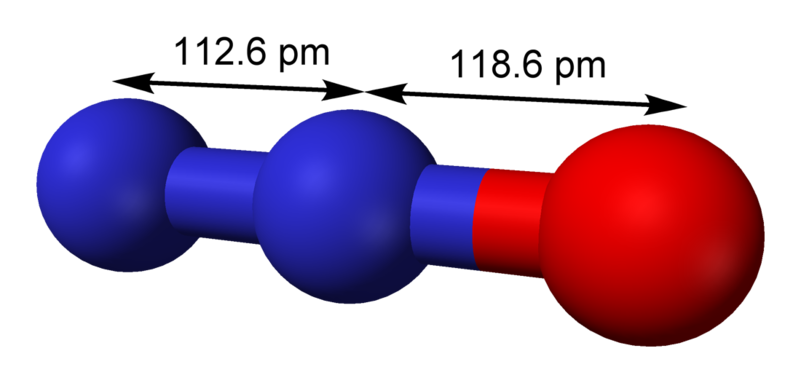
File:Nitrous-oxide-dimensions-3D-balls.png · Wikimedia Commons · See Wikimedia Commons
nitrous oxide
Sign in to saveAlso known as dinitrogen monoxide, hyponitrous acid anhydride, laughing gas, N2O, nitrous, nitro, NOS, NNO
chemical compound
OverviewAI-generated
Nitrous oxide is a chemical compound with the formula N₂O and a molecular mass of 44.001. Its IUPAC name is nitrous oxide. The substance has a density of 1.98 and a vapor pressure of 51.3. Physical properties include a melting point of -132 and -90.8, a boiling point of -127 and -88.48, and a speed of sound of 263. The standard molar entropy is 219.9, while the ionization energy is 12.89.
The compound exhibits a global warming potential of 298 and an electric dipole moment of 0.161. Its solubility is 0.1, and it has a time-weighted average exposure limit of 46. Structural data indicates zero hydrogen bond donors and two hydrogen bond acceptors, with a topological polar surface area of 19.1. The xlogp value is 0.5, and the charge is 0.
Synthesized by Vinony from 29 facts across 4 sources: Wikidata, PubChem, PubMed, Vinony graph. Generated from structured data (not the Wikipedia text) and checked against those facts — may still contain errors.
Chemical data
- Formula
- N2O
- Molecular weight
- 44.013 g/mol
- IUPAC name
- nitrous oxide
- SMILES
- [N-]=[N+]=O
- InChIKey
- GQPLMRYTRLFLPF-UHFFFAOYSA-N
- XLogP
- 0.5
- Polar surface area
- 19.1 Ų
- H-bond donors
- 0
- H-bond acceptors
- 2
- Formal charge
- 0
via PubChem
Research
26,615 papers- Nitrous oxide-induced neurotoxicity: A case report and literature review.ReviewBritish journal of clinical pharmacology · 2021Thayabaran D, Burrage DDOI: 10.1111/bcp.14779
- Exploring Nitrous Oxide as Treatment of Mood Disorders: Basic Concepts.ReviewJournal of clinical psychopharmacology · 2018Nagele P, Zorumski CF, Conway CDOI: 10.1097/JCP.0000000000000837
- Nitrous oxide: a unique drug of continuing importance for anaesthesia.ReviewBest practice & research. Clinical anaesthesiology · 2005Hopkins PMDOI: 10.1016/j.bpa.2005.03.002
- Nitrous oxide inhalation: History and experiences.Acta anaesthesiologica Scandinavica · 2024Kronenberg G, Seifritz E, Olbrich SDOI: 10.1111/aas.14462
- Nitrous oxide-oxygen anesthesia.Anesthesiology · 1946CLEMENT FWDOI: 10.1097/00000542-194611000-00004
- 'Cracking' the environmental problem of nitrous oxide in obstetrics.Anaesthesia · 2023Lucas DN, Wong R, Kearsley RDOI: 10.1111/anae.15907
- NITROUS OXIDE IN OBSTETRICS.ReviewClinical anesthesia · 1964HUSTEAD RF
- [Festive use of nitrous oxide: major risks !].ReviewLa Revue du praticien · 2019Auffret Y
via PubMed
Wikidata facts
- Subclass of
- nitrogen oxide
- Has part
- oxygen
- Mass
- 44.001
- Has use
- medication
Show 20 more facts
- described by source
- Brockhaus and Efron Encyclopedic Dictionary
- Commons category
- Nitrous oxide
- chemical formula
- N₂O
- time-weighted average exposure limit
- 46
- NIOSH Pocket Guide ID
- 0465
- speed of sound
- 263
- melting point
- -90.8
- boiling point
- -88.48
- vapor pressure
- 51.3
- ionization energy
- 12.89
- solubility
- 0.1
- medical condition treated
- substance abuse
- canonical SMILES
- N#[N+][O-]
- subject has role
- inhalant
- standard molar entropy
- 219.9
- density
- 1.967
- global warming potential
- 265
- on focus list of Wikimedia project
- WikiProject Climate change
- electric dipole moment
- 0.161
- different from
- nitrogen dioxide
Sources (10)
via Wikidata · CC0
~40 min read
Encyclopedic overview
Nitrous oxide (dinitrogen oxide or dinitrogen monoxide), commonly known as laughing gas or nitrous, among others, is a chemical compound, an oxide of nitrogen with the formula N 2O. At room temperature, it is a colourless non-flammable gas, and has a slightly sweet scent and taste. At elevated temperatures, nitrous oxide is a powerful oxidiser similar to molecular oxygen.
Nitrous oxide has significant medical uses, especially in surgery and dentistry, for its anaesthetic and pain-reducing effects, and it is on the World Health Organization's List of Essential Medicines. Its colloquial name, "laughing gas", coined by Humphry Davy, describes the euphoric effects upon inhaling it, which cause it to be used as a recreational drug inducing a brief "high". When abused chronically, it may cause neurological damage through inactivation of vitamin B12. It is also used as an oxidiser in rocket propellants and motor racing fuels, and as a frothing gas for whipped cream.
Excerpted from Wikipedia’s “nitrous oxide” article, available under the CC BY-SA 4.0 licence.
Gallery (13)
Available in 67 languages
- Español
- Français
- Deutsch
- 中文
- 日本語
- Русский
- Português
- Italiano
- العربية
- हिन्दी
- Afrikaans
- Armenian
- azb
- Azerbaijani
- Bahasa Indonesia
- Bangla
- Basque
- Bosnian
Show 48 more
- Bulgarian
- Catalan
- Chuvash
- Croatian
- Czech
- Danish
- Egyptian Arabic
- Esperanto
- Estonian
- Finnish
- Galician
- Greek
- Hebrew
- Hungarian
- Ido
- Irish
- Kazakh
- Latvian
- Lithuanian
- Low German
- Macedonian
- Malay
- Malayalam
- Nederlands
- Norwegian
- Norwegian Nynorsk
- Occitan
- Odia
- Polski
- Romanian
- Serbian
- Serbian (Latin)
- simple
- Slovak
- Slovenian
- Svenska
- Tamil
- Tiếng Việt
- Türkçe
- Ukrainian
- Urdu
- Welsh
- Western Panjabi
- Wu Chinese
- zh_yue
- فارسی
- ไทย
- 한국어
via Wikidata sitelinks · CC0