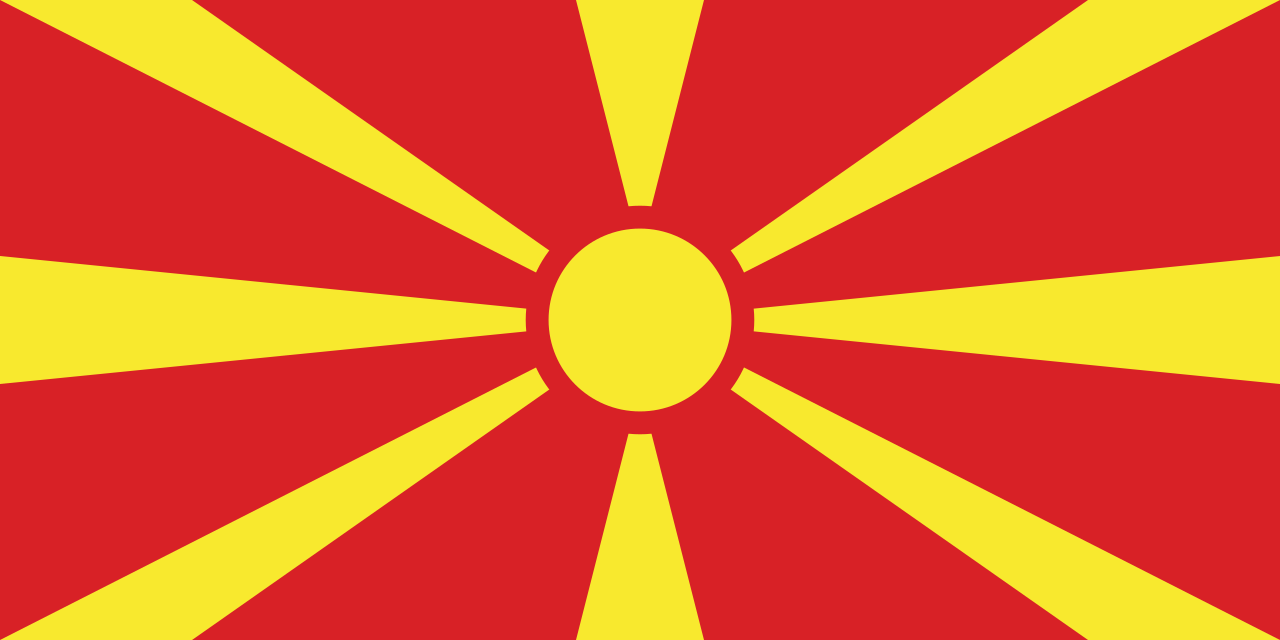
North Macedonia
Sign in to saveAlso known as Republic of North Macedonia, FYROM, FYR Macedonia, Former Yugoslav Republic of Macedonia, Republic of Macedonia, Macedonia
North Macedonia, officially the Republic of North Macedonia, is a landlocked country in Southeast Europe. It shares land borders with Greece to the south, Albania to the west, Bulgaria to the east, Kosovo to the northwest and Serbia to the north. It constitutes approximately the northern third of the larger geographical region of Macedonia. Skopje, the capital and largest city, is home to a quarter of the country's population of over 1.83 million. The majority of the residents are ethnic Macedonians, a South Slavic people. Albanians form a significant minority at around 25%, followed by Turks, Roma, Serbs, Bosniaks, Aromanians and a few other minorities.
OverviewAI-generated
North Macedonia, officially the Republic of North Macedonia, is a country in Southeast Europe. Its capital is Skopje, and it operates as a parliamentary republic. The state gained independence in 1991, replacing the Socialist Republic of Macedonia and the Socialist Federal Republic of Yugoslavia. The official languages are Macedonian and Albanian. The country’s currency is the Macedonian denar.
The population is recorded at 1822612, with 62.5645376928533 percent living in urban areas. Life expectancy is 76.6165853658537 years, and the unemployment rate is 12.256 percent. Internet usage reaches 93.1 percent of the population. Forest area covers 39.7101506740682 percent of the land, while renewable energy accounts for 19.5 percent. The gross domestic product is 16951682245.4202 USD.
North Macedonia participates in the Macedonia naming dispute and the Prespa agreement. It maintains diplomatic relations with Australia, Italy, Ukraine, and Israel. The legislative body is the Assembly of North Macedonia. The head of government holds the office of Prime Minister of North Macedonia. The country’s license plate code is MK, and its top-level domain is .mk.
Synthesized by Vinony from 67 facts across 9 sources: Wikidata, Openweathermap, Open Meteo, World Bank, OpenStreetMap, REST Countries, PubMed, Vinony graph, Geo. Generated from structured data (not the Wikipedia text) and checked against those facts — may still contain errors.
Weather now
cached 18h ago7-day forecast
via Open-Meteo
Country
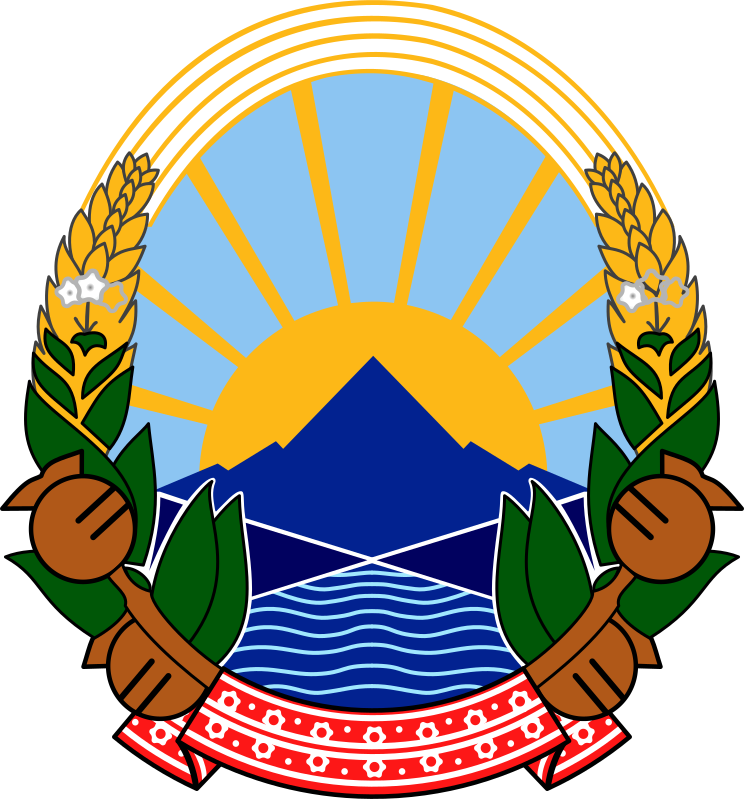
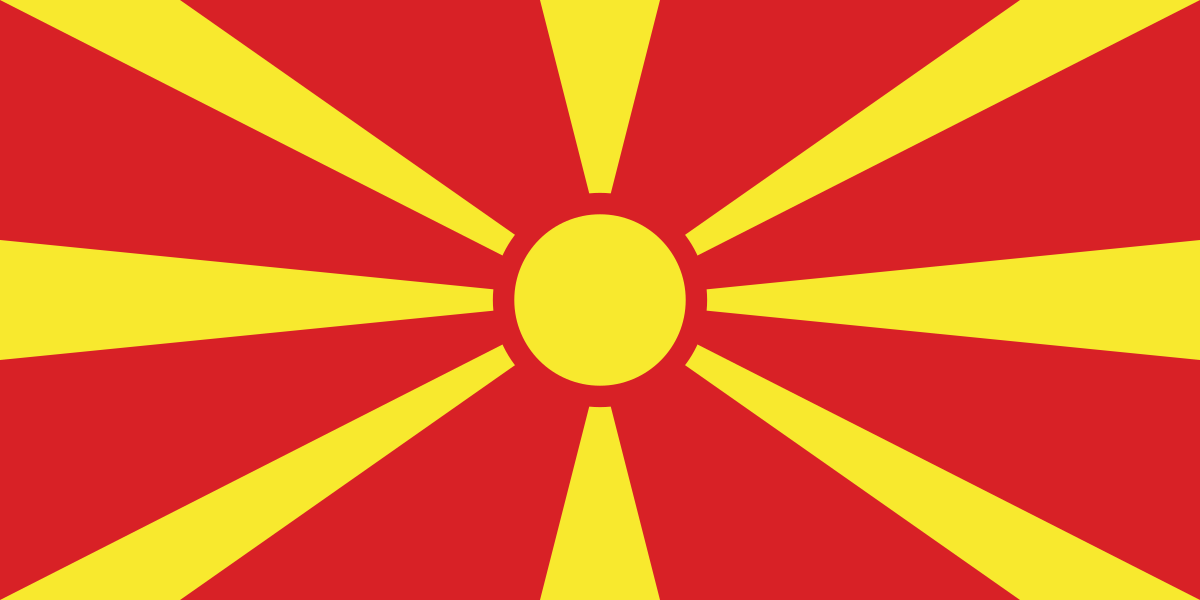
- Capital
- Skopje
- Population
- 1,822,612
- Region
- Europe · Southeast Europe
- Demonym
- Macedonian
- Currencies
- MKD (den)
- Languages
- Macedonian
- Calling code
- +389
- Drives on
- Right
- Gini
- 33 (2018)
- FIFA code
- MKD
- TLD
- .mk
- Timezones
- UTC+01:00
- Borders
- ALB, BGR, GRC, UNK, SRB
via REST Countries
Indicators · World Bank
- GDP
- $17B(2024)
- Population
- 1,824,359(2024)
- Life expectancy
- 76.6 yrs(2024)
- Unemployment
- 12.3 %(2025)
- Urban population
- 62.6 %(2024)
- Internet users
- 93.1 %(2025)
- Forest area
- 39.7 %(2023)
- Renewable energy
- 19.5 %(2021)
via World Bank Open Data · CC BY 4.0
Wikipedia views (30d)
138,252 totalvia Wikimedia Pageviews API
Research
5,991 papers- North Macedonia: Health System Review.ReviewHealth systems in transition · 2024Milevska Kostova N, Atanasova S, Dimkovski V et al.
- Global Dialysis Perspective: North Macedonia.Kidney360 · 2023Gjorgjievski N, Karanfilovski VDOI: 10.34067/KID.0000000000000107
- COVID-19 outbreak in North Macedonia: an overview of its impact on dentistry.ReviewMinerva dental and oral science · 2022Dimkov A, Gjorgievska E, Stevanovic M et al.DOI: 10.23736/S2724-6329.21.04537-X
- Developing modern primary care nursing in North Macedonia.Primary health care research & development · 2023Bryar R, Groenewegen PP, Sánchez Martínez M et al.DOI: 10.1017/S1463423623000348
- Towards leaving no one behind in North Macedonia: a mixed methods assessment of barriers to effective coverage with health services.ReviewInternational journal for equity in health · 2024Koller TS, Janeva JK, Ognenovska E et al.DOI: 10.1186/s12939-023-02082-3
- The changing pattern of fever of unknown origin in the Republic of North Macedonia.ReviewRomanian journal of internal medicine = Revue roumaine de medecine interne · 2019Bosilkovski M, Dimzova M, Cvetkova M et al.DOI: 10.2478/rjim-2019-0007
- Checklist of earthworms of North Macedonia (Clitellata: Megadrili).Zootaxa · 2025Popović FJ, Trakić TB, Szederjesi T et al.DOI: 10.11646/zootaxa.5589.1.17
- Toward value in healthcare: opportunities and challenges for implementing Value-Based Healthcare in North Macedonia.ReviewFrontiers in public health · 2025Grozdanova A, Mihajloska E, Naumovska Z et al.DOI: 10.3389/fpubh.2025.1646870
via PubMed
Wikidata facts
- Instance of
- country
- Named after
- Macedonia
- Official name
- República da Macedônia
- Demonym
- Nordmazedonierinnen
- Participant in
- Prespa agreement
- Country
- North Macedonia
- Contains
- Staro Nagoričane Municipality
- Continent
- Europe
- Capital
- Skopje
- Official language
- Albanian
- Currency
- Macedonian denar
- Population
- 1836713
- Area
- 25713
- Head of government
- Hristijan Mickoski
- Head of state
- Gordana Siljanovska-Davkova
- Form of government
- parliamentary republic
- Legislature
- Assembly of North Macedonia
- Anthem
- Denes nad Makedonija
- Shares border with
- Bulgaria
- Highest point
- Korab
- Official website
- vlada.mk
- Image
- Map of the Republic of Macedonia-mk.svg
- Life expectancy
- 74
- Nominal GDP
- 13563132057
Show 67 more facts
- Unemployment rate
- 14.477
- Calling code
- +389
- Licence plate code
- MK
- Electrical plug type
- Schuko
- Mains voltage
- 230
- Motto
- Diamser yw Gogledd Macedonia
- Coat of arms
- Emblem of North Macedonia
- topic's main Wikimedia portal
- Portal:North Macedonia
- Unicode character
- 🇲🇰
- category of associated people
- Category:Macedonian people
- trunk prefix
- 0
- geography of topic
- Geography of North Macedonia
- office held by head of government
- Prime Minister of North Macedonia
- number of out-of-school children
- 48258
- diplomatic relation
- Albania
- inception
- 1991-00-00
- Commons gallery
- Северна Македонија
- history of topic
- history of North Macedonia
- replaces
- Socialist Republic of Macedonia
- native label
- Република Северна Македонија
- mobile country code
- 294
- total fertility rate
- 1.524
- maritime identification digits
- 274
- marriageable age
- 18
- topic's main category
- Category:North Macedonia
- age of majority
- 18
- located in/on physical feature
- Southern Europe
- executive body
- Government of North Macedonia
- category for people who died here
- Category:Deaths in North Macedonia
- office held by head of state
- President of North Macedonia
- Commons category
- North Macedonia
- top-level Internet domain
- .mk
- category for people born here
- Category:Births in North Macedonia
- short name
- Macedônia do Norte
- driving side
- right
- lowest point
- Vardar
- language used
- Aromanian
- described by source
- Bible Encyclopedia of Archimandrite Nicephorus
- maintained by WikiProject
- WikiProject North Macedonia
- category for films shot at this location
- Category:Films shot in North Macedonia
- different from
- Macedonia
- GS1 country code
- 531
- culture
- culture of North Macedonia
- VAT rate
- 18
- BTI Status Index
- 7.37
- BTI Governance Index
- 6.3
- economy of topic
- economy of North Macedonia
- demographics of topic
- demographics of North Macedonia
- topic has template
- Template:North Macedonia topics
- Democracy Index
- 5.89
- Human Development Index
- 0.770
- P11012
- love
- hashtag
- NorthMacedonia
- on focus list of Wikimedia project
- Wikipedia:Vital articles/Level/4
- Happy Planet Index score
- 43.9
- Gini coefficient
- 33
- Inequality-adjusted Human Development Index
- 0.686
- P12749
- Horn
- birth rate
- 9.9
- male population
- 912991
- death rate
- 12.3
- rural population
- 748840
- female population
- 918720
- urban population
- 1082872
- P8168
- Sakuhei Fujiwhara
Sources (15)
via Wikidata · CC0
Travel guide
Understand
The country officially changed its name from the Republic of Macedonia (Macedonian: Македонија, Makedonija) to the Republic of North Macedonia in February 2019 in order to settle a dispute over its name with Greece. However, hardly any Macedonian refers to their country as "North Macedonia"; instead, they continue to use "Macedonia" and find "North" to be offensive. It was also known as "the former Yugolav Republic of Macedonia (FYROM)" prior to the official name change.
North Macedonia is a country with several ethnic minorities. The majority of the population is ethnic Macedonian and Orthodox Christian but there is also a significant Albanian Muslim minority, and Albanians form majorities in areas in the northwest.
Get in
thumb|450px|Visa policy of North Macedonia
See
thumb|Ohrid is known for its countless churches. thumb|The rugged landscapes of Galičica National Park.
This lovely, compact country has a surprising myriad of attractions to offer. It's a fascinating mix of the ancient Balkan, the laid-back Mediterranean and the hip and happening vibe of modern Europe.
It all starts in lively Skopje, the country's main city and the centre of its economy. It offers great shopping and party opportunities, but also grand historic monuments. The 5th century Tvrdina Kale Fortress is one of the main landsmarks, together with the beautiful Sveti Spas Church, the charming old Ottoman bazaar Čaršija and the Kameni Most. This 600 year old Stone Bridge will take you right onto the city's main square, where a gigantic statue of Alexander the Great awaits. If you're up for a hike, make your way up to the enormous Millennium Cross on top of Vodno mountain, or take the rope railway to get the same views with less effort. If summer makes the city hard to bear, follow the locals to the cool shores of Lake Matka just out of town, where you can explore the gorge and caves through hikes and kayak tours.
Smaller but a visitor's favourite is the city of Ohrid, famous for its countless Byzantine churches. Beautifully situated on Lake Ohrid, this place is listed by UNESCO as both a cultural and a natural monument. It's home to one of the most prominent collections of Byzantine icons in the world, second only to that of the famous Tretiakov Gallery in Moscow, as …
Eat
thumb|Fish plate, Ohrid If you are on a tight budget, try one of the Skara (grill) places. There are quite a few up-market restaurants serving better quality food on the waterfront, but these cater to tourists, so don't be surprised by a rather sizeable bill at the end of your meal.
Service at the restaurants and cafés nationwide tend to be slow-ish, either because these businesses are chronically understaffed, or because of the general laid-back culture. Consider yourself lucky if your food is served within half an hour after you get seated.
Drink
Rakija is a strong grape brandy that has the best claim to being the republic's national beverage. Homemade one can be bought for about 100 dinar per ½ L (sold in water bottles) in local markets from some fruit vendors, which sometimes sell quite high quality and percentage. Keep looking for yellowish one, which was fermented in wood barrels for a while.
Macedonians boast the largest winery in the Balkan area—the Tikveš (Tikvesh) winery in Kavadarci. Red wines are usually better than white ones. Try T'ga za Jug, a Macedonian affordable red wine made from a local grape variety called Vranec. Local white wines include Traminec and Temjanika.
The local beer market is dominated by Skopsko (Скопско, "of Skopje", following the Slavic convention of naming beers after their origin), a drinkable, if not entirely distinctive, lager. There are also many breweries which brew surprisingly good-tasting beer.
Sale of any alcoholic beverages from the stores end by 21:00 all over the country, but in the restaurants and cafés, it's business as usual.
Unlike much of the rest of the Balkans, sparkling water or water with gas is instead mineral water, or kisela voda.
The most common coffee drink in cafés is the macchiato (макијато, espresso topped by a foamy cream), which can be ordered as a single shot, small, mali macchiato, or double shot, large, golem macchiato. Cold cappuccinos with flavoured creams coming in large glasses are also popular in summer.
Tea is pretty much limited to…
Sleep
Being the national tourist attraction, Ohrid is more expensive than any other destination in North Macedonia. Hotel prices, primarily those of high-end hotels, are very expensive throughout the country and charge double rates to foreigners. It is therefore advisable to stay in private accommodation. If someone does not ask you at the bus station, you can always consult one of the many travel agencies in and around the centre. If you do opt for private accommodation make sure you see the room first and then decide. Payment is normally made in advance and should cost no more than €10-15 per night per person in peak season and half that during the rest of the year. Finding suitable accommodation in July and August is not easy, so try to book through a travel agent in advance.
When visiting Lake Ohrid, staying in nearby Struga as opposed to the more popular Ohrid is a wise alternative for the price and tourist-trap conscious.
Stay safe
North Macedonia is a safe country. Driving is not ill-advised, but it's recommended for foreigners to try to use taxis and public transport wherever possible. As in all countries, keep an eye out for pickpockets and all valuables safe. Hotels and most private accommodation will offer a safe to store valuables and cash in.
Most people are very friendly and hospitable.
Stay healthy
Water is safe to drink and there are public drinking water fountains in most public places. It is advisable to wash all fruit and vegetables.
Use caution when eating red meat at restaurants. Although Macedonian cuisine typically revolves around grills ("skara") there are some restaurants that do not use proper or clean methods of cooking, which if practised in many Western countries would be seen as a violation of certain health regulations. Bad restaurants can be spotted easily; they will probably not look very appealing and will not have many customers. However, the vast majority of restaurants in North Macedonia serve good quality food.
Respect
thumb|Part of Kale fortress, Skopje
It is advisable to simply refer to the country as "Macedonia". The "north" part of the name, added in 2019 to resolve a naming dispute with Greece, has not made it into everyday use among Macedonians and may never do so. Many, in fact, consider it offensive. Macedonia is directly transliterated from the Cyrillic as Makedonija, and is pronounced roughly how it would appear to an English speaker: "mahk-eh-DOHN-ee-yah".
Touchy topics are Macedonian-Bulgarian, Macedonian-Albanian, and Macedonian-Greek relations. Most Macedonians can hold strong political opinions regarding their neighbours and won't shy away from expressing their views in most cases. Politics often finds its way into conversation over a cup of coffee. To keep from upsetting your hosts or new-found friends, avoid topics such as the 2001 war against the NLA, Macedonia's partition during the Balkan wars and North Macedonia's pending membership into the European Union. Don't worry about talking about the Communist period or about Josip Tito.
There is a significant Albanian minority here, but some ethnic Macedonians are supportive of Serbia's position on the Kosovo issue. Ask as many questions as you'd like (within reason), but don't make any statements. Roughly one in four people you see on the street are likely to be Albanian, with far higher percentages in the west, and tensions are at times high between the Macedonian and Albanian communities.
Travel guide from Wikivoyage (CC BY-SA 4.0)
~40 min read
Encyclopedic overview
North Macedonia, officially the Republic of North Macedonia, is a landlocked country in Southeast Europe. It shares land borders with Greece to the south, Albania to the west, Bulgaria to the east, Kosovo to the northwest and Serbia to the north. It constitutes approximately the northern third of the larger geographical region of Macedonia. Skopje, the capital and largest city, is home to a quarter of the country's population of over 1.83 million. The majority of the residents are ethnic Macedonians, a South Slavic people. Albanians form a significant minority at around 25%, followed by Turks, Roma, Serbs, Bosniaks, Aromanians and a few other minorities.
The region's history begins with the kingdom of Paeonia. In the late sixth century BC, the area was subjugated by the Persian Achaemenid Empire, then incorporated into the Kingdom of Macedonia in the fourth century BC. The Roman Republic conquered the region in the second century BC and made it part of its larger province of Macedonia. The area remained part of the Byzantine Empire, but was often raided and settled by Slavic tribes beginning in the sixth century CE. Following centuries of contention between the Bulgarian, Byzantine, and Serbian Empires, it was part of the Ottoman Empire from the mid-14th until the early 20th century, when, following the Balkan Wars of 1912 and 1913, the modern territory of North Macedonia came under Serbian rule.
Excerpted from Wikipedia’s “North Macedonia” article, available under the CC BY-SA 4.0 licence.
Gallery (16)
On the map
2 mapped locations
Available in 269 languages
- Español
- Français
- Deutsch
- 中文
- 日本語
- Русский
- Português
- Italiano
- العربية
- हिन्दी
- Abkhazian
- abstract
- Achinese
- Adyghe
- Afrikaans
- Albanian
- Albanian
- Amharic
Show 250 more
- ami
- Angika
- Aragonese
- Aramaic
- Armenian
- Arpitan
- Asturian
- Avaric
- Awadhi
- azb
- Azerbaijani
- Bahasa Indonesia
- Balinese
- Bangla
- Bashkir
- Basque
- bat_smg
- Batak Toba
- Bavarian
- be_x_old
- Belarusian
- Betawi
- Bhojpuri
- Bikol
- Bishnupriya
- Bislama
- blk
- Bosnian
- Breton
- Bulgarian
- Buriat
- Burmese
- Catalan
- cbk_zam
- cdo
- Cebuano
- Central Kurdish
- Chechen
- Cherokee
- Church Slavic
- Chuvash
- Cornish
- Corsican
- Crimean Tatar
- Croatian
- Czech
- Danish
- Divehi
- dty
- Dzongkha
- Egyptian Arabic
- Erzya
- Esperanto
- Estonian
- Ewe
- Extremaduran
- Faroese
- Fiji Hindi
- Filipino
- Finnish
- fiu_vro
- Friulian
- Fula
- Gagauz
- Galician
- Ganda
- gcr
- Georgian
- Goan Konkani
- Gothic
- Greek
- Guarani
- Gujarati
- Haitian Creole
- Hakka Chinese
- Hausa
- Hawaiian
- Hebrew
- Hungarian
- hyw
- Icelandic
- Ido
- Igbo
- Iloko
- Inari Sami
- Interlingua
- Interlingue
- Irish
- Jamaican Creole English
- Javanese
- Kabardian
- Kabyle
- Kannada
- Kara-Kalpak
- Karachay-Balkar
- Kashmiri
- Kashubian
- Kazakh
- kge
- Khmer
- Kinyarwanda
- Komi
- Komi-Permyak
- Kongo
- Kotava
- Kurdish
- Kyrgyz
- Ladino
- Lao
- Latgalian
- Latin
- Latvian
- Lezghian
- Ligurian
- Limburgish
- Lingala
- Lingua Franca Nova
- Lithuanian
- lld
- Lombard
- Low German
- Lower Sorbian
- Luxembourgish
- Macedonian
- Madurese
- Maithili
- Malagasy
- Malay
- Malayalam
- Maltese
- Manx
- Māori
- map_bms
- Marathi
- Mari
- Mazanderani
- Minangkabau
- Mingrelian
- Mirandese
- Moksha
- Mongolian
- Moroccan Arabic
- Navajo
- nds_nl
- Nederlands
- Nepali
- Newari
- Northern Frisian
- Northern Sami
- Norwegian
- Norwegian Nynorsk
- Novial
- nup
- Obolo
- Occitan
- Old English
- olo
- Oromo
- Ossetic
- Pampanga
- Pangasinan
- Papiamento
- Pashto
- Picard
- Piedmontese
- Polski
- Pontic
- Punjabi
- Quechua
- roa_rup
- roa_tara
- Romanian
- Romansh
- Romany
- Rusyn
- Samoan
- Sanskrit
- Santali
- Sardinian
- Saterland Frisian
- Scots
- Scottish Gaelic
- Serbian
- Serbian (Latin)
- Shan
- Shona
- Sicilian
- Silesian
- simple
- Sindhi
- Sinhala
- Slovak
- Slovenian
- Somali
- Sranan Tongo
- Sundanese
- Svenska
- Swahili
- Swati
- szy
- Tachelhit
- Tajik
- Talysh
- Tamil
- Taroko
- Tatar
- tay
- Telugu
- Tetum
- Tibetan
- Tiếng Việt
- Tok Pisin
- Toki Pona
- Tongan
- Tsonga
- Tumbuka
- Türkçe
- Turkmen
- Tyap
- Udmurt
- Ukrainian
- Upper Sorbian
- Urdu
- Uyghur
- Uzbek
- Venetian
- Veps
- Volapük
- Walloon
- Waray
- Welsh
- West Flemish
- Western Frisian
- Western Panjabi
- Wolof
- Wu Chinese
- Xhosa
- Yakut
- Yiddish
- Yoruba
- Zaza
- Zeelandic
- zh_classical
- zh_min_nan
- zh_yue
- Zhuang
- Zulu
- فارسی
- ไทย
- 한국어
via Wikidata sitelinks · CC0