
Albania
Sign in to saveAlso known as Republic of Albania, Republika e Shqipërisë, Shqipërisë, People's Socialist Republic of Albania, People's Republic of Albania, Republika Popullore Socialiste e Shqiperise, Republika Popullore e Shqiperise
Albania, officially the Republic of Albania, is a country in Southeast Europe. It is located in the Balkans, on the Adriatic and Ionian Seas within the Mediterranean Sea, and shares land borders with Montenegro to the northwest, Kosovo to the northeast, North Macedonia to the east and Greece to the south. With an area of , it has a varied range of climatic, geological, hydrological and morphological conditions. Albania's landscapes range from rugged snow-capped mountains in the Albanian Alps and the Korab, Skanderbeg, Pindus and Ceraunian Mountains, to fertile lowland plains extending from the
Albania is a Southeast European country located in the Balkans on the Mediterranean coast, bordered by Montenegro, Kosovo, North Macedonia, and Greece. It features diverse landscapes ranging from snow-capped mountains to fertile lowland plains, with varied climatic and geological conditions.
AI-generated from the Wikipedia summary — may contain errors.
Weather now
7-day forecast
via Open-Meteo
Country

- Capital
- Tirana
- Population
- 2,363,314
- Region
- Europe · Southeast Europe
- Demonym
- Albanian
- Currencies
- ALL (L)
- Languages
- Albanian
- Calling code
- +355
- Drives on
- Right
- Gini
- 33.2 (2017)
- FIFA code
- ALB
- TLD
- .al
- Timezones
- UTC+01:00
- Borders
- MNE, GRC, MKD, UNK
via REST Countries
Indicators · World Bank
- GDP
- $27B(2024)
- Population
- 2,377,128(2024)
- Life expectancy
- 79.8 yrs(2024)
- Unemployment
- 10.9 %(2025)
- Urban population
- 58.5 %(2024)
- Internet users
- 85.9 %(2024)
- Forest area
- 28.8 %(2023)
- Renewable energy
- 41.9 %(2021)
via World Bank Open Data · CC BY 4.0
Wikipedia views (30d)
199,375 totalvia Wikimedia Pageviews API
Key facts
- Country.national_motto
- "You Albania, you give me honour,you give me the name Albanian"
- Country.religion_year
- 2023
- Country.demonym
- Albanian
- Country.leader_title2
- Prime Minister
- Country.established_date9
- 29 July 1913
- Country.established_date13
- 28 December 1976
- Country.image_flag
- Flag of Albania.svg
- Country.conventional_long_name
- Republic of Albania
- Country.national_anthem
- "Hymn to the Flag"File:Hymni i Flamurit instrumental.ogg
- Country.common_name
- Albania
- Country.alt_flag
- Red flag with a black double-headed eagle in the centre
- Country.image_coat
- 60px
- Country.image_map
- 225px|frameless
- Country.map_caption
- Location of Albania (green) in Europe (dark grey)
- Country.capital
- Tirana
- Country.largest_city
- Tirana
- Country.coordinates
- Country:
- Country.official_languages
- Albanian
via Wikipedia infobox
Research
4,472 papers- Blood banking: The situation in Albania.ReviewTransfusion and apheresis science : official journal of the World Apheresis Association : official journal of the European Society for Haemapheresis · 2023Seferi I, Shano VDOI: 10.1016/j.transci.2023.103792
- Lung Cancer in Albania.Journal of thoracic oncology : official publication of the International Association for the Study of Lung Cancer · 2023Xhemalaj D, Gradica F, Skenduli I et al.DOI: 10.1016/j.jtho.2023.08.023
- Analysis of Albania's diplomatic relations with the Soviet Union during the years 1948-1959.ReviewF1000Research · 2022Xhaferri M, Tase MDOI: 10.12688/f1000research.126497.2
- Albania.Cutis · 1990McCarthy JT
- Palliative Care-Albania.Journal of pain and symptom management · 2018Rama R, Çarçani V, Prifti F et al.DOI: 10.1016/j.jpainsymman.2017.05.014
- Albania.Department of State publication. Background notes series · 1986United States. Department of State. Bureau of Public Affairs
- Prevalence of child maltreatment in Albania.Eastern Mediterranean health journal = La revue de sante de la Mediterranee orientale = al-Majallah al-sihhiyah li-sharq al-mutawassit · 2024Dika Q, Duli M, Burazeri G et al.DOI: 10.26719/2024.30.12.821
- Perspective on trauma care in Albania.European journal of emergency medicine : official journal of the European Society for Emergency Medicine · 2020Downing C, Zenelaj A, Brataj S et al.DOI: 10.1097/MEJ.0000000000000736
via PubMed
Wikidata facts
- Instance of
- country
- Official name
- Albánska republika
- Demonym
- Albanerinnen
- Country
- Albania
- Contains
- Vlorë County
- Continent
- Europe
- Capital
- Tirana
- Official language
- Albanian
- Currency
- Albanian lek
- Population
- 2811655
- Area
- 28748
- Body of water
- Ionian Sea
- Head of government
- Edi Rama
- Head of state
- Bajram Begaj
- Form of government
- parliamentary system
- Legislature
- Parliament of Albania
- Anthem
- Himni i Flamurit
- Shares border with
- Montenegro
- Highest point
- Korab
- Official website
- www.e-albania.al
- Image
- Albania - Location Map (2013) - ALB - UNOCHA.svg
- Life expectancy
- 77
- Nominal GDP
- 23547179830
- Unemployment rate
- 16
Show 71 more facts
- Calling code
- +355
- Licence plate code
- AL
- Electrical plug type
- Europlug
- Mains voltage
- 220
- Motto
- Torra Dy Gwys Dy Hun
- Flag
- flag of Albania
- Coat of arms
- coat of arms of Albania
- topic's main Wikimedia portal
- Portal:Albania
- Unicode character
- 🇦🇱
- category of associated people
- Category:Albanian people
- geography of topic
- Geography of Albania
- office held by head of government
- Prime Minister of Albania
- diplomatic relation
- North Korea
- Commons gallery
- Shqipëria
- inception
- 1912-11-28
- trunk prefix
- 0
- history of topic
- history of Albania
- native label
- Republika e Shqipërisë
- mobile country code
- 276
- total fertility rate
- 1.784
- maritime identification digits
- 201
- marriageable age
- 18
- topic's main category
- Category:Albania
- central bank
- Bank of Albania
- age of majority
- 18
- located in/on physical feature
- Balkans
- category for people who died here
- Category:Deaths in Albania
- number of out-of-school children
- 155821
- office held by head of state
- President of Albania
- Commons category
- Albania
- top-level Internet domain
- .al
- category for people born here
- Category:Births in Albania
- water as percent of area
- 5.7
- driving side
- right
- lowest point
- Adriatic Sea
- IPA transcription
- ɐlˈbanʲɪjə
- described by source
- Pax Leksikon
- category for films shot at this location
- Category:Films shot in Albania
- language used
- Aromanian
- literacy rate
- 97
- suicide rate
- 3.7
- studied by
- albanology
- GS1 country code
- 530
- culture
- culture of Albania
- VAT rate
- 20
- BTI Status Index
- 6.84
- BTI Governance Index
- 6.28
- economy of topic
- economy of Albania
- demographics of topic
- demographics of Albania
- related category
- Category:Albania-related lists
- Democracy Index
- 5.91
- topic has template
- Template:Counties of Albania
- Human Development Index
- 0.796
- P11012
- galaxy
- category for honorary citizens of entity
- Q8942493
- hashtag
- Albania
- on focus list of Wikimedia project
- Wikipedia:Vital articles/Level/4
- Gini coefficient
- 30.8
- Happy Planet Index score
- 51
- Inequality-adjusted Human Development Index
- 0.710
- P12749
- Aníbal Zañartu
- highest judicial authority
- Constitutional Court of Albania
- birth rate
- 10.116
- male population
- 1385573
- death rate
- 11.194
- rural population
- 1005551
- female population
- 1392115
- urban population
- 1772138
- P8168
- Moseltalbahn
Sources (15)
via Wikidata · CC0
Travel guide
Understand
While the relative majority of the people in Albania are of Muslim heritage (55–65%), according to the polls, around 35% of the Albanians are agnostics; 22% are atheists; 19% are Muslim; 15% are Orthodox; 8% are Catholics and 1% are of other religions. Mixed marriages are very common.
Traditional Albanian culture honors the role and person of the guest. In return for this place of honor, respect is expected from the guest. Albanians enjoy long walks in the city streets, drinking coffee, and among the younger generations, participating in nightlife activities such as cafe lounging and dancing.
Albania is a poor country by European standards.
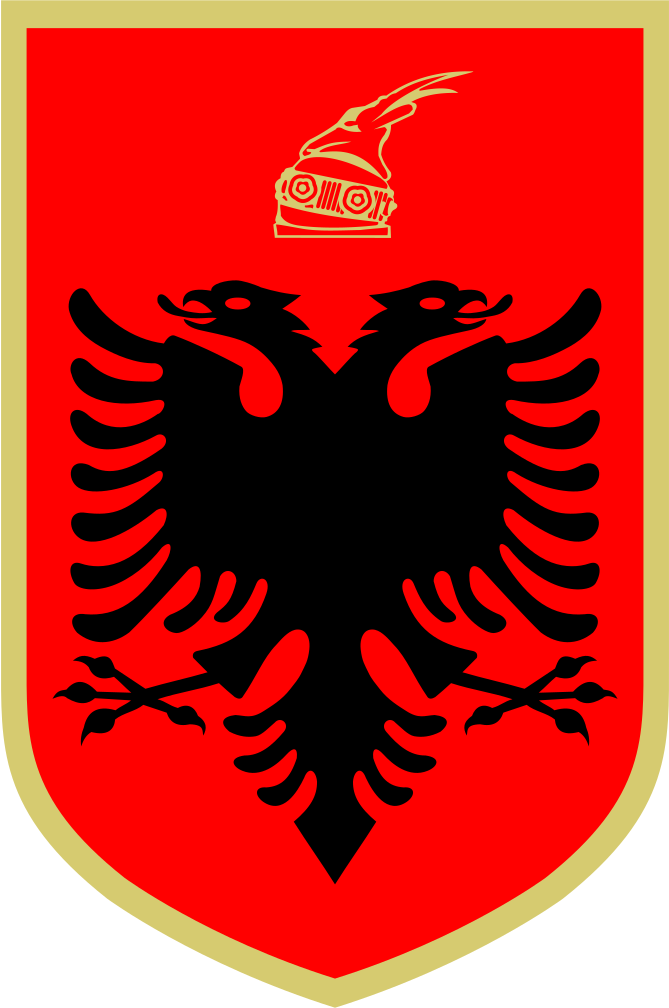
The English name Albania comes from Albanoi, the Greek name of an Illyrian tribe which lived in the area in during antiquity. Albanians call their own country Shqipëria, which means "Land of the Eagles". The name comes from an old myth that Albanians descend from a black eagle. A double headed black eagle was used as an insignia by the "Father of the Nation", Skanderbeg, as early as the 15th century, and can still be seen on the country's flag.
Get in
All road and tourist taxes (upon entering or leaving) the country have been lifted as of 2021.
See
thumb|right|300px|Beautiful and quiet beach at Ksamili thumb|right|300px|Beautiful beach at Dhermi thumb|300px|Golem beach south of Durres
Albania has varied cultural influences. In the south you can see the legacy of the Turks and Greeks, whereas in the north you can see many ancient Illyrian ruins.
The coastline is always a place to go, with its clear turquoise seas, and its many islands cast upon it, like in Saranda, the southern most coastal city in Albania. Along the Albanian Riviera, from Vlore to about Qeparo there exist mainly wooden villa complexes, bed and breakfasts, camping sites and a few beach resorts as accommodation facilities. Llogara Pass is a mountain pass located near Llogara National Park offering a majestic view of the riviera from above. Nearby is found Cesar's Pass, the place where Julius Cesar passed in his pursuit of Pompey. Dajti Mountain, a popular sight in Tirana allows you to get a whole green view of the capital. The ancient Illyrian city of Apollonia is only about 8 km (5 mi) away from Fier. A walk around southern cities like Butrint, a UNESCO world heritage site, is always ideal and memorable. Butrint is home to many ancient ruins. Castles are in many cities in Albania. Their beauty reminds anyone of the ancient times of Albania, and the world. There is Petrela Castle near Tirana, Rozafa castle in Shkodër, the inhabited castle of Berat, and Skanderbeg Castle in Kruje, (named after the national hero and now a popular museum holding …
Eat
250px|thumb|right|From upleft clockwise: Speca me djathë (pepper casserole), djathë furre me spec djegës (baked cheese with spicy pepper), tavë peshku koran (fish), hasude
Albania, like the Balkans in general, has a primarily Turkish influence in its cuisine. This influence stems from over 400 years of Ottoman rule in the region. Influences since the fall of communism in the early 1990s have been from Italy and Western Europe in general. Most of what is available in neighboring countries such as Greece and Italy will be available in Albania, particularly in the larger cities.
Sleep
Inside the cities, hotels are abundant and prices per night start as low as €15, hostels starting at around €8. Hotels are usually clean and their staff in major cities generally speak English and/or Italian.
Outside the big cities, hotels are less common, but in places like Gjirokastra can be excellent value (e.g., 1,000 lek). If, for any reason, you find nowhere to sleep, the Albanian people have always been known for their hospitality, and will treat you like royalty if you stay with them.
Stay safe
Albania is generally a safe place to visit but there are some safety precautions you have to take before visiting the country. In some Albanian cities like Berat there are no traffic lights and thus crossing on the road can be dangerous Avoid places that are deemed as slums and are sketchy, things like pickpocket can happen and also violence can occur, so avoid bringing valuables in those areas. Albania does have speed limits, but most people do not follow them. If you are driving on the highway, you have to pay extra attention to avoid car crashes . If you are not a good driver it is highly recommended that you take a bus.
Stay healthy
thumb|Mineral water at a restaurant
It's best to drink bottled water. Unboiled tap water should be avoided.
In summer, insect repellent should be used as mosquitos are very active especially near former swamps and along the Western lowland.
Be careful at the beaches because shards of glass and sea urchins are common on the sea floor.
Pharmacies and other stores are closed from about 12:00-16:00. Health clinics in small towns or village areas are not well equipped, so trips to nearby cities can be expected.
Many Albanians smoke cigarettes. The government has banned smoking in restaurants but this is not enfored.
Respect
Albanians are very hospitable. Even more so than the rest of the Balkans, elder males expect to be shown respect on account of their age. Men of the family have to be respected in particular. Shake hands with them and do not argue about topics such as religion and politics. Certain topics are strictly taboo, homosexuality being one. Don't speak about gay rights, no matter what. The situation changes a lot according to the location (village or city) and the people with whom you speak as well. In the hidden north, avoid topics that go beyond local understanding, but in Tirana you will find cosmopolitan people that are as open to new ideas as the citizens of Western Europe.
Sometimes, if you stay for a night or so at someone's house, don't be surprised if you see an AK-47 Kalashnikov hanging at the wall. It's pretty normal for Albanians to keep guns in the house.
Albania is mostly a secular country, although most of the population consider themselves either Muslim, the majority, or Christian. Ramadan does not close down street life, at least in Tirana, but you may still not want to break Islamic taboos without checking that it is OK in your current company.
Because of the Kosovo situation, there is a great deal of mistrust and resentment towards Serbia in Albania. Try to avoid being overly enthusiastic about Serbia, as it can quickly arouse negative sentiments among locals.
Go next
You can go from Shkoder in northern Albania to Ulcinj in Montenegro by taxi or vans. Fares can be negotiated between €15 and €20, it takes between 1 and 2 hours. There are buses leaving from Shkoder to other places in Montenegro (Podgorica, Budva and Kotor), departing at 10:00 or 13:20 From Ulcinj you can also take busses to other cities in Montenegro.
Crossing into North Macedonia at the border between Pogradec and Ohrid, North Macedonia is fairly straightforward. From Pogradec, one can take a taxi to the border - this will likely cost around €5 and take around 10 minutes. Once you get to the border, it is possible to walk into North Macedonia, but do not expect to find taxis on the other side of the border. Instead, hire a taxi on the Albanian side (€25, 40 minutes to Ohrid) or wait for the minibus that turns around at the border. This bus comes every few hours and is the same bus that services the Sveti Naum Monastery, which lies a few kilometers from the border. If the bus does not show up, your best option would be to head to monastery's parking lot a few kilometers distant to find the bus (check Google Earth first to get a fix on its location).
You can go to Kosovo from Kukës on the new highway. Travelling from Albania to Kosovo by car is a popular, scenic, and generally safe route that connects two culturally and historically linked countries. The most common route is Tirana to Pristina, which is around 260 km (160 miles), depending on the starting and…
Travel guide from Wikivoyage (CC BY-SA 4.0)
~40 min read
Encyclopedic overview
52 sectionsContents
- Etymology
- History
- Prehistory
- Antiquity
- Middle Ages
- Ottoman Empire
- Rilindja
- Independence
- First Republic
- Socialist Republic
- Fourth Republic
- Contemporary
- Geography
- Climate
- Biodiversity
- Conservation
- Protected areas
- Environmental issues
- Politics
- Foreign relations
- Military
- Human rights
- Administrative divisions
- Economy
- Primary sector
- Secondary sector
- Tertiary sector
- Transport
- Energy
- Media
- Technology
- Demographics
- Urbanisation
- Language
- Minorities
- Religion
- Education
- Health
- Culture
- Symbols
- Clothing
- Art and architecture
- Music
- Literature
- Cuisine
- Sports
- See also
- Notes
- References
- Sources
- Further reading
- External links
Albania, officially the Republic of Albania, is a country in Southeast Europe. It is located in the Balkans, on the Adriatic and Ionian Seas within the Mediterranean Sea, and shares land borders with Montenegro to the northwest, Kosovo to the northeast, North Macedonia to the east and Greece to the south. With an area of 28,748 km (11,100 sq mi), it has a varied range of climatic, geological, hydrological and morphological conditions. Albania's landscapes range from rugged snow-capped mountains in the Albanian Alps and the Korab, Skanderbeg, Pindus and Ceraunian Mountains, to fertile lowland plains extending from the Adriatic and Ionian seacoasts. Tirana is the capital and largest city in the country, followed by Durrës, Vlorë, and Shkodër.
Albania was inhabited by several Illyrian tribes, among them the Ardiaei, Bylliones, Dassaretii, Enchele, and Taulantians, with the Chaonians settled in the southwest. Several colonies were founded by the Ancient Greeks along the Albanian coast, most notably Apollonia. The Illyrians were the dominant power in Albania before the rise of Macedon. Following the Illyrian Wars, Albania was integrated into the Roman Empire and remained in the Byzantine Empire after its partition. During the Middle Ages, several Albanian principalities emerged, most notably the Principality of Arbanon, Kingdom of Albania, Principality of Albania and Albania Veneta. In the 15th century, Albania became a center of resistance against Ottoman expansion under the leadership of Gjergj Kastrioti Skanderbeg, whose military campaigns repelled Ottoman advances for over two decades. Although incorporated into the Ottoman Empire, Albania retained distinct cultural and social identities throughout four centuries of foreign rule, culminating in the Albanian Renaissance in the 19th century. Albania declared independence in 1912, followed by a turbulent 20th century marked by monarchy, foreign occupation during both World Wars, and a communist regime under Enver Hoxha.
Excerpted from Wikipedia’s “Albania” article, available under the CC BY-SA 4.0 licence.
Gallery (639)
On the map
60 mapped locations
Available in 322 languages
- Español
- Français
- Deutsch
- 中文
- 日本語
- Русский
- Português
- Italiano
- العربية
- हिन्दी
- Abkhazian
- abstract
- Achinese
- Adyghe
- Afrikaans
- Akan
- Albanian
- Albanian
Show 303 more
- Amharic
- ami
- Angika
- Aragonese
- Aramaic
- Armenian
- Arpitan
- Assamese
- Asturian
- Avaric
- Awadhi
- Aymara
- azb
- Azerbaijani
- Bahasa Indonesia
- Balinese
- Bangla
- Banjar
- Bashkir
- Basque
- bat_smg
- Batak Toba
- Bavarian
- be_x_old
- Belarusian
- Betawi
- Bhojpuri
- Bikol
- Bishnupriya
- Bislama
- blk
- Bosnian
- Breton
- btm
- Buginese
- Bulgarian
- Buriat
- Burmese
- Catalan
- cbk_zam
- cdo
- Cebuano
- Central Dusun
- Central Kurdish
- Chamorro
- Chechen
- Cherokee
- Cheyenne
- Church Slavic
- Chuvash
- Colognian
- Cornish
- Corsican
- Crimean Tatar
- Croatian
- Czech
- dag
- Danish
- dga
- Dinka
- Divehi
- dty
- Dzongkha
- Egyptian Arabic
- eml
- Erzya
- Esperanto
- Estonian
- Ewe
- Extremaduran
- Faroese
- Fiji Hindi
- Fijian
- Filipino
- Finnish
- fiu_vro
- Frafra
- Friulian
- Fula
- Gagauz
- Galician
- Gan Chinese
- Ganda
- gcr
- Georgian
- Gilaki
- Goan Konkani
- Gothic
- gpe
- Greek
- Guarani
- Gujarati
- Haitian Creole
- Hakka Chinese
- Hausa
- Hawaiian
- Hebrew
- Hungarian
- hyw
- Iban
- Icelandic
- Ido
- Igbo
- igl
- Iloko
- Inari Sami
- Interlingua
- Interlingue
- Inuktitut
- Inupiaq
- Irish
- isv
- Jamaican Creole English
- Javanese
- Kabardian
- Kabyle
- kai
- Kalmyk
- Kannada
- Kanuri
- Kara-Kalpak
- Karachay-Balkar
- Kashmiri
- Kashubian
- Kazakh
- kge
- Khmer
- Kikuyu
- Kinyarwanda
- Komi
- Komi-Permyak
- Kongo
- Kotava
- Kurdish
- Kyrgyz
- Ladino
- Lao
- Latgalian
- Latin
- Latvian
- Lezghian
- Ligurian
- Limburgish
- Lingala
- Lingua Franca Nova
- Lithuanian
- lld
- Lojban
- Lombard
- Low German
- Lower Sorbian
- Luxembourgish
- Macedonian
- Madurese
- Maithili
- Malagasy
- Malay
- Malayalam
- Maltese
- Manipuri
- Manx
- Māori
- map_bms
- Marathi
- Mari
- Mazanderani
- Minangkabau
- Mingrelian
- Mirandese
- Moksha
- Mongolian
- Moroccan Arabic
- Mossi
- N’Ko
- Navajo
- nds_nl
- Neapolitan
- Nederlands
- Nepali
- Newari
- Nias
- Northern Frisian
- Northern Sami
- Northern Sotho
- Norwegian
- Norwegian Nynorsk
- Novial
- nrm
- nup
- Nyanja
- Obolo
- Occitan
- Odia
- Old English
- olo
- Oromo
- Ossetic
- Pampanga
- Pangasinan
- Papiamento
- Pashto
- Pennsylvania German
- Picard
- Piedmontese
- Polski
- Pontic
- Punjabi
- Quechua
- roa_rup
- roa_tara
- Romanian
- Romansh
- Romany
- rsk
- Rundi
- Rusyn
- Samoan
- Sango
- Sanskrit
- Santali
- Sardinian
- Saterland Frisian
- Scots
- Scottish Gaelic
- Serbian
- Serbian (Latin)
- Shan
- Shona
- Sicilian
- Silesian
- simple
- Sindhi
- Sinhala
- skr
- Slovak
- Slovenian
- Somali
- Southern Sotho
- Sranan Tongo
- Standard Moroccan Tamazight
- Sundanese
- Svenska
- Swahili
- Swati
- syl
- szy
- Tachelhit
- Tahitian
- Tajik
- Talysh
- Tamil
- Taroko
- Tatar
- tay
- tdd
- Telugu
- Tetum
- Tibetan
- Tiếng Việt
- Tigrinya
- Tok Pisin
- Toki Pona
- Tongan
- Tsonga
- Tswana
- Tulu
- Tumbuka
- Türkçe
- Turkmen
- Tuvinian
- Tyap
- Udmurt
- Ukrainian
- Upper Sorbian
- Urdu
- Uyghur
- Uzbek
- Venetian
- Veps
- Volapük
- Walloon
- Waray
- Welsh
- West Flemish
- Western Frisian
- Western Mari
- Western Panjabi
- Wolof
- Wu Chinese
- Xhosa
- Yakut
- Yiddish
- Yoruba
- Zaza
- Zeelandic
- zh_classical
- zh_min_nan
- zh_yue
- Zhuang
- Zulu
- فارسی
- ไทย
- 한국어
via Wikidata sitelinks · CC0