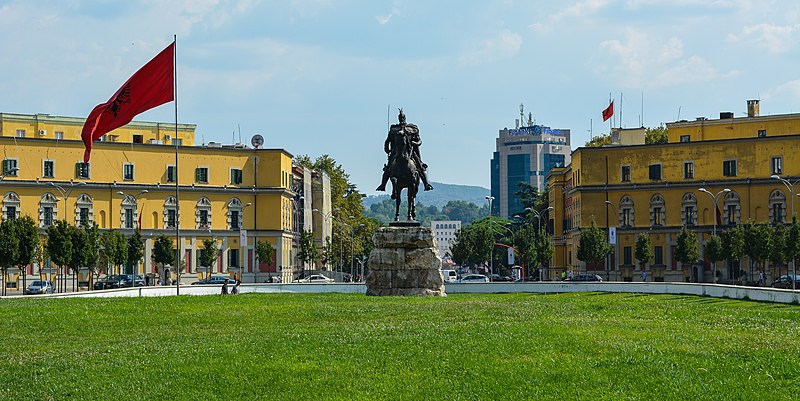
File:Skanderbeg_square_tirana_2016.jpg · Wikimedia Commons · See Wikimedia Commons
Tirana
Sign in to saveAlso known as Tiranë
Tirana ( , ; ) is the capital and largest city of Albania. It is located in the centre of the country, enclosed by mountains and hills, with Dajti rising to the east and a slight valley to the northwest overlooking the Adriatic Sea in the distance. It is among the wettest and sunniest cities in Europe, with 2,544 hours of sun per year.
Tirana is the capital and largest city of Albania, situated in the country's center and surrounded by mountains including Dajti to the east, with views toward the Adriatic Sea to the northwest. The city is notable for being one of Europe's wettest and sunniest cities, receiving 2,544 hours of sunshine annually.
AI-generated from the Wikipedia summary — may contain errors.
Weather now
7-day forecast
via Open-Meteo
Place details
- Locality
- Tiranë
- Region
- Shqipëria Qendrore
- Country
- Shqipëria
- Population
- 418,495
- Timezone
- Europe/Tirane
via OpenStreetMap · GeoNames
Key facts
- Settlement.name
- Tirana
- Settlement.other_name
- Tirona
- Settlement.settlement_type
- Capital city and municipality
- Settlement.image_alt
- Photomontage of Tirana
- Settlement.image_flag
- Flag of Tirana.svg
- Settlement.flag_alt
- Flag of Tirana
- Settlement.image_shield
- 55px|center
- Settlement.seal_alt
- Seal of Tirana
- Settlement.pushpin_map
- Albania#Europe
- Settlement.pushpin_relief
- 1
- Settlement.pushpin_mapsize
- 290
- Settlement.subdivision_type
- Country
- Settlement.subdivision_name
- Albania
- Settlement.subdivision_type1
- Region
- Settlement.subdivision_name1
- Central Albania
- Settlement.subdivision_type2
- County
- Settlement.subdivision_name2
- Tirana
- Settlement.subdivision_type3
- Municipality
via Wikipedia infobox
Official website

Bashkia Tiranë
Faqja zyrtare e Bashkisë së Tiranës. Lajme, publikime, njotime, informacion për mundësi punësimi ose praktika në bashki, informacione mbi njësitë administrative, informacione mbi atraksionet e Tiranës.
tirana.al →Link to the official site · 10,896 chars · not written by Vinony
Wikidata facts
- Instance of
- capital city
- Demonym
- tiranesi
- Country
- Albania
- Located in
- Tirana municipality
- Official language
- Albanian
- Population
- 389323
- Area
- 41.8
- Elevation
- 110
- Time zone
- UTC+01:00
- Body of water
- Tiranë
- Head of government
- Erion Veliaj
- Capital of
- People's Socialist Republic of Albania
- Official website
- www.tirana.al
- Image
- Tirana from South.jpg
- Dialing code
- 4
- Licence plate code
- TR
- Flag
- flag of Tirana
- Coat of arms
- Symbols of Tirana
Show 15 more facts
- Commons category
- Tirana
- postal code
- 1001–1028
- topic's main category
- Category:Tirana
- twinned administrative body
- Taranto
- category for people born here
- Category:Births in Tirana
- category for people who died here
- Category:Deaths in Tirana
- category of associated people
- Category:People from Tirana
- Commons gallery
- Tirana
- inception
- 1614-00-00
- native label
- Tiranë
- category for honorary citizens of entity
- Q32031878
- on focus list of Wikimedia project
- Wikipedia:Vital articles/Level/4
- P12749
- Baghdad
via Wikidata · CC0
Travel guide
Understand
thumb|300px|A view of downtown Tirana from Skytower Sulejman Pasha Bargjini, a native feudal lord from Mullet, established the city in 1614. His first constructions were a mosque, a bakery and a hamam or Turkish bath. On 8 February 1920, Tirana was made the temporary capital by the Congress of Lushnje, and it was proclaimed the permanent capital on 31 December 1925.
Today, Tirana suffers from pollution problems mainly due to the rapid increase in cars in the city and continuous construction, compounded by its position in a valley and air pollution blown in from heavy industry in Serbia. Long gone are the days when Tirana used to be subject to power outages almost daily and this made Tirana a noisy city as the lack of power and lack of traffic lights had cars navigating by honking their horns. The situation has dramatically improved regarding power outages. Tirana is undergoing a major renovation from its totalitarian days. Many of the ugly dull buildings have been repainted (including many crossings), but a lot of work outside of center is still to be done. English is the second language of many younger population, with many older residents speaking Italian.
The main business and entertainment area (not by coincidence) has become "The Block" (Blloku), which is the area where in the past, the communist leaders used to live under strict protection. Tirana is a youthful and lively city of 528,000 people (2024) resonating constant energy. The city was the European Youth Capital…
Get around
thumb|Tirana’s colorful pedestrian crossings (zebras)
There are no metros available in Tirana. Feet, buses and taxis are the only options to get around in the city if you do not have private transportation.
See
thumb|Et'hem Bey Mosque inner walls
Do
thumb|Skanderbeg Square in downtown Tirana
Go for a walk in the evening along the main streets or at one of the several parks and sit for a coffee or drink. Take part in the vibrant nightlife by visiting one of the numerous nightclubs. If you are adventurous and brave enough, try the peculiar experience of driving in the city's streets by renting a car, or rent a bicycle from a bike renting station. You can also cruise the city with a limousine or venture out in the picturesque suburbs either south or northeast/west of Tirana.
A "free" walking tour starting daily at 10:00 (10:00 and 18:00 during the summer period) in front of Tirana's Opera house is a good start to discover the city and learn more about its history, art and daily life.
Below are some venturing suggestions:
thumb|View from the cable car
Eat
Food is generally inexpensive, even in the more upscale places. The Italian influence is everywhere and most places will offer pizza and/or pasta along more elaborate dishes. A good rule of thumb is that the priciest or fanciest places rarely are the best ones, particularly in the Blloku. Notable dishes that exemplify the local cuisine include fërgesë (baked vegetables and cheese) and tavë dheu (fërgesë with the addition of liver).
thumb|Streetside restaurants
Stay safe
thumb|Car traffic and pedestrians at dusk You should take some precautions when walking around the city. The main advice is to simply watch your step. Although many parts of the city are maintained, there remain holes and worn-down street parts. Cars also seem to drive more recklessly than in most European cities, and assume a right-of-way, so care is needed in crossing the street. Not even a green light is always a guarantee of safety! Try to see when the locals cross the street and cross with them.
Crime, however, is not much of a problem. Tirana is a significantly safer city than most cities of comparable size in Europe, with people happily wandering through the city late into the night.
Go next
Zall-Bastar – For hiking near Bovilla Lake and a hot sprint near Perkola village. The bus runs from the Myslym Keta bus stop in the northeast of the city, the latter which of can be reached by L7 or L15. About 100 lek to Zall-Bastar. Shkodër – Fourth largest city in Albania, close to Montenegro's border. Albanian Alps Gjirokastra – Famous for its mulberry raki. Berat – City of the thousand windows with old Turkish buildings and a fortress. Saranda – Ferry to Corfu. Përmet – An interesting town with popular thermal springs nearby. Krujë - A fascinating historical town close to Tirana
There are also many direct connections to nearby countries, like Prizren, Pristina, Skopje, Athens and Podgorica.
Travel guide from Wikivoyage (CC BY-SA 4.0)
~51 min read
Encyclopedic overview
37 sectionsContents
- History
- Early development
- Modern development
- Contemporary
- Geography
- Climate
- Urbanism
- Politics
- Administration
- National capital
- International relations
- Economy
- Infrastructure
- Transport
- Air
- Road
- Rail
- Bus
- Cycling
- Education
- Health
- Demography
- Religion in Tirana
- Culture
- Architecture
- Museums
- Cuisine
- Sports
- Media
- Notable people
- Key of Tirana
- See also
- Notes
- References
- Sources
- Further reading
- External links
Tirana ( , ; ) is the capital and largest city of Albania. It is located in the centre of the country, enclosed by mountains and hills, with Dajti rising to the east and a slight valley to the northwest overlooking the Adriatic Sea in the distance. It is among the wettest and sunniest cities in Europe, with 2,544 hours of sun per year.
Tirana was founded in 1614 by Ottoman Albanian general Sylejman Pasha Bargjini, centered on the Old Mosque and türbe. The site of present-day Tirana has been continuously inhabited since the Iron Age and was likely the core of the Illyrian kingdom of the Taulantii, which in classical antiquity was centred in the hinterland of Epidamnus. Following the Illyrian Wars, it was annexed by the Roman Empire. With the collapse of the Western Roman Empire in the fourth century, most of Albania came under the control of the Eastern Roman Empire. The city was fairly unimportant until the 20th century, when the Congress of Lushnjë proclaimed it as Albania's capital after the Albanian Declaration of Independence in 1912.
Excerpted from Wikipedia’s “Tirana” article, available under the CC BY-SA 4.0 licence.
Gallery (52)
On the map
3 mapped locations
Available in 257 languages
- Español
- Français
- Deutsch
- 中文
- 日本語
- Русский
- Português
- Italiano
- العربية
- हिन्दी
- Achinese
- Afrikaans
- Akan
- Albanian
- Albanian
- Amharic
- Aragonese
- Aramaic
Show 238 more
- Armenian
- Arpitan
- Asturian
- Aymara
- azb
- Azerbaijani
- Bahasa Indonesia
- Balinese
- Bangla
- Bashkir
- Basque
- bat_smg
- Bavarian
- be_x_old
- Belarusian
- Betawi
- Bikol
- Bislama
- blk
- Bosnian
- Breton
- Bulgarian
- Buriat
- Burmese
- Catalan
- cbk_zam
- cdo
- Cebuano
- Central Dusun
- Central Kurdish
- Chamorro
- Chechen
- Cherokee
- Cheyenne
- Church Slavic
- Chuvash
- Colognian
- Cornish
- Crimean Tatar
- Croatian
- Czech
- dag
- Danish
- Divehi
- Egyptian Arabic
- eml
- Erzya
- Esperanto
- Estonian
- Ewe
- Extremaduran
- Faroese
- Fiji Hindi
- Fijian
- Filipino
- Finnish
- fiu_vro
- Friulian
- Fula
- Gagauz
- Galician
- Gan Chinese
- Ganda
- gcr
- Georgian
- Gilaki
- Gothic
- gpe
- Greek
- Guarani
- Haitian Creole
- Hakka Chinese
- Hausa
- Hebrew
- Hungarian
- hyw
- Icelandic
- Ido
- Igbo
- Iloko
- Inari Sami
- Interlingua
- Interlingue
- Inuktitut
- Inupiaq
- Irish
- Javanese
- Kabyle
- kai
- Kara-Kalpak
- Kashmiri
- Kazakh
- kge
- Khmer
- Kinyarwanda
- Komi
- Kongo
- Kotava
- Kurdish
- Kyrgyz
- Ladino
- Lao
- Latgalian
- Latin
- Latvian
- Ligurian
- Limburgish
- Lingala
- Lingua Franca Nova
- Lithuanian
- lld
- Lojban
- Lombard
- Low German
- Lower Sorbian
- Luxembourgish
- Macedonian
- Maithili
- Malagasy
- Malay
- Malayalam
- Maltese
- Manipuri
- Manx
- Māori
- map_bms
- Marathi
- Mari
- Mazanderani
- Minangkabau
- Mingrelian
- Mirandese
- Moksha
- Mongolian
- Moroccan Arabic
- Navajo
- nds_nl
- Neapolitan
- Nederlands
- Nepali
- Northern Frisian
- Northern Sami
- Norwegian
- Norwegian Nynorsk
- Novial
- nrm
- Nyanja
- Occitan
- Odia
- Old English
- olo
- Ossetic
- Palatine German
- Pampanga
- Papiamento
- Pashto
- Pennsylvania German
- Picard
- Piedmontese
- Polski
- Pontic
- Punjabi
- pwn
- Quechua
- roa_rup
- roa_tara
- Romanian
- Romansh
- rsk
- Rusyn
- Santali
- Sardinian
- Saterland Frisian
- Scots
- Scottish Gaelic
- Serbian
- Serbian (Latin)
- Shan
- Shona
- Sicilian
- Silesian
- simple
- Sindhi
- Sinhala
- skr
- Slovak
- Slovenian
- Standard Moroccan Tamazight
- Svenska
- Swahili
- syl
- szy
- Tahitian
- Tajik
- Talysh
- Tamil
- Tatar
- Tetum
- Tibetan
- Tiếng Việt
- Tigrinya
- Tok Pisin
- Tongan
- Tswana
- Tumbuka
- Türkçe
- Turkmen
- Udmurt
- Ukrainian
- Upper Sorbian
- Urdu
- Uyghur
- Uzbek
- Venetian
- Veps
- Volapük
- Walloon
- Waray
- Welsh
- West Flemish
- Western Frisian
- Western Panjabi
- Wolof
- Wu Chinese
- Xhosa
- Yakut
- Yiddish
- Yoruba
- Zaza
- Zeelandic
- zh_classical
- zh_min_nan
- zh_yue
- Zhuang
- Zulu
- فارسی
- ไทย
- 한국어
via Wikidata sitelinks · CC0