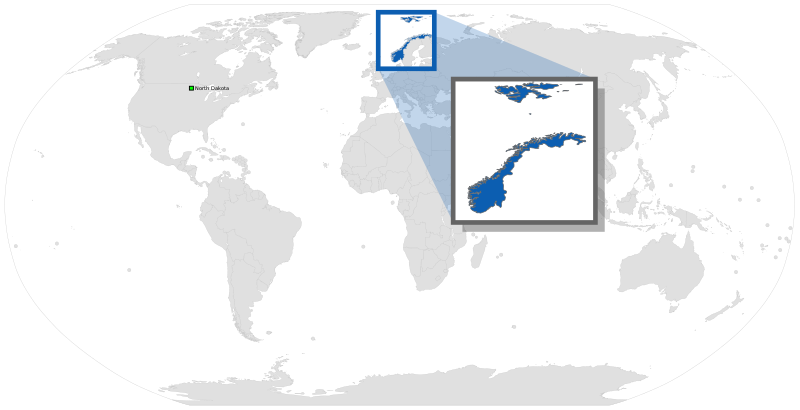
File:Norwegian_language_map.svg · Wikimedia Commons · See Wikimedia Commons
Norwegian is a North Germanic language spoken primarily in Norway. It matters as the primary language of communication, culture, and daily life for millions of people in Scandinavia.
AI-generated from the Wikipedia summary — may contain errors.
Wikidata facts
- Instance of
- modern language
- Subclass of
- West Scandinavian
- Has part
- Høgnorsk
- Country
- Norway
- Image
- Dano-Norwegian alphabet.jpg
- Has parts of class
- word
Show 22 more facts
- writing system
- Latin script
- Commons category
- Norwegian language
- topic's main category
- Category:Norwegian language
- Wikimedia language code
- no
- native label
- norsk
- number of speakers, writers, or signers
- 5200000
- has grammatical case
- dative case
- short name
- норвегиаг
- described by source
- New International Encyclopedia
- has grammatical gender
- common
- indigenous to
- Norwegians
- history of topic
- history of the Norwegian language
- category for films in this language
- Category:Norwegian-language films
- studied by
- Scandinavian studies
- P10369
- Portugal
- has tense
- future tense
- P11012
- Pornography
- entry in abbreviations table
- норв.
- Stack Exchange tag
- linguistics.stackexchange.com/tags/norwegian
- P8168
- Brasidas samarensis
- NCI Thesaurus ID
- C154059
Sources (8)
via Wikidata · CC0
~40 min read
Encyclopedic overview
Norwegian (endonym: norsk [ˈnɔʂːk] , norsk språk [ˈnɔʂːk sproːk]) is a North Germanic language from the Indo-European language family spoken mainly in Norway, where it is an official language. Along with Swedish and Danish, Norwegian forms a dialect continuum of more or less mutually intelligible local and regional varieties; some Norwegian and Swedish dialects, in particular, are very close. These Scandinavian languages, together with Faroese and Icelandic as well as some extinct languages, constitute the North Germanic languages. Faroese and Icelandic are not mutually intelligible with Norwegian in their spoken form because continental Scandinavian has diverged from them. While the two Germanic languages with the greatest numbers of speakers, English and German, have close similarities with Norwegian, neither is mutually intelligible with it. Norwegian is a descendant of Old Norse, the common language of the Germanic peoples living in Scandinavia during the Viking Age.
Today there are two official forms of written Norwegian, Bokmål (Riksmål) and Nynorsk (Landsmål), each with its own variants. Bokmål developed from the Dano-Norwegian language that replaced Middle Norwegian as the elite language after the union of Denmark–Norway in the 16th and 17th centuries and then evolved in Norway, while Nynorsk was developed based upon a collective of spoken Norwegian dialects. Norwegian is one of the two official languages in Norway, along with Sámi, a group of Finno-Ugric languages spoken by the Indigenous people of the same name. Norwegian is one of the working languages of the Nordic Council. Under the Nordic Language Convention, citizens of the Nordic countries who speak Norwegian have the opportunity to use it when interacting with official bodies in other Nordic countries without being liable for any interpretation or translation costs.
Excerpted from Wikipedia’s “Norwegian” article, available under the CC BY-SA 4.0 licence.
Gallery (6)
Available in 168 languages
- Español
- Français
- Deutsch
- 中文
- 日本語
- Русский
- Português
- Italiano
- العربية
- हिन्दी
- Abkhazian
- Afrikaans
- Albanian
- Albanian
- Amharic
- Angika
- Aragonese
- Armenian
Show 149 more
- Arpitan
- Asturian
- azb
- Azerbaijani
- Bahasa Indonesia
- Balinese
- Bangla
- Bashkir
- Basque
- bat_smg
- be_x_old
- Belarusian
- Bosnian
- Breton
- Bulgarian
- Buriat
- Catalan
- cdo
- Cebuano
- Central Kurdish
- Chechen
- Chuvash
- Cornish
- Croatian
- Czech
- Danish
- Egyptian Arabic
- Erzya
- Esperanto
- Estonian
- Ewe
- Faroese
- Fiji Hindi
- Filipino
- Finnish
- Galician
- Georgian
- Greek
- Guarani
- Gujarati
- Hakka Chinese
- Hebrew
- Hungarian
- Icelandic
- Ido
- Iloko
- Inari Sami
- Interlingua
- Irish
- Javanese
- Kabardian
- Kannada
- Karachay-Balkar
- Kashmiri
- Kazakh
- kge
- Komi
- Kotava
- Kurdish
- Kyrgyz
- Latin
- Latvian
- Ligurian
- Limburgish
- Lingua Franca Nova
- Lithuanian
- Lombard
- Low German
- Luxembourgish
- Macedonian
- Malagasy
- Malay
- Malayalam
- Manipuri
- Manx
- Marathi
- Mari
- Mazanderani
- Mingrelian
- Moksha
- Mongolian
- Moroccan Arabic
- nds_nl
- Nederlands
- Nepali
- Newari
- Northern Frisian
- Northern Sami
- Norwegian
- Norwegian Nynorsk
- nrm
- Occitan
- Old English
- olo
- Ossetic
- Pampanga
- Papiamento
- Pashto
- Polski
- Punjabi
- Quechua
- Romanian
- Romansh
- Rusyn
- Samoan
- Sardinian
- Saterland Frisian
- Scots
- Scottish Gaelic
- Serbian
- Serbian (Latin)
- Sicilian
- Silesian
- simple
- Slovak
- Slovenian
- Svenska
- Swahili
- Tajik
- Talysh
- Tamil
- Tatar
- Tiếng Việt
- Tok Pisin
- Toki Pona
- Türkçe
- Udmurt
- Ukrainian
- Urdu
- Uyghur
- Uzbek
- Veps
- Volapük
- Walloon
- Waray
- Welsh
- West Flemish
- Western Frisian
- wikifunctions
- Wu Chinese
- Yiddish
- Yoruba
- Zaza
- Zeelandic
- zh_min_nan
- zh_yue
- فارسی
- ไทย
- 한국어
via Wikidata sitelinks · CC0