Nuremberg trials
Sign in to saveAlso known as Nürnberg trials
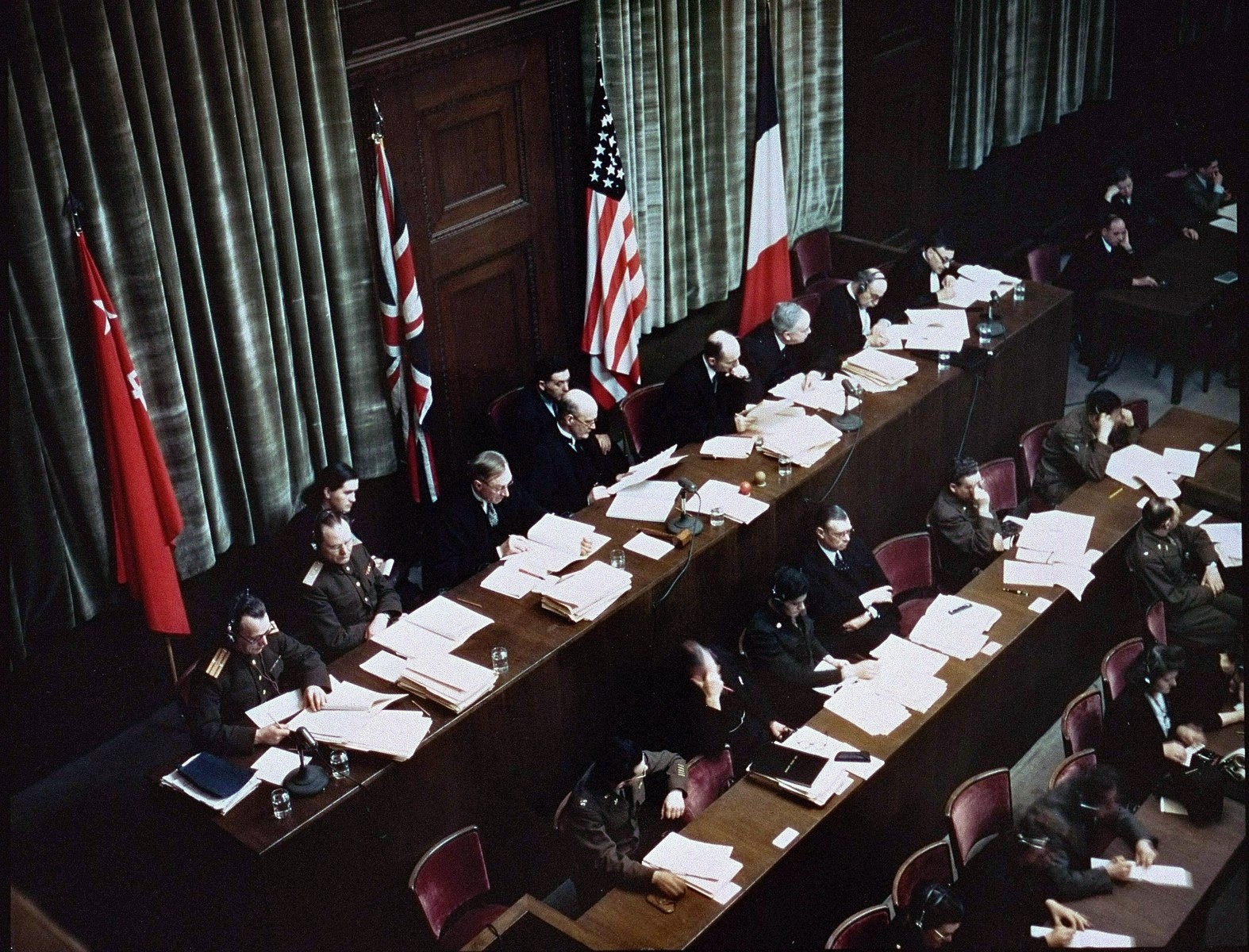
The Nuremberg trials were international criminal trials held by France, the Soviet Union, the United Kingdom, and the United States against leaders of defeated Nazi Germany for plotting and carrying out invasions of several countries across Europe and committing atrocities against their citizens in the Second World War.
OverviewAI-generated
The Nuremberg trials were a series of war crimes trials held in Germany at the Palace of Justice. These proceedings took place from November 20, 1945, to October 1, 1946. The trials were conducted by the International Military Tribunal under the Nuremberg Charter.
Prominent defendants included Hermann Göring, Rudolf Hess, Martin Bormann, and Joachim von Ribbentrop. They faced charges of conspiracy, war of aggression, war crime, and crime against humanity. The prosecution was led by Robert H. Jackson, Roman Rudenko, Hartley Shawcross, and François de Menthon. The bench included judges Francis Biddle, John J. Parker, Iona Nikitchenko, and Alexander Volchkov.
These proceedings are classified as a subclass of trial and an instance of a war crimes trial. They were followed by the subsequent Nuremberg trials.
Synthesized by Vinony from 18 facts across 2 sources: Wikidata, Firecrawl. Generated from structured data (not the Wikipedia text) and checked against those facts — may still contain errors.
In the Vinony graph
Within Vinony's link graph, Nuremberg trials is referenced by 4,094 other articles, and connects out to Bandenbekämpfung, Auschwitz and Charter of the United Nations.
The entry is geolocated on the map in event.
It sits within the topics 1940s trials, 1945 in case law and 1945 in Germany.
Its subject is documented across 82 Wikipedia language editions.
Wikipedia views (30d)
210,286 totalvia Wikimedia Pageviews API
Wikidata facts
- Instance of
- war crimes trial
- Subclass of
- trial
- Country
- Germany
- Followed by
- subsequent Nuremberg trials
- Location
- Palace of Justice
- Official website
- museen.nuernberg.de/memorium-nuernberger-prozesse
- Image
- Nuremberg Trials. Looking down on defendants dock, circa 1945-1946. - NARA - 540127.jpg
Show 15 more facts
- plaintiff
- Auguste Champetier de Ribes
- charge
- crime against humanity
- Commons category
- Nuremberg Trials
- topic's main category
- Category:Nuremberg trials
- Commons gallery
- Nuremberg Trials
- start time
- 1945-11-20
- end time
- 1946-10-01
- work available at URL
- archive.org/details/TheNurnbergTrial
- judge
- Robert Falco
- defendant
- Erich Raeder
- on focus list of Wikimedia project
- Wikipedia:Vital articles/Level/4
- topic has template
- Template:Main Nuremberg defendants
- different from
- Q4328551
- main regulatory text
- Nuremberg Charter
Sources (7)
via Wikidata · CC0
~40 min read
Encyclopedic overview
The Nuremberg trials were international criminal trials held by France, the Soviet Union, the United Kingdom, and the United States against leaders of defeated Nazi Germany for plotting and carrying out invasions of several countries across Europe and committing atrocities against their citizens in the Second World War.
Between 1939 and 1945, Nazi Germany invaded many countries across Europe, inflicting 27 million deaths in the Soviet Union alone. Proposals for how to punish the defeated Nazi leaders ranged from a show trial (the Soviet Union) to summary executions (the United Kingdom). In mid-1945, France, the Soviet Union, the United Kingdom, and the United States agreed to convene a joint tribunal in Nuremberg, occupied Germany, with the Nuremberg Charter as its legal instrument. Between 20 November 1945 and 1 October 1946, the International Military Tribunal (IMT) tried 22 of the most important surviving leaders of Nazi Germany in the political, military, and economic spheres, as well as six German organizations. The purpose of the trial was not only to try the defendants but also to assemble irrefutable evidence of Nazi war crimes, offer a history lesson to the defeated Germans, and delegitimize the traditional German elite.
Excerpted from Wikipedia’s “Nuremberg trials” article, available under the CC BY-SA 4.0 licence.
Gallery (13)
On the map
Available in 82 languages
- Español
- Français
- Deutsch
- 中文
- 日本語
- Русский
- Português
- Italiano
- العربية
- Afrikaans
- Albanian
- Armenian
- Asturian
- azb
- Azerbaijani
- Bahasa Indonesia
- Bangla
- Bashkir
Show 63 more
- Basque
- be_x_old
- Belarusian
- Bosnian
- Breton
- Bulgarian
- Catalan
- Central Kurdish
- Chechen
- Croatian
- Czech
- Danish
- Egyptian Arabic
- Esperanto
- Estonian
- Filipino
- Finnish
- Galician
- Georgian
- Greek
- Hebrew
- Hungarian
- Icelandic
- Ido
- Kazakh
- Kyrgyz
- Latin
- Latvian
- Lithuanian
- Luxembourgish
- Macedonian
- Malay
- Malayalam
- Mongolian
- Nederlands
- Norwegian
- Norwegian Nynorsk
- Occitan
- Romanian
- Serbian
- Serbian (Latin)
- simple
- Slovak
- Slovenian
- Svenska
- Swahili
- Tamil
- Tatar
- Tiếng Việt
- Türkçe
- Ukrainian
- Uzbek
- Welsh
- Western Frisian
- Western Panjabi
- Wu Chinese
- Yiddish
- zh_classical
- zh_min_nan
- zh_yue
- فارسی
- ไทย
- 한국어
via Wikidata sitelinks · CC0