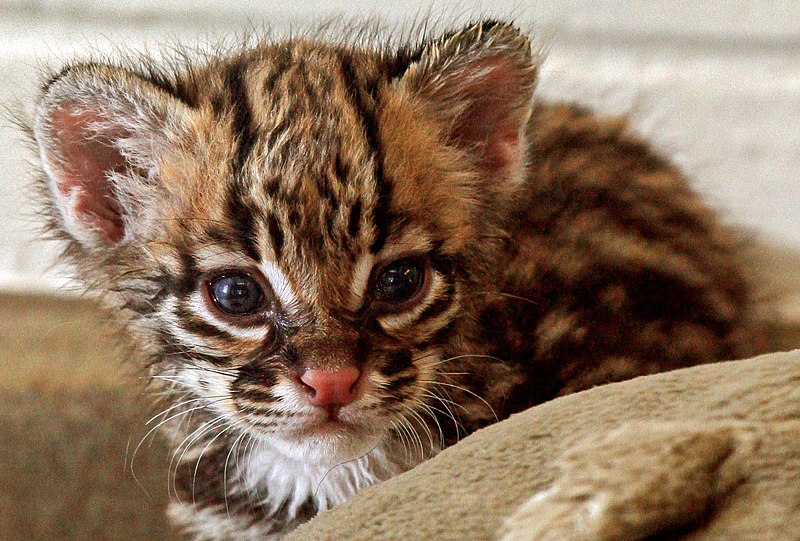
File:Ocelo_baby_1.jpg · Wikimedia Commons · See Wikimedia Commons
ocelot
Sign in to saveAlso known as dwarf leopard, Leopardus pardalis, ocelots
The ocelot (Leopardus pardalis) is a medium-sized spotted wild cat that reaches at the shoulders and weighs between on average. It is native to the southwestern United States, Mexico, Central and South America, and the Caribbean islands of Trinidad and Margarita. Carl Linnaeus scientifically described it in 1758. Two subspecies are recognized.
The ocelot is a medium-sized spotted wild cat native to the southwestern United States, Mexico, Central and South America, and the Caribbean islands of Trinidad and Margarita. It matters as a notable member of the wild cat family that has been scientifically recognized since Carl Linnaeus first described it in 1758.
AI-generated from the Wikipedia summary — may contain errors.
Species
Least Concern虎貓(學名Leopardus pardalis),又名美洲豹貓,是產於南美、中美和墨西哥以及美國最南端、加勒比地區的野生貓科動物。體長可達100厘米,尾長45厘米,體重10-15千克,是虎貓屬中體型最大的一種。同屬的小斑虎貓和長尾虎貓與其外表相近,分布於同一地區。 虎貓的皮毛接近美洲豹,因此被遭到大量的捕殺,面臨生存的威脅。
via IUCN
Wikidata facts
Show 13 more facts
- main food source
- green iguana
- taxon rank
- species
- IUCN conservation status
- Least Concern
- taxon name
- Leopardus pardalis
- Commons category
- Leopardus pardalis
- Commons gallery
- Leopardus pardalis
- taxon common name
- Ocelot
- gestation period
- 77
- litter size
- 1.5
- longest observed lifespan
- 28.2
- CITES Appendix
- Appendix I of CITES
- different from
- Ocelot
- taxon range
- Brazil
via Wikidata · CC0
~21 min read
Encyclopedic overview
16 sectionsContents
- Etymology
- Taxonomy
- Subspecies
- Phylogeny
- Characteristics
- Distribution and habitat
- Ecology and behavior
- Hunting and diet
- Reproduction and life cycle
- Threats
- Conservation
- In Texas
- In captivity
- In culture
- References
- External links
The ocelot (Leopardus pardalis) is a medium-sized spotted wild cat that reaches at the shoulders and weighs between on average. It is native to the southwestern United States, Mexico, Central and South America, and the Caribbean islands of Trinidad and Margarita. Carl Linnaeus scientifically described it in 1758. Two subspecies are recognized.
The ocelot is efficient at climbing, leaping and swimming. It prefers areas close to water sources with dense vegetation cover and high prey availability. It preys on small terrestrial mammals, such as armadilloes, opossums, and lagomorphs. It is typically active during twilight and at night and tends to be solitary and territorial. Both sexes become sexually mature at around two years of age and can breed throughout the year; peak mating season varies geographically. After a gestation period of two to three months, the female gives birth to a litter of one to three kittens. They stay with their mother for up to two years, after which they leave to establish their own home ranges.
Excerpted from Wikipedia’s “ocelot” article, available under the CC BY-SA 4.0 licence.
Gallery (23)
Available in 86 languages
- Español
- Français
- Deutsch
- 中文
- 日本語
- Русский
- Português
- Italiano
- العربية
- हिन्दी
- Aragonese
- Armenian
- Avaric
- azb
- Azerbaijani
- Bahasa Indonesia
- Balinese
- Basque
Show 67 more
- be_x_old
- Belarusian
- Breton
- Bulgarian
- Burmese
- Catalan
- Cebuano
- Chuvash
- Croatian
- Czech
- Danish
- Egyptian Arabic
- Esperanto
- Estonian
- Filipino
- Finnish
- Galician
- Georgian
- Greek
- Guarani
- Hebrew
- Hungarian
- Icelandic
- Ido
- Interlingua
- Irish
- Javanese
- Kazakh
- Kotava
- Kurdish
- Latgalian
- Latin
- Latvian
- Lithuanian
- Lojban
- Macedonian
- Mari
- Mingrelian
- Navajo
- Nederlands
- Norwegian
- Norwegian Nynorsk
- Polski
- ppl
- Quechua
- Romanian
- Scots
- Serbian
- Serbian (Latin)
- simple
- Slovak
- Slovenian
- Svenska
- Tiếng Việt
- Türkçe
- Udmurt
- Ukrainian
- Uzbek
- Waray
- Welsh
- Western Panjabi
- Wu Chinese
- zh_min_nan
- zh_yue
- فارسی
- ไทย
- 한국어
via Wikidata sitelinks · CC0