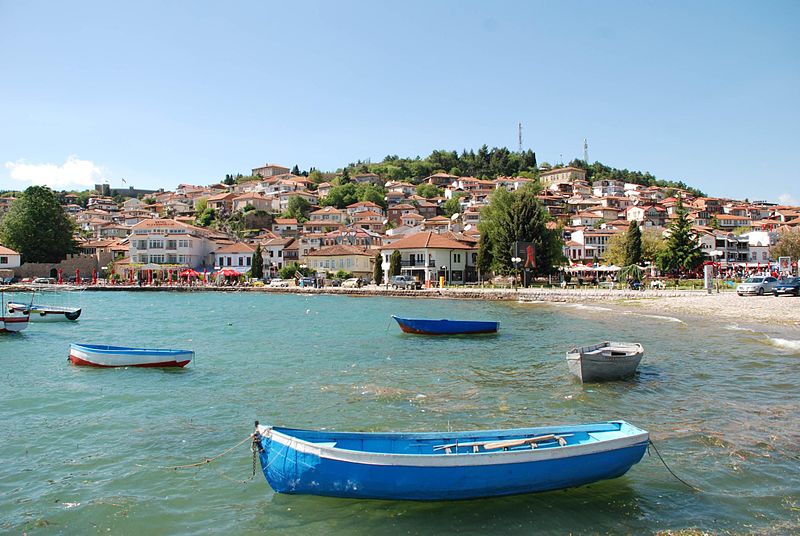
File:03760-Ohrid_(16064511578).jpg · Wikimedia Commons · See Wikimedia Commons
Ohrid
Sign in to saveOhrid ( ) is a city in North Macedonia and is the seat of the Ohrid Municipality. It is the largest city on Lake Ohrid and the eighth-largest city in the country, with it recording a population of over 38,000 inhabitants as of 2021. Ohrid is known for once having 365 churches, one for each day of the year, and has been referred to as the "Jerusalem of the Balkans". The city is rich in picturesque houses and monuments, and tourism is predominant. It is located southwest of Skopje, west of Resen and Bitola. In 1979 and in 1980, respectively, Ohrid and Lake Ohrid were accepted as Cultural and Nat
OverviewAI-generated
Ohrid is a city in North Macedonia that serves as the capital of the Ohrid Municipality. It is situated next to Lake Ohrid and has an elevation of approximately 700 meters above sea level. The city covers an area of 389.93 square kilometers and has a population of 42,033. Macedonian is the official language, and the local postal code is 6000.
The city is part of the Natural and Cultural Heritage of the Ohrid region. Historically, Ohrid has been located within the Socialist Federal Republic of Yugoslavia, the Kingdom of Yugoslavia, and Bulgaria. It maintains twinned relationships with Piran, Inđija, Wollongong, and Budva. The native and official name of the city is Охрид.
Synthesized by Vinony from 50 facts across 7 sources: Wikidata, Open Meteo, Openweathermap, OpenStreetMap, GeoNames, Vinony graph, Geo. Generated from structured data (not the Wikipedia text) and checked against those facts — may still contain errors.
Weather now
7-day forecast
via Open-Meteo
Place details
- Locality
- Охрид
- Country
- Северна Македонија
- Population
- 42,033
- Timezone
- Europe/Skopje
via OpenStreetMap · GeoNames
Key facts
- Settlement.utc_offset
- +1
- Settlement.name
- Ohrid
- Settlement.nicknames
- Balkan JerusalemMacedonian JerusalemEuropean Jerusalem
- Settlement.image_caption
- Ohrid and Lake Ohrid
- Settlement.image_flag
- Mk-ohri.png
- Settlement.image_blank_emblem
- Coat of Arms of the Municipality of Ohrid (North Macedonia).png
- Settlement.blank_emblem_type
- Coat of arms
- Settlement.pushpin_map
- North Macedonia
- Settlement.pushpin_label_position
- right
- Settlement.pushpin_map_caption
- Location within North Macedonia
- Settlement.subdivision_type
- Country
- Settlement.subdivision_type1
- Region
- Settlement.subdivision_name1
- 15px Southwestern
- Settlement.subdivision_type2
- Municipality
- Settlement.subdivision_name2
- 15px Ohrid
- Settlement.leader_title
- Mayor
- Settlement.leader_name
- Kiril Pecakov (VMRO-DPMNE)
- Settlement.area_total_km2
- 383.93
via Wikipedia infobox
Wikidata facts
- Instance of
- city
- Official name
- Охрид
- Country
- Ottoman Empire
- Located in
- Ohrid Municipality
- Official language
- Macedonian
- Population
- 38818
- Area
- 389.93
- Elevation
- 700
- Time zone
- Central European Summer Time
- Body of water
- Lake Ohrid
- Official website
- ohrid.gov.mk
- Image
- Ohrid from Samuel's Fortress 2.jpg
- Dialing code
- 046
Show 14 more facts
- twinned administrative body
- Tirana
- Commons category
- Ohrid
- topic's main category
- Category:Ohrid
- category for people born here
- Category:Births in Ohrid
- described by source
- Granat Encyclopedic Dictionary
- category of associated people
- Category:People from Ohrid
- located in/on physical feature
- Ohrid Municipality
- postal code
- 6000
- native label
- Охрид
- male population
- 18924
- female population
- 19894
- P8168
- Peter Joseph Kofler
- P12749
- Paderborn
Sources (10)
via Wikidata · CC0
Travel guide
Understand
thumb|350px|Ohrid and Lake Ohrid
Archaeological finds indicate that Ohrid is one of the oldest human settlements in all of Europe. The lake itself is over three million years old. Ohrid town is first mentioned in Greek documents from 353 BCE, when it was known as Lychnidos - or, “the city of light.” Only much later, in 879 CE, was it renamed Ohrid. The name probably derives from the phrase “vo hridi” – meaning roughly, “in the cliff.” It comes from the time when the town was limited in a small area on the lake side of the hill, which in fact is a huge cliff rising above the lakeshore. The town as we know it today was built mostly between the 7th and 19th centuries. During the Byzantine period, Ohrid became a significant cultural and economic centre, serving as an episcopal centre of the Orthodox Church and as the site of the first Slavic university run by Saints Clement and Naum at the end of the 9th century. At the beginning of the 11th century, Ohrid briefly became the capital of the kingdom ruled by Tsar Samuel, whose fortress still presides over the city today.
See
thumb|280px|Looking toward the town from the fortress Aside from the lake, Ohrid is most famous for its ancient churches, basilicas, and monasteries where Saints Kliment and Naum with the help of Bulgarian king Boris I (students of Cyril and Methodus) wrote their teachings and formulated the Cyrillic alphabet used in North Macedonia, as well as neighboring countries Bulgaria, Serbia and Montenegro and as far as Russia, and many of the countries of the former Soviet Union. Most of these churches charge an entry which for tourists is normally double that what locals pay, but is still worth it. It is a good idea to cover up when entering a church, but most locals will understand the inconveniences involved during a hot Macedonian Summer. There is also a wonderful ancient walled fortress at the top of the city.
Do
thumb|287x287px|The Bay of Bones, an outdoor archaeological museum on Lake Ohrid that features a reconstruction of a Neolithic lake settlement (pictured).
Sleep
Main forms of accommodation are private houses, apartments and villas. From €20 per night, you will find excellent private facilities, located mostly in the Old Town. The best solution is to make your reservation in advance via Internet or phone for at least the first few days, having in mind the growing popularity of Ohrid as tourist destination:
Stay safe
Ohrid Pearl is a type of imitation pearl (an artificial, man-made pearl) and as such has no real value as a gemstone. Most of the "pearls" sold around Lake Ohrid, on the street and in most shops, are simply unfinished imitation pearls (beads made of nacre, but without the pearly coating). Although selling shops have clear notes stating these are hand made ones.
Go next
Bitola (E 80 km) – One of the most European-flavoured cities in the country, Bitola is known for its colourful neo-classical architecture and the Ancient Macedon ruins of Heraclea Lyncestis nearby. Kičevo (N 60 km) Kruševo (NE 90 km via Bitola) – A museum-city nestled high up in the mountains of southwestern North Macedonia; it is one of the most historically significant destinations in the country as it was the site of a revolt against the Ottoman Empire; there is skiing in the winter, and paragliding, walking and mountain biking in the summer. Prilep (NE 110 km) – Tobacco fields, medieval monasteries, and strange rocks. Resen (E 25 km) – The home to Saraj Castle built in 1908. Struga (E 16 km) – A small town on Lake Ohrid which used to be rather quiet, yet nowadays (2016) it receives an enormous number of Dutch tourists. Debarca – A rural region just north of Ohrid. Pogradec, Albania (SW 40 km) – A small city on the other side of the lake, and worth a visit for those with extra time in Ohrid.
Travel guide from Wikivoyage (CC BY-SA 4.0)
~23 min read
Encyclopedic overview
22 sectionsContents
- Name
- History
- Antiquity
- Middle Ages
- Ottoman period
- Modern
- Geography and climate
- Demographics
- Cultural Heritage sites
- Archaeological sites
- Christian sites
- Islamic sites
- National Liberation War sites
- Old town architecture
- Transportation
- Sports
- Recurring events
- Twin towns – sister cities
- See also
- References
- Sources
- External links
Ohrid ( ) is a city in North Macedonia and is the seat of the Ohrid Municipality. It is the largest city on Lake Ohrid and the eighth-largest city in the country, with it recording a population of over 38,000 inhabitants as of 2021. Ohrid is known for once having 365 churches, one for each day of the year, and has been referred to as the "Jerusalem of the Balkans". The city is rich in picturesque houses and monuments, and tourism is predominant. It is located southwest of Skopje, west of Resen and Bitola. In 1979 and in 1980, respectively, Ohrid and Lake Ohrid were accepted as Cultural and Natural World Heritage Sites by UNESCO. Ohrid is one of only 40 sites that are part of UNESCO's World Heritage that are Cultural as well as Natural sites.
== Name ==
Excerpted from Wikipedia’s “Ohrid” article, available under the CC BY-SA 4.0 licence.
Gallery (44)
On the map
5 mapped locations
Available in 79 languages
- Español
- Français
- Deutsch
- 中文
- 日本語
- Русский
- Português
- العربية
- Albanian
- Aragonese
- Armenian
- Azerbaijani
- Bahasa Indonesia
- Bashkir
- Basque
- be_x_old
- Belarusian
- Bosnian
Show 60 more
- Bulgarian
- Burmese
- Catalan
- Cebuano
- Church Slavic
- Crimean Tatar
- Croatian
- Czech
- Danish
- Egyptian Arabic
- Esperanto
- Estonian
- Finnish
- Galician
- Georgian
- Greek
- Hebrew
- Hungarian
- Irish
- Kazakh
- Kyrgyz
- Latin
- Latvian
- Lithuanian
- Lombard
- Lower Sorbian
- Luxembourgish
- Macedonian
- Malay
- Maltese
- Mingrelian
- Moksha
- Nederlands
- Northern Frisian
- Norwegian
- Norwegian Nynorsk
- Ossetic
- Pashto
- Polski
- Romanian
- Scots
- Serbian
- Serbian (Latin)
- simple
- Slovak
- Slovenian
- Svenska
- Tatar
- Tiếng Việt
- Türkçe
- Ukrainian
- Upper Sorbian
- Urdu
- Volapük
- Welsh
- Wu Chinese
- zh_min_nan
- فارسی
- ไทย
- 한국어
via Wikidata sitelinks · CC0